Water damage in walls is concealed moisture intrusion inside a wall cavity. That cavity is the enclosed space between your interior drywall and the exterior sheathing. A slow leak soaks framing, insulation, and gypsum board there for weeks before anything appears on the painted surface. The early warning signs are quiet ones: a faint brown stain, paint that bubbles in a single spot, a musty smell in a closed closet. Because the damage compounds while it stays invisible, hidden moisture detection is the whole game. As of 2026, the Insurance Information Institute (2026) still ranks water damage and freezing as the second most common homeowners insurance claim, at roughly 22.6% of all homeowners losses.
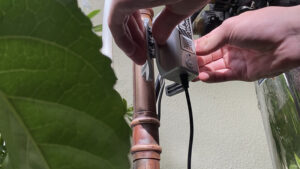
Every sign below appears after moisture has already been sitting in the wall for a while. Flow data appears sooner. Bluebot clamps onto the outside of any pipe, in any place, with no cutting and no plumber, so the line you worry about is the line you can meter: the upstairs bathroom supply, the laundry run, the irrigation main. It flags water moving when nothing in the house should be running, which is the earliest signal a hidden supply leak gives you.
This guide covers the eight warning signs of water damage in walls that appear first. It also covers the detection methods that confirm them, what each stage costs, and how monitoring closes the gap between the day a leak starts and the day you notice it.
Key facts at a glance
- The window that matters: the U.S. Environmental Protection Agency (2026) advises drying wet or damp materials within 24 to 48 hours. Dry them inside that window and, in most cases, mold will not grow.
- The humidity band: the EPA recommends keeping indoor relative humidity below 60%, ideally between 30% and 50%.
- The claim frequency: about 1 in 67 insured homes files a water damage or freezing claim each year, according to the Insurance Information Institute.
- The average claim: industry figures for wall water damage losses are commonly quoted above $11,000. The Institute’s most recent multi-year analysis, covering claim years 2018 through 2022, puts the average water damage and freezing claim at $13,954.
- The waste: EPA WaterSense (2026) reports that household leaks waste more than 10,000 gallons of water per year in the average home, and that about 10% of homes have leaks wasting 90 gallons or more per day.
- The first test to run: shut off every fixture, wait 30 minutes, and check whether your water meter has moved.

What Is Water Damage in Walls, and Why Does It Stay Hidden?
Water damage in walls happens when moisture enters a wall assembly and has nowhere to go. A pinhole in a supply line, a failed shower pan, a gap in the building envelope, or persistent condensation puts water into a closed box. Insulation holds it against the framing, and the vapor barrier that keeps humidity out now keeps it trapped.
Drywall gives the problem away eventually. Gypsum board absorbs water readily. Restoration professionals judge whether it is wet by comparing its moisture content against an unaffected reference wall of the same type in the same building. That is the drying standard defined in the ANSI/IICRC S500 (2021) Standard for Professional Water Damage Restoration. Until that comparison is made, water damage behind drywall looks ordinary from the room side, which is why the visible symptom almost always understates the wet area behind it.
Time is what turns concealed water damage into a large invoice. The S500 standard classifies water by contamination: Category 1 (clean), Category 2 (gray), and Category 3 (black). Clean Category 1 water degrades toward Category 2 within roughly 48 to 72 hours if it is not properly dried. A sanitary supply-line drip becomes a contaminated cleanup on a timeline measured in days.
Water damage in walls develops in a predictable order. Moisture enters the wall cavity. Drywall and insulation absorb it. Microbial growth begins where moisture meets an organic food source. Only then does a stain, a bubble, or a smell reach the finished surface. By the time a homeowner sees the first signs of a hidden leak, the wet area behind the drywall is usually larger than the visible mark.
Mold is why the clock runs fast. The EPA’s position is that moisture control is the key to mold control: mold needs water, an organic food source, and a suitable temperature. Drywall paper supplies the food, and household temperatures (broadly between 40°F and 100°F) supply the rest. Remove the water and the chain breaks.
The health dimension is why this is not purely a repair question. CDC (2026) and NIOSH (2013) research links building dampness and mold exposure to respiratory symptoms, asthma, hypersensitivity pneumonitis, rhinosinusitis, and bronchitis. The CDC notes that mold may cause a stuffy nose, sore throat, coughing or wheezing, burning eyes, or skin rash. People with asthma or a mold allergy may react severely, and immune-compromised people may develop lung infections. These are population-level associations, not a diagnosis of any individual home. Persistent symptoms are a conversation for a physician.
What Are the Eight Early Signs of Water Damage in Walls?
These telltale signs and indicators of water damage surface first, roughly in the order most homeowners encounter them. Any one of these red flags of wall moisture justifies a check. Two together justify looking inside the wall.
1. Stains and Discoloration
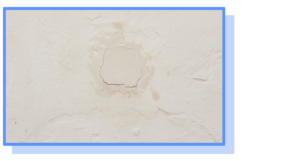
The first sign is usually a yellowish or brownish patch that does not follow a paint line or drywall seam. Water travels through gypsum board and carries dissolved minerals to the surface, and the irregular edge is the giveaway: cosmetic scuffs have straight boundaries, water stains have organic ones. Check beside plumbing fixtures, on ceilings under upstairs bathrooms, around window frames, and on exterior walls that take weather.
A ring-shaped stain with a dry, hard center means a past leak that dried, not a solved one. Ring patterns often mark intermittent leaks that return whenever the fixture above is used. A stain that feels damp, or darkens week over week, is active.
2. Peeling or Bubbling Paint
Paint is a moisture sensor you already own. Coatings lose adhesion when the substrate behind them stays damp, so peeling paint at an edge points to moisture migrating out through the wall. Bubbling paint means water has collected between the film and the drywall and lifted the coating off.
Moisture failure looks different from age failure: aging chalks or fades evenly across a whole wall, while water-driven failure is local and the bubbles feel soft under a fingertip. Wallpaper behaves the same way but hides it longer, because it is less permeable and holds moisture against the board.
3. Warping, Buckling, or Soft Spots
Wet gypsum board swells, then loses stiffness. Run a flat hand across the suspect area and feel for ridges, bulges, or a patch that gives more than the wall around it. Then sight down the wall with a light held close to the surface: oblique lighting reveals warping that a straight-on look misses.
Visible buckling is a late sign, not an early one, and the affected area extends past what you can see. Baseboards pulling away and gaps at crown molding point the same direction, because swelling board pushes trim outward.
4. A Musty, Earthy Odor
A persistent musty smell is one of the earliest reliable indicators of damp walls, and often the first. Mold and mildew release microbial volatile organic compounds as they grow, and those compounds carry through drywall before any growth becomes visible.
Odors concentrate where air does not move (closets, closed bathrooms, rooms behind a shut door), so the smell is strongest in the first seconds after you enter a room that has been shut for hours. The distinguishing feature is trend: an ordinary closet smell is stable, while a moisture smell strengthens over weeks and does not clear after cleaning or ventilating.
5. Visible Mold or Mildew
Mold on a wall surface (black, green, gray, or brown speckling, usually starting in a corner) means moisture has been present long enough for colonization. Surface growth appears after cavity growth, so visible mold on the room side generally indicates a larger colony behind it.
Look where moisture meets still air: behind furniture against an exterior wall, inside closets, around window frames, and beside plumbing fixtures. Sustained moisture is the trigger, so mold on a wall points toward water intrusion rather than ordinary humidity.
6. Rising Indoor Humidity and Window Condensation
A hidden leak adds water to your indoor air, and that registers on a hygrometer before it registers on a wall. If windows that used to stay clear now fog, or a dehumidifier runs constantly without holding a setpoint, treat it as a moisture-source question.
An inexpensive hygrometer settles it. Target the EPA’s band: below 60%, ideally 30% and 50% relative humidity. Higher readings both promote mold growth and suggest a moisture source beyond cooking and showering. Condensation is loudest in cold months, when the indoor-outdoor temperature gap is widest, but the leak does not take a summer off: the argument for continuous monitoring over seasonal spot checks.
7. Ceiling Stains Below a Bathroom
The ceiling under an upstairs bathroom is the highest-yield place in the house to look. Tubs, showers, toilets, and their supply lines all sit inside or above wall cavities, and a brown or yellow ceiling stain means water has already saturated ceiling board from above.
Pay attention to the pattern. A stain that appears during use, fades, and returns is an intermittent leak: typically a shower pan, a tub surround, or a wax ring. A continuously growing stain is a supply-line leak. Neither should be waited out.
8. Weak Water Pressure or the Sound of Running Water
Some hidden leaks announce themselves through the plumbing rather than the drywall. If pressure drops at a single fixture, or several weaken at once, water may be escaping inside a wall before it reaches the tap. Then listen: with every fixture off and no appliance cycling, the house should be silent, and running, dripping, or hissing near a wall carrying supply lines points to an active leak.
Confirm it at the meter. Turn off all water use, wait 30 minutes, and check the dial. Any movement means water is leaving the system somewhere. Our guide to reading a water meter walks through the low-flow indicator and the sweep hand. This is the lowest-cost diagnostic in the house, and the same principle EPA WaterSense promotes during Fix a Leak Week.
How Do You Detect Hidden Moisture Behind Walls?
Symptoms of hidden water damage tell you where to look. Confirming water damage behind walls takes measurement: whether you are right, and how far the wet area extends.
| Method | What it finds | Invasive? | Typical use |
|---|---|---|---|
| Visual inspection | Surface stains, warping, paint failure | No | First pass, whole house |
| Moisture meter | Moisture content in drywall and framing | Pin-type: barely | Confirming a suspect area |
| Thermal imaging camera | Temperature anomalies from wet material | No | Mapping the extent of a wet area |
| Water meter shutoff test | Whether the system is losing water at all | No | Whole-house leak screening |
| Acoustic leak detection | Pressurized pipe leaks deep in walls or slabs | No | Locating a leak before demolition |
| Endoscopic inspection | Cavity condition, insulation, framing | Small access hole | Confirming scope before repair |
| Smart water monitoring | Abnormal flow, continuously | No | Catching a leak the day it starts |
DIY Detection You Can Do Today
A moisture meter is the most useful tool a homeowner can own for detecting moisture behind walls. Pin-type meters push two probes into the material and read moisture content directly; pinless models scan electromagnetically and leave no mark. The technique that matters is comparison: read the suspect wall, then read a wall of the same material you know is dry. That is the same logic the IICRC S500 drying standard uses.
Thermal imaging is the other non-invasive moisture testing option. An infrared camera does not see water: it sees temperature, and evaporating moisture cools a surface. Professional-grade thermal cameras run into the thousands, but smartphone attachments with basic thermal capability are commonly available for $200 to $300. Do not skip the flashlight either: systematic visual inspection with oblique light is what tells the meter where to go.
What a Professional Adds
When DIY tools say, “Something is wrong here,” but cannot say how far it goes, professional water leak detection buys precision. A professional moisture inspection documents which areas read elevated. Infrared thermography finds patterns a handheld pass misses and produces images that hold up with an insurance adjuster. Acoustic detection handles leak location for pressurized pipes deep inside walls or slabs, so repairs are targeted instead of exploratory. Endoscopic inspection is the last step before demolition: a small access hole and a fiber-optic camera show the actual state of insulation and framing. Our guide to choosing a water leak detection company covers what to ask about certification, equipment, and documentation.
Continuous Monitoring with a Bluebot Smart Water Meter
Every method above shares one limitation: it works only when someone decides to look. That is the gap Bluebot’s smart water monitoring closes: a monitor watches flow continuously and flags the abnormal pattern a hidden leak creates, often before anything reaches the drywall.
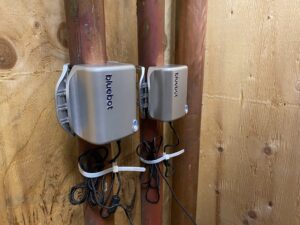
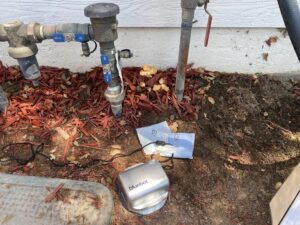
The 100-W (Bluebot Hero) clamps onto the main water line without cutting pipe or replacing shutoff valves, so one device reads the whole plumbing system. When flow behaves in a way it should not (a small draw that never stops, usage at 3 a.m. with the house asleep), you get an alert on your phone rather than a discovery six weeks later.
For a specific high-risk run, the 50-W (Bluebot Mini) is a compact, IP68-rated monitor sized for pipes from 3/4 inch to 1 inch, which makes dedicated coverage practical on an upstairs bathroom line, a laundry supply, or an outbuilding. Real-time alerts handle the emergency; historical usage data catches the slow drift that signals a developing problem.
A smart water monitor and a moisture meter answer different questions. The moisture meter tells you whether this wall is wet right now. The monitor tells you whether the house is losing water at all, continuously, without anyone checking. Together they cover the leak you suspect and the one you have not noticed.

How Fast Does Hidden Water Damage Get Worse, and What Does It Cost?
The cost curve is steep because damage categories stack. A leak caught in week one is a plumbing repair. The same leak caught in month four is a plumbing repair plus remediation plus reconstruction.
| Stage | Typical scope | Commonly quoted range |
|---|---|---|
| Caught early | Pipe repair, small drywall patch | $500 to $1,500 |
| Mold present | Containment, removal, verification | $2,000 to $6,000 |
| Framing affected | Structural repair and replacement | $5,000 to $15,000 |
| Multi-room reconstruction | Full wall rebuild, finishes | $20,000 to $40,000 |
| Professional mitigation, moderate loss | Industrial drying and monitoring | $1,500 to $4,000 |
These are typical market ranges, not published statistics: pricing varies by region, by how much material is affected, and by local labor rates. Treat them as an order of magnitude and get written estimates.
What is documented is how often the loss happens and how large it runs. The Insurance Information Institute reports that water damage and freezing accounts for roughly 22.6% of homeowners insurance losses. It is the second most common cause of loss, and about 1 in 67 insured homes files such a claim each year. Figures above $11,000 are widely quoted for in-wall claims. The Institute’s own analysis across claim years 2018 through 2022 puts the average water damage and freezing claim at $13,954. Either way, the gap between the early-repair range and the reconstruction range is the whole argument for catching a leak early.
The EPA’s guidance, current as of 2026, comes down to one number: 24 to 48 hours. Dry wet or damp materials inside that window and in most cases mold will not grow.
How Do You Prevent Water Damage in Walls?
Maintain the failure points. Inspect supply lines, drain connections, and fixture fittings quarterly, and replace worn washers before a weep becomes a leak. Shutoff valves under sinks and behind toilets often start seeping the first time they are turned after years of sitting still. Check caulk and sealant around tubs, showers, windows, and doors annually; failed sealant is among the most preventable causes of water reaching a wall cavity.
Move water away from the building. Grade soil so it slopes away from the foundation, and clean gutters and downspouts seasonally. A clogged downspout dumps roof water against a wall: one of the few ways to get in-wall moisture with no plumbing failure at all.
Harden the high-risk rooms. Upstairs bathrooms carry the highest consequence, because anything that leaks there ends up in the wall or ceiling below. In cold climates, insulate pipes running through exterior walls and consider freeze sensors. In the laundry, rubber washing machine hoses are a common failure point. Replacing them with braided stainless steel every 3 to 5 years is a widely recommended interval. A Bluebot Mini clamped onto the laundry supply line reads that run continuously, so a hose that starts weeping shows up as flow you did not ask for rather than as a wet floor.
Close the detection gap. Maintenance reduces how often moisture damage inside walls starts. It does nothing about how long a leak runs before you notice. That is what a Bluebot meter is for: continuous flow monitoring that learns your household’s normal pattern and flags the anomaly. EPA WaterSense makes the everyday scale plain. Household leaks waste more than 10,000 gallons per year in the average home. About 10% of homes leak 90 gallons or more per day, and fixing the easy ones trims roughly 10% off a water bill. That is the gap Bluebot’s Dollarize(TM) closes: it converts the flow the meter reads into the dollars the leak is costing you, so a drip you cannot see still shows up as a number you can act on. One Bluebot uncovered a $13,000 water-billing error.
Many insurers also offer premium credits in the range of 5% to 10% for homes with monitored leak-detection systems. Availability and amount vary by carrier and by state, so confirm with your own insurer rather than assuming it applies.
What Should You Do If You Find Water Damage in a Wall?
Stop the water first. Close the fixture shutoff, or the main if you cannot isolate it, and call an emergency plumber for anything you cannot control. Source control comes before cleanup, because everything else is undone while water is still arriving.
Document before you touch anything. Photograph and video the damage from several angles: staining, warping, any growth, and the relationship between the wet area and the nearest fixture. Claims turn on evidence, and evidence gathered after cleanup is worth less than evidence gathered before it.
Start drying immediately. Fans, dehumidifiers, and removal of saturated drywall and insulation, all inside that 24 to 48 hours window. Open the affected cavity so air moves through it; moisture sealed inside a wall does not evaporate, it colonizes.
Bring in professionals for anything beyond a small patch. Restoration contractors have industrial drying equipment, moisture-mapping tools, and documented protocols. When mold is present or suspected, certified remediators follow containment and verification procedures that DIY removal does not: disturbing a colony without containment spreads it. Get multiple written estimates from licensed, insured contractors, and verify licensing for your jurisdiction, since requirements differ by state.
Handle the claim carefully. Most homeowners policies cover sudden, accidental water damage (a pipe that bursts) while excluding damage attributed to long-term neglect or deferred maintenance. That distinction is why documenting the timeline matters, and it is why homeowners insurance differs from flood insurance, which covers a different peril entirely. File promptly, since policies impose notice deadlines. For large or contested claims, a public insurance adjuster works for you rather than the carrier. Fees commonly run 10% to 15% of the settlement. Both licensing and fee caps vary by state, so verify the rules where you live.
The Bottom Line: The First 48 Hours Decide the Cost
Water damage in walls is a timing problem disguised as a repair problem. The eight early signs (staining, peeling or bubbling paint, warping and soft spots, musty odor, visible mold, rising humidity, ceiling stains below a bathroom, and pressure or sound changes) all appear after the wall cavity has been wet for a while. Detection tools shorten that lag. Continuous monitoring closes it.
The numbers make the case without embellishment. The EPA’s drying window is 24 to 48 hours. The IICRC’s clean-water category degrades in roughly 48 to 72 hours. Early repairs commonly run $500 to $1,500, a multi-room rebuild commonly runs $20,000 to $40,000, and the industry-average water damage and freezing claim is $13,954. Every one of those figures rewards finding the leak sooner.
Run the meter test this week. Put a hygrometer in the room that smells wrong. And if you would rather not rely on noticing, put a monitor on the line: Bluebot’s smart water monitoring flags the abnormal flow that precedes the stain.
Frequently Asked Questions
How long does it take for mold to grow behind a wall after a leak?
Mold can begin growing within 24 to 48 hours of water exposure. The EPA advises drying wet or damp materials inside that window, because in most cases mold will not grow if the material dries in time. Behind a wall, that clock runs unseen.
Can a wall have water damage without any visible stain?
Yes. Hidden water damage often produces a musty odor or a rise in indoor humidity before any stain appears, because moisture reaches the painted drywall face last. A moisture meter reading, or meter movement after 30 minutes with every fixture off, will confirm it.
Will wet drywall dry out on its own?
Usually not fast enough. A wall cavity is enclosed, so insulation holds water against the framing and the vapor barrier slows evaporation. Restoration crews open the cavity and force airflow precisely because sealed wet gypsum board tends to stay wet long enough for mold to colonize.
What moisture meter reading means a wall is wet?
There is no single universal number. The ANSI/IICRC S500 standard sets the drying goal by comparison: read an unaffected wall of the same material in the same building, then compare. A suspect wall reading meaningfully higher than that reference is the signal that matters.
Does homeowners insurance cover water damage inside walls?
Usually only when the damage is sudden and accidental, such as a burst pipe. Most policies exclude losses attributed to long-term neglect or deferred maintenance, and flood is a separate peril entirely. Coverage language and state rules vary, so check your own policy terms.