Homeowners insurance water damage coverage is a conditional part of a standard policy: it pays for water damage that is sudden and accidental, and it excludes water damage that is gradual. A pipe that bursts overnight is normally covered. The same pipe seeping behind drywall for six months is normally not. Nothing about the wet drywall looks different. Only the timeline does. That is why Bluebot clamps a meter onto the pipe you care about, without cutting it, and keeps a dated flow record you can hand an adjuster. That single distinction decides most approved and denied claims, and it is the one thing a homeowner can influence in advance.
This guide explains what a standard homeowners policy typically covers, what it excludes, which add-on coverages fill the gaps, how an adjuster reaches a sudden-versus-gradual decision, and how documented timing changes that conversation. Coverage language varies by state, carrier and policy form, so treat this as orientation and read your own declarations page.
Water damage coverage at a glance
- Frequency: Water damage and freezing is the second most common homeowners insurance claim in the United States (Insurance Information Institute, 2026).
- Severity: As of 2026, the most recent Triple-I claim-year data (2018 to 2022) puts the average water damage and freezing claim at $13,954, well above $13,000 per loss.
- Odds: About 1 in 60 insured homes files a water damage or freezing claim in a given year (Insurance Information Institute, 2026).
- Flood is separate: Standard policies exclude flood entirely. Cover it through the National Flood Insurance Program or a private flood policy, with NFIP residential limits of $250,000 building and $100,000 contents (FEMA, 2026).
- Backup is an add-on: Sewer and drain backup needs an endorsement, commonly $50 to $150 a year (Insurance.com, 2026).
- Detection pays twice: Insurers commonly discount premiums 5% to 10% for qualifying leak detection systems (Amica, 2026), and water utilities rebate up to $200 toward the device (Southern Nevada Water Authority, 2026; EBMUD, 2026).
What counts as “water damage” on a homeowners policy?
Water damage, in policy terms, is damage caused by water escaping from inside your home’s own plumbing, appliances or fixtures, not water arriving from outside.
That boundary matters. A standard policy is built around perils inside the dwelling and treats an interior discharge very differently from rising groundwater. Your policy responds through three components: dwelling coverage (Coverage A, the structure), personal property coverage (belongings the water ruined), and additional living expenses or loss of use, which pays to house you if the home becomes uninhabitable while it dries out.
Two policy terms then decide whether any of those three pay at all. Sudden and accidental water damage is an abrupt, identifiable event you could not reasonably have detected in advance. Gradual water damage is slow deterioration a reasonably attentive owner should have found and fixed. Insurers class gradual damage with wear and tear under the maintenance exclusion, because the policy is designed to fund accidents rather than deferred upkeep.
What water damage does homeowners insurance usually cover?
Most standard homeowners policies cover water damage that starts abruptly inside the home and could not have been caught earlier.
Typical covered scenarios include a burst pipe (including one that ruptures from freezing, a pressure spike or material failure), a water heater that splits and floods a basement, a washing machine or dishwasher supply line that lets go, and an accidental overflow from a sink, tub or toilet that is not caused by a backup from outside. A storm-driven roof opening is usually covered too, if the roof failed in the storm rather than from age.
Timing and detectability drive the outcome, not the amount of water. If a supply line ruptures while you are away and you return to a flooded floor, that is still sudden and accidental, because you had no realistic opportunity to intervene. Coverage narrows the moment evidence suggests the leak was findable. Prompt response matters as well: policies impose a duty to mitigate, meaning you are expected to shut the water off, extract standing water and stop further loss once you know about it. Failing to take reasonable steps can reduce or eliminate a payout for the damage that spread afterwards.
What water damage is excluded, and what covers it instead?
Standard policies exclude gradual leaks, flood, sewer backup and maintenance-related loss, and each of the last three has its own separate remedy.
Gradual leaks are the most common gap. A slow drip beneath a bathroom sink, a pinhole leak behind a refrigerator, or seepage from a failing shower pan produces damage identical to a covered burst pipe. If it developed across weeks or months before anyone noticed, insurers generally reclassify it as a maintenance issue. There is no endorsement that reliably buys this back; detection is the only real remedy.
Flood damage requires separate flood insurance through the National Flood Insurance Program, administered by FEMA, or through a private flood carrier. Standard homeowners policies specifically exclude rising water, storm surge and overflowing rivers. The source of the water, not its appearance, controls coverage.
Sewer and drain backup is its own exclusion. When a municipal main or a blocked lateral pushes sewage back through your drains, the standard policy typically will not respond. A water backup endorsement usually costs $50 to $150 a year at common limits, and Insurance.com puts the full market range at roughly $50 to $250 depending on the limit and carrier, with limits commonly running $5,000 to $25,000. With a finished basement or an older sewer connection, that is inexpensive protection.
Maintenance-related damage rounds out the list: roof leaks from deferred repairs, pipes that froze unwinterized, and damage that followed ignored warning signs.
How does an adjuster decide whether damage was sudden or gradual?
An adjuster reconstructs the timeline from physical evidence, because the policy language turns on when the leak started rather than on what broke.
Expect the adjuster to photograph the loss, take moisture readings in framing and subfloor, and look for markers that only accumulate over time. Extensive mold growth, rotted subfloor, layered water staining and mineral scale all argue for a long-running leak. Clean breaks, fresh saturation and an intact surrounding structure argue for a sudden one. In ambiguous cases, insurers retain forensic plumbers to determine whether a pipe failed abruptly or corroded slowly.
Documentation shifts the balance. Homeowners who can show maintenance records, recent inspections and a fast response generally fare better than those relying on recollection. Water usage data is the strongest form of that documentation, because consumption is measured continuously and independently of anyone’s memory.
Here is why this matters more than anything else in a water claim: the policy does not ask whether you were careless, it asks when the water started moving. Damage patterns are an indirect, contestable proxy for that answer. A flow record is a direct one. Whoever holds better timeline evidence effectively sets the frame the claim is judged in.
How do you prove when a leak actually started?
You prove it with continuous flow data, the kind a Bluebot meter keeps automatically, which converts a disputed timeline into a dated record.
This is where real-time water monitoring does something leak alarms cannot. A puck sensor on the floor tells you water has already arrived. A whole-home meter watches the flow itself, so an abnormal pattern registers while the leak is still small. When a claim is later questioned, that record shows the date abnormal flow began. A slow leak found in February that your data shows started two weeks earlier reads very differently to an adjuster than the same leak with no timeline at all.
Volume is the reason small leaks stop being small. A leaking toilet flapper can waste up to 200 gallons a day, according to the EPA’s 2026 WaterSense figures, enough to run up a utility bill for months without producing a single visible stain. By the time the ceiling below shows a mark, the loss has already drifted into gradual territory. The same leak caught on day one is a sudden discovery with a clear start date.
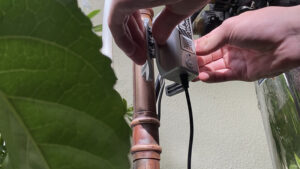
Bluebot’s smart water meters clamp onto the pipe you actually want to watch, anywhere it runs: the service line at the meter, the branch feeding a finished basement, the irrigation valve box in the yard. No cutting, no plumber. Once it is on, it monitors flow around the clock and alerts you when usage deviates from your baseline, so a slow leak surfaces as a measurable change rather than a stain on a ceiling. For a home on a 3/4 inch or 1 inch service line, the 50-W (Bluebot Mini) covers the whole house; for larger service lines up to 2 inch, the 100-W (Bluebot Hero) does the same job with tighter low-flow sensitivity.
For a landlord or property manager, the 100-WAN (Bluebot ProLink) uses long-range wireless to report through a Bluebot Gateway, one of which covers an entire building. Bluebot does not shut the water off. It is a meter, not a valve, and that is what lets it clamp onto any of those pipes, including the irrigation and tenant lines a shutoff device cannot reach.
The economics work even before a claim. Insurers commonly offer premium discounts of 5% to 10% for homes with qualifying leak detection systems, the kind of 2026 discount Amica publishes for water-damage mitigation devices, and many water utilities add a rebate. The Southern Nevada Water Authority pays 50% of the purchase price or up to $200, whichever is less, and EBMUD caps its flowmeter rebate at $200 per device, both current as of 2026. Programs like these set their own eligibility lists, and a device that qualifies for one insurer or utility may not qualify for another. Bluebot tracks the programs it qualifies for at bluebot.com/rebates; ask your carrier and your utility what they accept before you count on either.
What should you do before and after water damage?
Before a loss, buy the right coverage and install detection. After one, protect the property and document everything.
Before. Read your homeowner’s policy and confirm what it says about gradual damage, flood and backup. Ask your agent directly whether you carry a water backup endorsement and what the limit is. Add one if you have a basement or an older sewer connection. Then clamp on a Bluebot and let it watch the flow, so a leak is found in days instead of the months it takes to become excluded.
After. Shut the water off at the fixture or the main. Photograph and video everything before any cleanup starts. Notify your carrier promptly, since most policies require prompt notice. Keep the failed part (the split pipe, the cracked hose, the failed valve) because it is physical evidence of an abrupt failure. If you have a Bluebot, export the flow record showing when abnormal use began and hand it over with the claim.
Who sets the rules, and what changed in 2026?
No single body sets water damage coverage; it emerges from carrier policy forms, state insurance regulation and federal flood policy, and carriers have been tightening their side of it.
The Insurance Information Institute (2026) publishes the industry claim data behind the frequency and severity figures above. FEMA (2026) administers the National Flood Insurance Program, and the NFIP’s Standard Flood Insurance Policy form is published in the Federal Register. The EPA’s WaterSense (2026) program supplies the household leak-volume research. Your state’s insurance department regulates the policy forms and endorsements a carrier may sell you, which is why coverage language differs across state lines.
The clearest 2026 signal is on the carrier side. Mercury Insurance now requires qualifying smart water leak detection devices on certain new HO-3 homeowners policies effective May 29, 2026 and later (currently aimed at older homes in high non-weather water-risk territories and at higher Coverage A tiers), and offers a discount to policyholders who install one. Whole-home flow monitoring, smart shutoff valves and point-of-leak sensors all qualify under that program. Detection is moving from a discount to a condition of coverage. Bluebot was built for exactly that record: a dated, continuous flow history you own, on any pipe, without cutting one.
The bottom line
A standard homeowners policy pays for damage that arrives suddenly and declines damage that arrives slowly, and the line between them is drawn with evidence rather than intent. Flooding needs the NFIP or a private flood policy. Sewage backing up through a drain needs an endorsement. Slow seepage has no add-on: only earlier detection.
So the practical answer to the question, “Does homeowners insurance cover water damage?” is: your policy covers the leaks you find fast. Documented timing keeps a loss on the covered side of that line, and it is the one part you still control.
Frequently Asked Questions
How long does a leak have to go undetected before insurers call it gradual?
There is no fixed number of days in a standard homeowners policy. Insurers judge it from physical evidence rather than a calendar: mold growth, rotted subfloor and layered staining point to weeks or months, while a clean break and fresh saturation point to hours. In practice, damage discovered within days of the flow changing is much easier to defend as sudden and accidental.
Why do insurers deny water damage claims?
The most common reasons are policy exclusions rather than bad faith. A claim is typically denied when the damage is judged gradual and therefore a maintenance issue, when the water came from outside and is really flood, when sewage backed up and there is no water backup endorsement, or when the homeowner did not take reasonable steps to stop further loss after discovering it.
Does homeowners insurance cover flood damage if I don’t live in a flood zone?
No. Standard homeowners policies exclude flood everywhere, not only in mapped high-risk zones, so living outside a flood zone does not change the exclusion. You cover it separately through the National Flood Insurance Program, administered by FEMA, or through a private flood carrier. NFIP residential limits are $250,000 for the building and $100,000 for contents.
What does a water backup endorsement cost, and what does it cover?
A water backup endorsement usually costs $50 to $150 a year at common limits, and Insurance.com puts the full market range nearer $50 to $250 depending on the limit and the carrier. It responds when sewage or water backs up through your drains or a sump pump fails. Limits commonly run $5,000 to $25,000, so ask your agent which limit suits your basement.
Is a slowly leaking toilet or faucet covered by homeowners insurance?
Usually not. A slow drip from a toilet flapper or a worn faucet washer is treated as routine maintenance, so neither the wasted water nor the damage it eventually causes is normally covered. The EPA’s WaterSense program (2026) notes that a leaking toilet can waste up to 200 gallons a day, which shows up on your water bill long before it shows up on your ceiling.
Who decides whether water damage was sudden or gradual?
The claims adjuster your insurer assigns makes the call, sometimes with a forensic plumber in ambiguous cases. The decision rests on physical evidence rather than on your description of events. You can supply counter-evidence, and you can ask what the determination was based on. Continuous water usage data is the most direct record of when abnormal flow actually began.