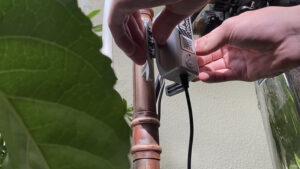
Bluebot clamps onto the outside of any pipe, anywhere water runs on your property, and starts reading flow in about 10 minutes. No cutting, no plumber, no shutoff. That placement freedom is why a Bluebot smart water meter finds the leaks a floor puck never can: behind a wall, under a slab, or in a buried irrigation lateral, the leaks you would otherwise discover from a stain, a smell, or a bill.
That distinction matters, because most leaks do not announce themselves. According to EPA WaterSense (2026), household leaks waste nearly 1 trillion gallons of water nationwide each year. The average American home loses more than 10,000 gallons annually to leaks nobody notices. A contact sensor cannot see any of that. A flow-based water leak detection system can.
Key Facts at a Glance
What it is | Clamp-on smart water meter with continuous leak detection |
Sensing method | Transit-time ultrasonic, dual sensors, non-invasive |
Flow accuracy (field) | 95%-97% of reading on the Bluebot Mini; 98%-99% on the Bluebot Hero and ProLink |
Typical field tolerance | +/-3% to +/-5% (Mini); +/-1% to +/-2% (Hero and ProLink) |
Pipe compatibility | 80 pipe size and type combinations on the 100-W (Bluebot Hero) and 100-WAN (Bluebot ProLink), 3/4″ to 2″ on the Standard models and 2.5″ to 4″ on the Prime models |
Pipe materials | Bluebot Hero and ProLink: copper (Type L & M), PVC (Sch 40 & 80), CPVC (Sch 40 & 80), PEX, PE, galvanized steel, stainless steel. Bluebot Mini: copper (Type L & M), PVC (Sch 40 & 80), PEX, galvanized steel. |
Installation | DIY clamp-on. No cutting, no plumber, no water shutoff |
Monitoring | 24/7 live flow streaming with push and SMS alerts |
Connectivity | Built-in 2.4 GHz Wi-Fi on the Bluebot Mini and Hero (direct to the Bluebot Cloud, no gateway); LoRaWAN on the Bluebot ProLink, which requires a Bluebot Gateway |
Models | 50-W (Bluebot Mini) from $258.76 · Bluebot Hero from $558.34 (each includes 1 year of Premium Data) |
Why Flow Monitoring Beats Waiting for Water on the Floor
A point moisture sensor only alerts you after water has already reached the floor or the surface it sits on. By then, a burst supply line has been running for however long it took the water to travel, and a slow drip inside a wall cavity may never reach a sensor at all. A water sensor on the floor (the Aqara water leak sensor, the Eve Water Guard) is useful where you can predict the puddle, under a dishwasher or beside a water heater, but it is reactive by design.
Bluebot’s leak detection system inverts that. It is a flow meter rather than a contact sensor, so it monitors your entire plumbing network from a single installation point on the main line. That one point covers every branch downstream. It sees the under-sink connections and supply lines where leaks most often begin. It also sees the concealed leak in a wall cavity, the slab leak under a foundation, and the underground water leak in a buried run: places no puck sensor could ever reach. Independent category reviews make the same structural point: whole-supply monitors are the class of device that can detect a leak anywhere downstream of the main, while point sensors report only what happens where they sit.
The practical consequence is coverage without clutter. You need no dozen pucks, no moisture sensing cable along a basement wall, no map of where you think a failure will happen. One wireless water leak sensor at the main sees the whole system. That is why this water leak detection device catches both costly failure modes: the catastrophic high-flow event, and the slow, silent loss that quietly inflates a bill for months.
How Bluebot Detects a Leak
Bluebot uses transit-time ultrasonic technology, the same measurement principle used in industrial and municipal metering for decades, now packaged for residential and commercial pipes. The ultrasound technology behind it is closer to a medical imaging device than to a plumbing gadget.
- The meter clamps onto your pipe. Nothing is cut, tapped, or spliced. The Bluebot Hero and ProLink fit 80 pipe size and type combinations across copper, PVC, CPVC, PEX, PE, galvanized steel, and stainless steel.
- It calibrates itself to your pipe. Bluebot’s patented robotic servo technology and Adaptive Angle Technology (AAT) auto-configure the sensor to your pipe’s diameter and material, which is what removes the technician from the process.
- Dual ultrasonic sensors measure the flow. Each sensor sends a pulse through the water; the difference in travel time with the current versus against it yields the flow rate. On the Bluebot Hero, measurements typically fall within +/-1% to +/-2% of actual flow, and every meter ships with an individual Calibration Certificate against NIST-traceable standards. Real field performance varies with pipe material, pipe size, installation quality, and straight-pipe length.
- The system learns your normal. Continuous analysis builds a baseline of how your property actually uses water, so it can separate a shower from an irrigation cycle from an anomaly.
- Anomalies trigger an alert. Continuous flow that should have stopped, a rate outside your thresholds, or a pattern consistent with a developing leak pushes a notification to your phone in real time.
- Everything is logged. Historical flow data lives in the bluebot Water app and in FloDash(TM), the web dashboard, so you can investigate a spike after the fact rather than guess.
For context on the measurement standard: the American Water Works Association’s C750-10 (2010) standard for clamp-on ultrasonic sensing sets a 1% accuracy requirement for this class of meter. Every Bluebot meter is calibrated across its full operating flow range against NIST-traceable standards and ships with an individual Calibration Certificate recording its serial number, calibration date, and measured performance. You can read more about why transit-time ultrasonic flow meters hold up in field conditions, and why ultrasonic metering has displaced mechanical meters in municipal use.
What the Bluebot Water Leak Detector Gives You
Live data, not a periodic snapshot
Most connected water monitors report on an interval: every few minutes, sometimes hourly. Bluebot streams live flow, so you see the graph move as it happens rather than waiting for the next polling interval. You also get flow start and stop alerts, so you know when water begins and ends moving anywhere on the property. In the minutes between a pipe failing and you knowing about it, that is the whole difference.
One device, whole-property coverage
There is no moisture sensing cable to route and no sensor budget to ration. A single meter on the main line covers the entire downstream network: fixtures, appliances, irrigation, and buried runs alike. Adding a bathroom does not mean adding hardware.
Clamp it on yourself, no cutting and no plumber
You clamp the device onto your water pipe and you are done. Clamp-on installation means no pipe cutting, no soldering, no shutting off the water, no plumber required, no permit conversation. Non-invasive installation is the single biggest practical difference between the Bluebot detector and inline monitors, and it is why the clamp-on design suits renters, older plumbing, and properties where cutting into the supply line is simply not on the table.
Thresholds you actually set
A vacation cabin, a four-unit building, a restaurant, and a farm have nothing in common hydraulically. Bluebot lets you define flow-rate ceilings, continuous-flow durations, and time-of-day rules that reflect your property, so alerts stay meaningful instead of becoming noise you learn to swipe away.
Water intelligence beyond the alarm
The same data that catches leaks tells you where your water goes. Consumption tracking runs daily, weekly, and monthly; water usage analytics identify which events drive the total; and you can set water budgets and verify utility billing against your own measurements. Dollarize(TM) turns that same data into a plain-dollar figure, not just gallons, so a Bluebot meter becomes an ongoing water conservation tool. How much that saves depends on what your own data turns up, which is rather the point: you are measuring your house, not an average.
Bluebot alerts you; it does not close a valve, and that is on purpose
Bluebot is a meter, not a valve. That single choice is what lets it clamp onto any pipe, anywhere, including the irrigation runs and tenant lines a shutoff device cannot reach. You trade an automatic valve for total visibility: Bluebot tells you the moment water starts moving when it should not, wherever on the property that is.
Who This Water Leak Detector Is For
Homeowners. The core case: continuous visibility into the house you live in, including the pipes you cannot see. If you have ever had a high water bill with no visible leak, this is the instrument that answers the question.
Owners of second homes and rentals. An unoccupied property is where a small failure becomes a large one, because nobody is there to hear it. Remote monitoring for vacation homes sends the alert wherever you are.
Multi-unit property managers. Per-unit water tracking supports both leak response and cost allocation. Bluebot’s water leak detection system is widely used for water submetering across multi-unit properties, where the same multi-unit metering that catches a running toilet also produces defensible per-unit billing data.
Businesses and facilities. Restaurants, retail, offices, and light industrial sites all run water bills large enough that a persistent leak hides inside normal variance. Bluebot’s commercial and multi-site deployments scale the same sensing across multiple lines and sites.
Growers and large landscapes. Irrigation is the classic invisible loss: a cracked lateral underground can run for a season. Catching irrigation system leaks early is often where the device pays for itself first, and the Bluebot ProLink’s long-range LoRaWAN reaches sites without reliable Wi-Fi.
Choose Your Model: Bluebot Mini or Bluebot Hero
Bluebot Mini | Bluebot Hero | |
|---|---|---|
Position | Affordable smart water meter | Flagship smart water meter |
Starting price | $258.76 | $558.34 |
Includes | 1-Year Premium Data | 1-Year Premium Data |
Pipe range | 3/4″ to 1″ | 3/4″ to 2″ |
Connectivity | Wi-Fi | Wi-Fi |
Placement | Indoor / Outdoor | Indoor / Outdoor |
Best for | Single-family homes and small businesses on standard residential lines | Larger homes, multi-unit buildings, and commercial properties with larger mains |
Both are starting prices captured as of 2026, and both include a full year of Premium Data, so the first year of alerting and analytics is covered in the purchase. If your main line is 1″ or smaller, the Mini smart water meter is the right instrument, and the entry-level Bluebot costs less to deploy across a portfolio. For a 1.25″ to 2″ main, the Hero smart water meter is the one to buy; it covers the widest pipe range of the two Wi-Fi Standard models. For a main above 2″, the Bluebot Hero Prime and Bluebot ProLink Prime cover 2-1/2″ through 4″. Where Wi-Fi is unreliable, the 100-WAN (Bluebot ProLink) uses long-range LoRaWAN, which requires a Bluebot Gateway as a separate purchase from $399. See the technology page.
Specifications and Compatibility
Specification | Detail |
|---|---|
Sensing technology | Transit-time ultrasonic, dual sensors |
Flow accuracy (field) | 95%-97% of reading on the Bluebot Mini; 98%-99% on the Bluebot Hero and ProLink |
Typical field tolerance | +/-3% to +/-5% (Mini); +/-1% to +/-2% (Hero and ProLink) |
Pipe diameters | 3/4″ through 2″ on the Standard Bluebot Hero and ProLink; 2-1/2″ through 4″ on the Bluebot Hero Prime and ProLink Prime |
Pipe compatibility | 80 pipe size and type combinations (Hero and ProLink) |
Pipe materials | Bluebot Hero and ProLink: copper (Type L & M), PVC (Sch 40 & 80), CPVC (Sch 40 & 80), PEX, PE, galvanized steel, stainless steel. Bluebot Mini: copper (Type L & M), PVC (Sch 40 & 80), PEX, galvanized steel. |
Installation requirement | A straight, accessible run of at least 3.5 inches (89 mm) for the Bluebot Mini, or 4.0 inches (102 mm) for the Bluebot Hero and ProLink |
Monitoring | 24/7 continuous flow analysis |
Alerts | Push notification and SMS; continuous-flow, rate-threshold, and flow start/stop alerts |
Connectivity | Built-in 2.4 GHz Wi-Fi on the Bluebot Mini and Hero (direct to the Bluebot Cloud, no gateway); LoRaWAN on the Bluebot ProLink, which requires a Bluebot Gateway |
Management | Bluebot mobile app and cloud dashboard |
The one physical prerequisite to check before ordering is that straight run, at least 3.5 inches for the Mini or 4.0 inches for the Hero and ProLink, near where the main enters the building, with clearance to close the clamp around it.
How Bluebot Compares to Other Water Leak Detection Systems
Bluebot’s own architecture sets it apart on two counts: what a meter touches, and where it can go. The comparison below is scoped to those two facts, not to any single competing brand’s specifications.
Bluebot | Inline meters | Utility-meter readers | Point sensors | |
|---|---|---|---|---|
Where it sits | Clamped to the outside of any pipe, anywhere on the property | Cut into the supply line | Strapped to the utility meter | On a floor or surface |
What it touches | Never touches the water | Sits in the flow path | Never touches the water | Never touches the water |
Coverage | Everything downstream of wherever you clamp it | Everything downstream of the cut-in | Whatever passes the utility meter | Only where placed |
An inline meter sits in the flow path, which can reduce flow through the pipe over time, and its impeller can foul with sediment. Installing one also means cutting into the supply line: a plumber, and an interruption to your water service. The clamp-on Bluebot meter attaches to the outside of the existing pipe instead, so it installs in minutes without either.
A utility-meter reader shares Bluebot’s non-invasive installation, but it reads the utility meter rather than the pipe, so it can only see total household usage, not a single line. It cannot isolate a tenant’s meter, an irrigation lateral, or one fixture the way a Bluebot meter clamped directly onto that line can. If whole-property usage through the existing utility meter is all you need, that is a real option, and worth weighing against the ability to isolate a single line.
Installing Your Wireless Water Leak Detector
Installation is a same-day, no-tools-required job for most properties, typically about 10 minutes once the meter is on the pipe.
- Pick the spot. Find the main supply line where it enters the building and identify a straight, accessible section: at least 3.5 inches of clear pipe for the Mini or 4.0 inches for the Hero and ProLink, clearance for the clamp, and, on Wi-Fi models, a usable signal.
- Prep and clamp. Clean the pipe surface with the included materials, position the meter on the straight section, and close the clamp following the in-app prompts.
- Power and pair. Connect the power adapter, confirm the LED shows a good state, then add the device in the Bluebot app, sign in, and join it to your Wi-Fi network.
- Verify. Run a fixture and confirm live flow appears in the app. If the graph moves when the water moves, you are calibrated.
- Set your alerts. Configure continuous-flow duration, flow-rate ceilings, and any time-of-day rules, then test them by leaving a tap running until the alert fires.
- Tune over the first weeks. Review the dashboard, learn which patterns map to which activities, and adjust sensitivity so real anomalies stand out.
Step-by-step installation resources walk through each screen. Ongoing maintenance is minimal but not zero. Confirm device status periodically, check that the clamp is still secure, keep the app updated, and make sure the USB-C power adapter stays connected: Bluebot meters run on 5 VDC wall power and need no batteries. Revisit your thresholds whenever water use genuinely changes: a new tenant, a new irrigation zone, a seasonal shift. Reviewing flow data during quiet periods, when nothing should be running, is the simplest recurring leak test there is.
What to Do When Your Water Leak Detector Alerts You
An alert is information, not an emergency in itself. The response sequence that resolves most events takes a few minutes.
- Open the app and read the alert. The alert type tells you a great deal on its own. A continuous-flow alert at 3 a.m. is a very different problem from a high-rate alert during a laundry cycle.
- Check the flow graph. Look at when the flow started, whether it is steady or intermittent, and roughly how much water has moved. A steady low rate that never stops is the classic signature of a running toilet or a supply-line drip; a sudden high rate that does not taper is the signature of a failure.
- Do a fast physical sweep. Walk the accessible fixtures and appliances, listen for running water with everything off, and look for damp spots, warm floor patches, or new discoloration on walls and ceilings.
- Isolate if you can. Shutting a fixture’s local valve and watching whether flow drops in the app narrows the location quickly. If flow stops, you have found it; if it continues, the leak is upstream or buried.
- Shut off the main if the volume warrants it. If the flow rate suggests an active failure and you cannot find it, close the main.
- Call a plumber, and document. Screenshot the flow graph. Timestamped consumption data is genuinely useful evidence when you file a claim, because it establishes when the loss began.
Finding the leaks you cannot see
Underground and slab leaks are where flow monitoring is least replaceable, because there is no surface for a moisture sensor to find. The tell is unexplained continuous flow with every fixture closed: the meter keeps registering water leaving the main and nothing inside the building is using it. Corroborate outdoors: look for a patch of grass greener than everything around it, ground that stays soft in dry weather, unexplained damp on a driveway or slab, or the sound of running water at the main with the house quiet. Use the app’s volume data to gauge severity before you decide between a watchful repair and an urgent excavation, and bring a professional locator in for the final few feet. The same signature identifies a failed irrigation lateral, which is why the device so often pays for itself on the landscape side first.
What a Leak Actually Costs, and What Detection Is Worth
The economic argument for a water leak detector rests on three numbers.
Damage. Bluebot’s own 2020 analysis of water damage statistics puts the average water damage claim above $10,000. The Insurance Information Institute (Triple-I)‘s 2025 homeowners claims analysis reports that water damage and freezing accounted for 22.6% of all home insurance claims, with insurers paying an average of roughly $13,954 per water-related claim. Burst pipe damage and other water losses form the second-most common homeowners claim category after wind and hail, and a single catastrophic water loss can exceed the average many times over.
Waste. Separate from any flood damage event, the U.S. Environmental Protection Agency’s WaterSense program estimates the average home leaks away more than 10,000 gallons a year, and that roughly one in ten homes has a leak wasting 90 gallons a day or more. That loss shows up on a bill long before it shows up on a wall, which makes catching it early and controlling the bill the same project.
Insurance. Many property insurance carriers now offer premium credits for leak detection and automatic shutoff devices, commonly in the range of 3% to 10%. Chubb has offered 8% on qualifying homeowners policies, and carriers including Amica and Farmers run similar device programs. A growing number of home insurers now require an automatic shutoff valve on larger or secondary homes, rather than merely rewarding one. Credit availability, size, and eligibility rules vary by carrier and by state. Confirm with your own insurer before counting on a discount.
Against those numbers, a $258.76 Mini or a $558.34 Hero is a small position against a large, common loss you would otherwise not see coming. The primary return is the damage you avoid, not the line item on next month’s bill.
See Your Water, Anywhere a Pipe Runs
A clamp-on Bluebot meter earns its place by shortening the gap between when a leak starts and when you know about it: from weeks or months down to minutes. This one does that with ultrasonic sensing on the outside of your existing pipe, 24/7 monitoring of every line downstream of the main, live alerts to your phone, and the usage data to keep managing your water long after the emergency you never had.
The decision is simple. Pick the Mini for a residential main of 1″ or less, the Hero for larger, multi-unit, or commercial properties up to 2″. Where there is no reliable Wi-Fi, the 100-WAN (Bluebot ProLink) uses long-range LoRaWAN, which requires a Bluebot Gateway as a separate purchase from $399. Every model shares the same sensing hardware and the same water leak alarm logic; only pipe range and connectivity differ. One Bluebot installation uncovered a $13,000 water-billing error that would otherwise have gone unnoticed, proof of what continuous flow visibility is worth. Unsure which fits your property? Contact us and we will size it with you.
Disclosure. This is a Bluebot product page. Specifications, pricing, and customer-outcome figures are first-party Bluebot data; independent statistics are attributed below.
Frequently Asked Questions
How is a water leak detector different from a moisture sensor?
A moisture sensor reports water that has already reached the spot where it sits, so it only helps where you predicted the puddle. A water leak detector built on flow monitoring watches water moving through the main line instead, which covers every fixture and buried run downstream of one installation point. That is why flow devices catch leaks behind walls and underground while contact sensors cannot.
Do I need a plumber to install a Bluebot water leak detector?
No. The meter clamps onto the outside of your existing pipe, so nothing is cut, soldered, or drained. You need a straight, accessible pipe run of at least 3.5 inches for the Bluebot Mini or 4.0 inches for the Bluebot Hero and ProLink near where the main enters the building, plus a nearby outlet and, on Wi-Fi models, a usable signal. Most installations take about 10 minutes without a trade visit.
Will a water leak detector lower my home insurance premium?
Often, but not automatically. Property insurance carriers commonly offer premium credits of 3% to 10% for leak detection and automatic shutoff devices, and Chubb has offered 8% on qualifying homeowners policies. Some carriers now require an automatic shutoff valve on larger or secondary homes rather than merely rewarding one. Eligibility and credit size vary by carrier and by state, so confirm with your own insurer first.
What pipe sizes and materials does Bluebot work with?
The Bluebot Hero and ProLink fit 80 pipe size and type combinations covering copper, PVC, CPVC, PEX, PE, galvanized steel, and stainless steel. Standard models run 3/4″ to 2″. For 2-1/2″ through 4″ mains, the Bluebot Hero Prime and Bluebot ProLink Prime are the separate products that cover that range. Your choice depends on both your main’s diameter and its material: the Mini covers copper, PVC, PEX, and galvanized steel, while the Hero adds CPVC, PE, and stainless steel.
Can it detect a leak in an underground or irrigation line?
Yes, because a buried leak still draws water through the main. The signature is continuous flow with every fixture closed, which Bluebot flags as an anomaly and logs so you can judge severity. Corroborate outdoors with unusually green grass, ground that stays soft in dry weather, or running-water sounds at the main. A failed irrigation lateral produces the same pattern.
How much does a Bluebot water leak detector cost?
As of 2026 the Bluebot Mini starts at $258.76 and the Bluebot Hero starts at $558.34, and both prices include a full year of Premium Data. These are starting prices and can change. Weigh them against the loss they guard: insurers paid an average near $13,954 per water-related claim as of 2025, and Bluebot’s own 2020 analysis puts the average water damage claim above $10,000.