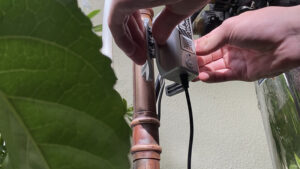
Bluebot clamps a smart water meter onto the outside of almost any pipe, almost anywhere, and starts reading water in about 10 minutes. No cutting, no shutoff, no plumber. That is what separates it from the rest of the whole-house category below, where getting a meter onto your main line usually means a plumbing job.
A whole-house water leak detection system is a device installed at your home’s main water line that watches every gallon entering the house, learns what normal use looks like, and raises an alert when the pattern changes. Two designs dominate. A smart water monitor measures flow or pressure and tells you something is wrong. A system built around an automatic water shutoff valve goes further and closes the supply itself. Which job you need done drives cost, installation and insurance eligibility.
Water damage is among the most common and expensive things that go wrong in a house. The Insurance Information Institute (2026), using ISO/Verisk claims data, reports that water damage and freezing made up between 19.6% and 29.0% of homeowners insurance claims from 2018 through 2022, peaking at 27.6% in 2022, with an average claim severity of $13,954.
Most leaks are not dramatic. EPA WaterSense (2026) estimates that the average family wastes 180 gallons a week, roughly 9,400 gallons a year, through household leaks, and that 9% of homes leak 50 gallons or more per day. Fixing those leaks cuts a typical water bill by about 10%. Dollarize™(TM) turns that percentage into the actual number on your own bill.
About this guide. Bluebot publishes this page and sells smart water meters in the category it describes.
Key Facts at a Glance
- Hardware: roughly $200 to $600 for monitor-only systems. Premium shutoff-enabled installations can exceed $2,500.
- Installation: $150 to $500 in plumber labor for inline devices. Clamp-on monitors are homeowner-installable.
- Subscriptions: Sseveral systems charge nothing. Where a plan is required, expect about $60 to $240 a year.
- Warranty: Ccompeting systems commonly advertise 1 to 5 years. The 100-W (Bluebot Hero) and 100-WAN (Bluebot ProLink) carry a 12-month warranty.
- Insurance: Ppremium credits of roughly 3% to 10% are common. Eligibility varies by insurer and state.
- Sampling, as of August 2026: Phyn (2026) states its pressure sensor reads 240 times per second. The 100-W (Bluebot Hero) delivers real-time flow alerts through the bluebot Water app.
- Governing standard: IAPMO IGC 115-2013 covers automatic water leak detection and shut-off devices in sizes NPS-1/4 to NPS-10.

What Is a Whole House Water Leak Detection System?
A whole-house water leak detection system monitors the entire plumbing network, from the main supply line to the last fixture. That separates it from a point moisture sensor, which watches one appliance or one patch of floor. A puck under the dishwasher tells you the dishwasher failed. A main-line monitor tells you 40 gallons moved through the house at 3 a.m. while nobody was home.
The costliest failures are rarely the obvious ones. The Insurance Institute for Business & Home Safety reports that water heater failure claims average $4,444, and that about 69% of those failures come from a slow leak or a sudden burst. A leak inside a wall makes no puddle for a sensor to find, only a small, steady, unexplained flow. That is the leak a clamp-on Bluebot meter is built to surface: the 100-W (Bluebot Hero) reads flow as low as 0.1 GPM, so a small, steady leak behind drywall shows up as an anomaly in the bluebot Water app long before it shows up on a ceiling.
How Water Leak Detection Systems Work, Including Bluebot’s Ultrasonic Method
Every system here does three things. It measures something at the main line, compares that against a learned baseline for your household, and decides whether the difference is worth an alert.
A smart water monitor measures flow rate through the main supply line against your normal pattern. Continuous flow at an hour when nobody uses water reads as an anomaly rather than a shower. A pressure-based system instead reads how the pressure wave behaves, which lets it infer which fixture is running. Both work, and each reads a different signal: flow tells you how much moved, pressure tells you where it moved from.
Bluebot measures flow from outside the pipe with ultrasonic sensing, so there is nothing to cut and no plumber to book. Here is how the clamp-on install works.
What Types of Whole House Leak Detection Systems Are There?
Flow-Based Monitors
Flow-based systems track how much water moves and for how long. Clamp-on designs never break the pipe, and they produce detailed usage data: whether the irrigation zone ran twice, whether a toilet flapper bleeds overnight. Their limitation is that they alert, usually through an app or smart home integration, but do not stop anything. The 100-W (Bluebot Hero) clamps onto the pipe and connects straight to Wi-Fi, with no gateway to buy.
Pressure-Based Monitors
Pressure-based detection reads the pressure signature in the line. Phyn states its sensor measures pressure changes 240 times per second, using high-definition pressure sensing to tell one fixture from another. The trade-off is installation: these are inline devices and require a plumber.
Automatic Shutoff Valves
An automatic water shutoff valve adds a motorized valve to the detection logic, producing a hard stop to the supply when a failure signature appears. It is the only design that acts without a person present, which is why more insurers now require one on large or seasonal properties. Two costs come with it. Installation requires a licensed plumber, because a section of the main line is removed to fit the valve. And an unnecessary shutoff cuts water to the house until somebody resets it.
Point Moisture Sensors
Point sensors cost very little and are worth owning. They belong in a layered strategy alongside a main-line monitor, not instead of one: point sensors catch the leak at the appliance, and a clamp-on Bluebot meter on the main line catches everything they cannot see, including the wall and the yard. Put them where failure is likely and expensive: the water heater pan, behind the washing machine, under sinks.
How Much Does a Whole House Water Leak Detection System Cost?
Hardware runs roughly $200 to $600 for monitor-only devices, and more than $2,500 for premium shutoff-enabled systems with professional installation. As of August 2026, list prices for the three most cross-shopped systems sit between $258.76 and $623.99.
Installation for an inline device typically costs $150 to $500 in plumber labor. Moen (2026) states that professional installation by a licensed plumber is recommended for its shutoff, because fitting it means removing a section of the main water pipe. Clamp-on monitors avoid that cost.
Subscriptions differ sharply. A monitoring subscription fee runs from nothing to roughly $60 to $240 a year. Moen’s FloProtect plan is optional at about $5 a month and adds enhanced data, an extended warranty and up to $5,000 in deductible coverage. Phyn states there is no mandatory monthly fee. Bluebot meters include 12 months of premium data in the purchase price, need no batteries, and renewal after year one is optional at $4.98 a month.
Maintenance is mostly batteries: point sensors need replacing, and a dead battery is a silent gap in coverage. Competing systems commonly advertise 1 to 5 years of warranty coverage. If you are chasing an unexplained bill rather than a catastrophe, the economics differ, as Bluebot’s breakdown of a high water bill with no visible leak sets out.
Where Should You Install a Bluebot Water Meter?
Install the main unit on the main water line where it enters the home, near the water meter and the main shutoff valve. Everything upstream belongs to the utility; everything downstream is yours. A whole-house system therefore requires a workable mounting point on the main line and reliable connectivity at that spot, which is the constraint people underestimate.
Water mains sit in basements, crawlspaces, garages and outdoor boxes, where Wi-Fi often does not reach. The 100-WAN (Bluebot ProLink) long-range water meter uses LoRaWAN instead of household Wi-Fi for that case, reporting to a Bluebot Gateway rather than to your router. Check signal at the mounting point first.

How Do the Leading Whole-House Systems Compare?
These three are cross-shopped most often. Prices and specifications below are each manufacturer’s own published figures as of August 2026.
| System | List price | Detection method | Installation | Auto shutoff | Ongoing cost |
|---|---|---|---|---|---|
| Moen Flo Smart Water Monitor and Shutoff | $623.99 | Flow, learned patterns | Inline, licensed plumber | Yes | Optional, about $5/month |
| Phyn Plus Smart Water Assistant + Shutoff (2nd Gen) | $579.99 | Pressure wave, 240/second | Inline, professional | Yes | No mandatory fee stated |
| 50-W (Bluebot Mini) / 100-W (Bluebot Hero) | From $258.76 / $558.34 | Ultrasonic flow, real-time alerts | Clamp-on, no cutting | No | Included first year, then optional at $4.98/month |
Moen Flo is a plumbing job to install, and its deductible coverage sits behind the optional FloProtect plan.
Phyn Plus reads the pressure signature in the line, which is what lets it attribute flow to a particular fixture. It is an inline device, so fitting it is a plumbing job.
Bluebot takes the opposite trade. It clamps on, so there is no plumber and no pipe modification, and on the Hero and ProLink its patented design self-adjusts to more than 80 pipe size and material combinations. Bluebot is a meter, not a valve: it alerts rather than shutting the water off, and that is what lets it go on lines a shutoff device cannot reach.
None is right for every house; they answer different questions.
Do Insurance Companies Give Discounts for Leak Detectors?
Often yes, but the number is smaller and more conditional than marketing suggests. Premium credits for a qualifying leak detection or automatic shutoff device commonly run about 3% to 10%, though a homeowners insurance premium discount requires carrier-specific device certification and varies by insurer and by state.
Two details matter more than the percentage. Several carriers run partnership programs that subsidize the hardware. And a growing list of carriers now requires an automatic shutoff valve before writing or renewing certain homes, turning the device from a discount into a condition of coverage. A clamp-on Bluebot meter is a leak-detection device in the same category these credits target, so it is worth raising with your carrier alongside any shutoff requirement. Confirm the approved device list with your own carrier first, because requirements are jurisdiction-specific and they change.
Can Water Leak Detectors Prevent Burst Pipes?
No, and any product claiming otherwise is overselling. A burst pipe caused by freezing or material fatigue is a mechanical failure, and no sensor prevents it. What detection changes is the interval between failure and response, which is where nearly all of the cost lives. A burst pipe differs from a slow supply-line leak in exactly that way: the slow leak is the one a flow monitor can catch days or weeks earlier, before it soaks a subfloor or corrodes a joint.
That is also the honest trade a shutoff valve makes: it compresses response from minutes to seconds, at the cost of the plumbing job it takes to fit one. Bluebot takes the other side of that trade: it alerts fast enough to act, on lines a shutoff valve is never installed to reach.
How Do You Choose the Right System, and Where Bluebot Fits
Work from the house, not from the product.
- The property sits empty for stretches, or is seasonal. You need two things: something that watches the line while nobody is home, and, if your carrier requires it, a shutoff valve. A Bluebot meter clamps onto the line at the property without a plumber visit, so you can see flow at a house you are not standing in, and it goes on the irrigation and outbuilding lines a single main-line valve never covers.
- You are home most of the time and want early warning. A clamp-on smart water monitor delivers the detection value without a plumber or a valve.
- Your main line sits where Wi-Fi does not reach. Solve connectivity first. A long-range or cellular meter decides this, not the sensing method.
- You manage more than one unit. Look at metering built for that shape, such as Bluebot’s water sub-metering approach.
- You want the lowest lifetime cost. Add hardware, installation and 5 years of subscription before comparing. A low-priced device on a mandatory plan often loses to a more expensive one without.
Setup questions sit in Bluebot’s water monitoring FAQ and the hardware range on the Bluebot shop. EPA WaterSense’s Fix a Leak Week (2026) runs each March, and many utilities pair rebates with it.
About the Author and This Guide
This guide was written and reviewed by Matthew Olin, Founder and CEO of Lookout Lab, Inc., the company behind Bluebot. That commercial interest is disclosed at every claim about Bluebot’s own products. Water-waste figures come from EPA WaterSense, claim data from the Insurance Information Institute using ISO/Verisk figures, failure research from the Insurance Institute for Business & Home Safety, and the device standard from IAPMO IGC 115.
Frequently Asked Questions
What is the difference between a water leak detector and a whole house water leak detection system?
A water leak detector is usually a point moisture sensor that alarms when water touches it, so it protects one appliance or one patch of floor. A whole-house water leak detection system installs on the main water line and watches every gallon entering the house, which lets it catch a slow leak inside a wall that never reaches a sensor. Most homes benefit from having both.
Can a whole house water leak detection system work without Wi-Fi?
Yes. Some meters use long-range radio instead of household Wi-Fi, which matters because water mains often sit in basements, crawlspaces or outdoor boxes where a router signal does not reach. Bluebot’s ProLink meter, for example, uses LoRaWAN and reports to a Bluebot Gateway rather than to your router. Check the signal at your intended mounting point before buying, because connectivity rather than sensing method is usually what decides which system will work.
Will a leak detection system lower my water bill?
It can, indirectly, by surfacing leaks you would otherwise miss. EPA WaterSense estimates that the average family wastes roughly 9,400 gallons a year through household leaks, and that fixing easily corrected leaks trims a typical water bill by about 10%. Dollarize turns that percentage into the actual number on your own bill. A main-line monitor does not repair anything itself. It tells you what needs fixing and how urgently.
How long does a whole house water leak detection system last?
Warranties across the category commonly run 1 to 5 years, and a longer term usually signals more confidence in the hardware. Bluebot’s 100-W (Bluebot Hero) and 100-WAN (Bluebot ProLink) carry a confirmed 12-month warranty. Powered clamp-on meters have no batteries to fail, while wireless point sensors need replacement batteries across every unit. Ask about firmware support as well, since detection accuracy depends on software the manufacturer keeps current.
Do I need a plumber to install a water leak detection system?
It depends on the design. Any system with an automatic water shutoff valve is an inline device, and Moen states that professional installation by a licensed plumber is recommended for its shutoff because a section of the main line must be removed. Clamp-on flow meters attach to the outside of the pipe and are homeowner-installable, which is why they avoid that labor cost.
Are whole house water leak detection systems worth the cost?
For most homeowners the arithmetic is favorable, though it depends on the property. The Insurance Information Institute reports an average water damage and freezing claim severity of $13,954, while monitor-only hardware starts near $200 and shutoff-enabled systems cost considerably more. Many carriers also offer premium credits of roughly 3% to 10%, but eligibility varies by insurer and by state, so confirm yours before buying.