Installing a house water meter means adding your own meter to the main line that feeds your home. There are two ways to do it: cut a mechanical meter into the pipe, or clamp an ultrasonic sensor like a Bluebot onto the outside. The first is a plumbing job and shuts your water off. The second clamps onto any pipe, in any place, with no cutting and no plumber, and takes about 15 minutes. This guide runs both water meter installation paths through the same six steps.
Why bother when the utility already meters you? It reports once a month, and a month is long enough for a drip to become a repair. The U.S. Environmental Protection Agency’s WaterSense program (2026) has the numbers. Home leaks waste more than 10,000 gallons per home each year. Ten percent of homes leak 90 gallons or more per day. And fixing simple leaks cuts a water bill by about 10 percent. A meter you own shows that number before the bill does.
What You’ll Need
For either method
- A straight, reachable run of your main service line
- Your pipe’s material and outside diameter. Copper, PVC, CPVC, PEX and galvanized steel are all common
- A phone for baseline readings
Traditional inline meter (cut-in)
- A pipe cutter matched to the pipe material, plus a propane torch and solder for copper
- Compression fittings, threaded adapters, and thread sealant tape or pipe dope
- Two shutoff valves, adjustable wrenches and a bucket
- Budget 2-4 hours, plus roughly $200 to $500 in plumber labor if you hire the cut-in out
Clamp-on meter, no cutting
- The unit, its mounting bracket and the coupling gel
- Wi-Fi at the pipe, or a gateway if it sits far from the router
- About 15 minutes and no tools
Before You Cut Anything: Permits, Code and the Utility’s Meter
Read this before you buy hardware. A private submeter belongs to you and sits downstream of the utility’s meter. It never replaces it. Changing, bypassing or tampering with the utility’s meter is illegal and treated as theft of service.
Cutting into a drinking-water line is regulated work in many places. The Los Angeles Department of Water and Power (2024) asks for a plumbing permit and a licensed, bonded contractor on a home submeter. Backflow is a separate rule. Model plumbing code and standards such as the City of San Diego’s meter and backflow bulletin (2025) call for a backflow preventer downstream of the meter. Rules vary by jurisdiction, so check with your building department and water utility first.
Parts matter too. Anything the drinking water touches should be certified to NSF/ANSI 61 and meet the lead limits of NSF/ANSI 372. Displacement meters built to ANSI/AWWA C700 (2009) must register between 98.5% and 101.5% at normal and high flows. Multijet units from 5/8 in. through 2 in. fall under ANSI/AWWA C708 (2019). As of 2026 the AWWA meter standards are still being revised, so buy to the current edition.
A clamp-on sensor never cuts into the pipe. That is why it usually skips the permit and water-contact questions, though local rules still differ.
Step-by-Step: Installing Your Water Meter
Step 1 – Locate the main line and choose a measurement point
Find where the main line enters the building. In most homes the pipe shows up in the basement, crawlspace, garage or utility closet, near the city shutoff or well pressure tank. Look for a straight section at least 10-15 pipe diameters long. It should have no bends, valves or fittings just upstream.
That straight run is not a formality. Elbows and tees leave the water swirling, and swirling water is read wrong by every meter type. The trade rule of thumb, per Lanry Instruments (2024), is about ten pipe diameters upstream and five downstream. A short straight run can push a clamp-on water meter from about ±1% error to more than ±3%, and peer-reviewed research on pipe disturbance (2025) agrees. Pick the calm stretch of pipe, not the handy one.
Note the pipe material and measure the outside diameter. Most houses run 3/4-inch or 1-inch mains. Older or busier homes may be 1-1/4 inch or larger. That number decides what fits and whether you need adapters.
Step 2 – Choose your method: cut-in or clamp-on
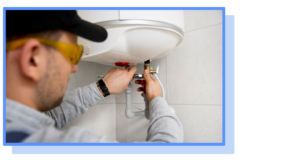
Decide now, because everything after this branches. A traditional inline meter is spliced into the pipe. You shut the water off, cut out a section, and rebuild the run with the meter and two isolation valves. Joints can be compression fittings, threaded adapters or soldered. Mechanical designs, positive displacement or multi-jet, have been the utility standard for decades.
A non-invasive water meter reads through the pipe wall instead. Transit-time ultrasonic sensing sends a sound pulse with the flow and another against it. The gap between the two travel times gives you the flow rate. Because nothing enters the pipe, there is no new joint to leak, no shutdown, and no plumber. Bluebot’s Adaptive Angle Technology (AAT) works this way across 80+ pipe types and size combinations on the 100-W (Bluebot Hero) and 100-WAN (Bluebot ProLink), 3/4 inch to 4 inch across their Standard and Prime models.
The honest trade-off. A cut-in gives you a standards-tested dial that needs no power or network, but it costs hours, risk at two new joints, and maybe a permit. A clamp-on smart water meter leans on mounting quality and a clean straight run.
Step 3 – Prepare, and confirm your fit
Stage everything before the water goes off. For a cut-in, dry-fit the meter and valves to check the length to remove, lay out fittings in order, and keep the bucket underneath. Copper needs the torch and solder ready. PEX and CPVC need the right crimp or solvent system.
For a clamp-on, prep is checking, not building. Make sure the pipe size is in range, the signal reaches the spot, and you can get a hand on the pipe. If the pipe sits far from the router, the Bluebot ProLink reaches it over LoRaWAN, covering spots well over 1,000 feet from the router and up to 1.2 miles in a typical urban setting. It pairs with a Bluebot Gateway, bought separately, which is what carries the readings back to the cloud.
Step 4 – Install the meter
Cut-in: Shut the main valve and open a low faucet to drain the line. Cut out the section you measured. Fit an isolation valve on each side so you can service the meter later without draining the house. Point the flow-direction arrow the way water really travels. Bring the pressure back slowly and check every joint. A weep is a failure, not a break-in period: shut down, reseal, retest.
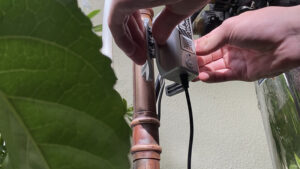
Clamp-on: Clean the pipe where the sensor will sit. Take off dirt, rust and loose paint down to a sound surface. Spread the coupling gel that came in the box so sound crosses into the pipe wall, then seat the unit in its bracket where the quick-start guide says. The water never stops, and it takes about 15 minutes.
Step 5 – Commission, test and verify accuracy (and pair your Bluebot)
Nothing is installed until it reads right. For a mechanical dial, run a known volume such as a 5-gallon bucket and check that the dial moves the way it should. A big gap points to trapped air, a plumbing fault, or a faulty unit.
For a connected device, pair it first. Download the app, set up the account, and run the on-screen setup. AAT configures the sensor to your pipe during that step, so there is nothing to set by hand. Every Bluebot meter also arrives already calibrated across its full flow range against NIST-traceable standards, with its own Calibration Certificate in the box. The Bluebot Hero and Bluebot ProLink measure to a typical field tolerance of ±1% to ±2%, and the Bluebot Mini to ±3% to ±5%. Real tolerance varies with pipe material, pipe size, installation quality and straight-pipe length, which is why Step 1 matters more than the spec sheet.
Step 6 – Baseline your usage, then hunt leaks
Spend the first week building a baseline of normal morning, evening and overnight use. Overnight is the tell. With every tap closed, flow should be zero. Any steady overnight draw is a running toilet, a dripping valve or a slow leak.
From there the meter does the watching. Models such as the 50-W (Bluebot Mini) and the Bluebot Hero ping you when flow drifts off baseline. A monthly bill reports once a month. A meter that watches flow reports continuously, and that difference in timing is the whole of the advantage. Slow seepage is exactly the damage most home policies leave out.
Tips and Troubleshooting
The key is matching the method to the pipe, not to your ambition. If your only straight stretch is short or crowded, a cut-in with proper valves may read better than a sensor beside an elbow.
- Readings drift or drop out on a clamp-on. Clean the surface again, add fresh coupling gel, move away from fittings. Most ultrasonic gripes are sound contact.
- A new joint weeps after a cut-in. Drain it and redo it. Sealant will not save an under-seated compression ring.
- Numbers look right but low. Check the flow arrow, then check the straight run against the 10-15 pipe diameters rule.
- No signal at the pipe. Add a gateway rather than moving to a worse spot on the line.
- Submetering rentals, a well or irrigation? Meter each branch on its own. One combined reading hides the failing zone.
Next Steps
Pick your path from the fit, not the marketing. If you can reach the line and the straight run is clean, the non-invasive route is shorter. As of 2026 Bluebot lists the Mini at $258.76 for 3/4-inch to 1-inch pipe and the Hero at $558.34 for 3/4-inch to 2-inch, each with a year of premium data. If you want a standards-tested mechanical dial on a line you are opening anyway, plan the permit, valves and 2-4 hours.
Either way the win is the same: you stop finding water problems on a bill. Compare pipe ranges across the full product line, and measure your pipe first.
Frequently Asked Questions
Will installing a water meter lower my water bill?
Not on its own. A house water meter measures use, it does not cut it. The savings come from what you do with the data. EPA WaterSense estimates that fixing easily corrected household leaks trims a water bill by about 10 percent, and a meter is how you find those leaks in days instead of billing cycles.
Does a clamp-on water meter work on galvanized or cast iron pipe?
Often, but check the model first. An ultrasonic water meter reads sound through the pipe wall, so heavy rust, interior scale or a cement lining can scatter the signal on older galvanized and cast iron lines. The Hero and ProLink cover 80+ pipe types and size combinations, so confirm your exact material and size against the product spec before you buy.
When do I need a permit or a licensed plumber to install a water meter?
Usually when you cut the pipe. A traditional in-line meter opens a drinking-water line, and jurisdictions such as Los Angeles require a plumbing permit and a licensed, bonded contractor for a home water meter installation. A clamp-on install adds no joint and no penetration, so it commonly falls outside that rule. Local rules differ, so ask your building department before installing a water meter.
How accurate is a clamp-on meter compared with a mechanical water meter?
They land in a similar range, but they are tested differently. Mechanical water meters built to ANSI/AWWA C700 must register between 98.5% and 101.5% at normal and high flows. Bluebot’s Hero and ProLink land in a typical field tolerance of ±1% to ±2%, and the Mini in ±3% to ±5%. The difference that matters in practice is placement, since a short straight run costs a clamp-on more accuracy than its spec suggests.
Will a house water meter reduce my water pressure?
A clamp-on will not, because nothing enters the pipe and the flow path is unchanged. An in-line meter adds a small pressure drop, since the water has to pass through the register. On a healthy service line most homes never notice it. If your pressure is already low, that is a real argument for the no-cut water meter route.
What happens if the Wi-Fi or power goes out?
A mechanical dial keeps counting, because it needs no power and no network. A connected smart water meter needs both to send alerts, so a dropout means no notifications until it reconnects. If coverage is the problem, adding a gateway usually beats moving the meter to a worse spot on the line.
Can a private submeter replace my utility’s meter for billing?
No. A private submeter measures water for your own use, and the utility still bills from its own revenue meter. Changing, bypassing or tampering with that meter is illegal and treated as theft of service. If you want a utility to bill from a submeter, ask them directly, because the rules vary by jurisdiction and normally require a permit.