Pool leak detection is a diagnostic service that finds where a swimming pool is losing water, through the shell, the buried plumbing, or the equipment. As of 2026, national cost indices put the cost of pool leak detection at $100 to $1,000, with most inground jobs at $400-$1,000. A leak found in a week costs a few hundred dollars. Found a year later, it can cost five figures. Smart water monitoring is what closes that gap.
This guide breaks the price down by pool type, by method, and by leak source. It also covers what most cost guides skip: what happens between inspections.
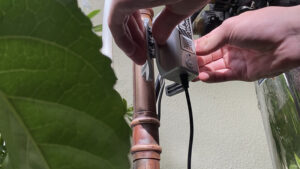
Bluebot builds the meter for the gap between inspections. The 100-W (Bluebot Hero) clamps onto the outside of your pool fill line, no cutting, no shutoff, no plumber, and starts reading flow in about 10 minutes. It goes on the line you care about, whether that is the fill line, the irrigation valve box, or the main.
The ranges here are 2026 national figures, cross-checked against our own quotes, and every number is attributed to where it came from. Those ranges are wide for a reason. A vinyl above-ground pool and a 40-foot gunite pool with buried lines are different jobs needing different equipment. Use the numbers to sanity-check a quote you have been given, not to predict the one you will get.
Key facts (as of 2026)
- Swimming pool leak detection costs $100 to $1,000 nationally. Inground pools run $400-$1,000 and above-ground pools run $100 to $500 (HomeGuide, Angi, 2026).
- A standard residential inspection is commonly quoted at $150-$500, with about $300 typical.
- Once the leak is found, repair adds $500 to $1,500 on average (HomeGuide).
- Structural damage and soil erosion from an ignored leak can escalate into a five-figure repair.
- The average household’s leaks waste more than 9,300 gallons of water every year, and nine percent of homes have leaks that waste 50 gallons or more per day (U.S. Environmental Protection Agency, 2026).
- About 10.4 million U.S. homes have a pool, roughly 59% of them inground (Pool & Hot Tub Alliance, 2026).
- Normal water loss is about 1/4 inch a day in humid weather and 3/8 to 1/2 inch a day in dry climates (American Leak Detection, 2026).

What is pool leak detection, and what are you paying for?
Finding a pool leak is a structured search for the exact point where water leaves your pool. A good technician does not guess and dig. They isolate the system, test each part, and mark the spot so the repair crew opens one small area instead of your whole deck.
You are paying for three things: calibrated equipment, a method that matches your pool, and a written finding you can hand to a contractor. That written pool leak diagnosis is what saves you money, because it turns an open-ended excavation into a defined job.
How does pool leak detection work?
Pool leak detection requires a plumbing pressure test, dye testing, or electronic listening equipment, and often all three on one visit. A line pressure test isolates each buried pipe and watches whether it holds. A visual dye inspection traces movement at a crack or fitting. Acoustic leak detection differs from dye testing because it finds leaks that are invisible at the surface: a listening device hears water escaping a buried pipe that no dye trail will ever reach.
Where pool leaks actually come from
Leaks come from a short list of places: the pool shell, the buried plumbing lines, the skimmer and drain fittings, the vinyl liner, and the equipment pad. Each has its own price to find and its own price to fix.
How much does pool leak detection cost in 2026?
Nationally the job runs $100 to $1,000 in 2026, and pool type is the single largest factor. HomeGuide’s 2026 cost data puts an inground pool at $400-$1,000 and an above-ground pool at $100 to $500. Inground pools cost more because the plumbing is buried and the shell is not fully visible.
Our own quotes cluster tighter than that national cost index band. A standard residential inspection is usually $150-$500, with about $300 typical. Location moves it: urban quotes commonly run $250-$500, rural quotes $150-$350. Pool size, concrete construction, and hidden underground leaks push pool leak detection pricing toward the top of its range.
What each method costs
| Method | Typical detection cost | What it finds |
|---|---|---|
| Visual inspection and dye test | $100-$200 | Surface cracks, liner tears, obvious fitting leaks |
| Pressure test | $150-$300 | Leaks inside buried return and suction lines |
| Electronic leak detection | $250-$500 | Hidden leaks located by sound, without digging |
| Underwater inspection | $300-$600 | A cracked pool shell or main drain leak that needs a diver |
| Comprehensive detection | $400-$750 | Several methods combined for a full assessment |
Pressure testing is used for isolating leaks in buried pool plumbing lines, which is why it appears on almost every inground quote.
What the leak source does to the price
- Concrete shell. A surface crack costs $150-$300 to detect and $200-$800 to repair. A deep structural crack costs $300-$500 to detect and $1,000-$3,000 to repair, and a widening concrete pool crack only gets more expensive the longer it runs.
- Vinyl liner. A vinyl liner leak is cheaper to find at $100-$250, but a full liner replacement runs $2,000-$4,000 when the damage is widespread.
- Fiberglass. Detection lands at $200-$400, with repairs of $500-$2,500.
- Underground plumbing. An underground plumbing leak is the hardest and priciest to trace, typically costing $300-$600 because of the equipment involved. A suction line leak can run for months while soaking the soil under your deck, which is why it does the most damage.
- Skimmers, drains, and fittings. A skimmer leak is cheaper to find at $150-$300, but reaching it can mean cutting deck. Angi’s 2026 cost guide puts a skimmer repair at $100 to $130, while a full replacement averages $2,000 to $3,000.
What does a pool leak cost if you ignore it?
Ignoring a leak turns a repair bill into a reconstruction bill. A pool shell crack produces soil erosion and settling that escalates repair cost over time. Decking cracks, the shell shifts, and nearby foundations take on moisture.
The numbers move fast. A minor crack that costs $200-$800 to fix today can create $3,000-$8,000 in structural damage after months of undermining. Left longer, full soil and structural repair can run into five figures. That gap, a few hundred dollars now against five figures later, is what catching a leak early is worth. What you actually save depends on how early the leak is caught, not on a fixed number.
Your water bill moves too. A small leak can add $200-$500 or more a year. Losing 1/4 inch a day from a typical 600 to 650 square foot pool surface wastes roughly 3,000 gallons a month. At common U.S. water rates that is about $30-$50 per month, or $360-$600 a year. A larger leak can waste 10,000 gallons a month.
This is not a pool-only problem. According to EPA WaterSense, the average household’s leaks account for more than 9,300 gallons of water wasted every year, nine percent of homes have leaks that waste 50 gallons or more per day, and household leaks waste nearly 1 trillion gallons of water annually nationwide. That is the loss Bluebot is built to surface. A clamp-on meter on the fill line sees the extra water going into the pool long before the deck starts moving.
Is your pool leaking, or is it just evaporation?
Before you pay anyone, run the free check. The five-gallon bucket test is used for separating a real leak from normal evaporation.
- Fill a 5-gallon bucket with pool water and set it on a pool step.
- Match the level inside the bucket to the pool’s level, and mark both.
- Turn the pump off and wait 24 hours.
- Compare the two drops. Sun and wind hit both the same way, so if the pool dropped further, that is a leak.
Know what normal daily water loss looks like first. American Leak Detection (ALD) reports about 1/4 inch per day in humid climates and 3/8 to 1/2 inch per day in arid ones. More than that is worth a check. If your autofill line keeps topping the pool off, that steady demand hides the loss completely. That is exactly what an autofill hides and what a Bluebot meter on the fill line does not, because it counts the water going in, not the level sitting still.
DIY or professional: which is actually cheaper?
DIY detection is cheap to start and expensive to get wrong. The DIY bucket test is free, leak dye costs $10-$20, and basic listening gear or an underwater camera costs $50-$200. A thorough DIY hunt takes 10-20 hours and still misses leaks inside buried lines.
Paying a pro for locating a pool leak buys accuracy and speed. Technicians can find in an afternoon what takes an owner two weeks, and many back the visit with a written warranty plus a report listing leak locations, severity, and repair estimates.
Picking the cheapest quote often costs more. A miss means a second service call and more weeks of water in your soil. Look for licensed and insured technicians, a written finding, and a repair estimate you can act on. Between visits, a Bluebot meter on the fill line watches for the next leak, so you are not relying on the calendar to catch it.
Can Bluebot catch the loss before the repair bill grows?
Smart water monitoring is continuous flow measurement that flags abnormal water use in real time. It makes the opposite trade-off from an inspection. Continuous water monitoring differs from professional detection by watching constantly instead of once, but it will not pinpoint where the leak is. It tells you that something changed, days or weeks before the water level shows it. That is the honest division of work: the sensor finds it early, a technician finds the spot.
Disclosure: Bluebot makes the meter described below. Cost ranges above come from independent sources, cited by name.
The 100-WAN (Bluebot ProLink) clamps onto the pool fill line with no pipe cutting, no shutoff and no plumber. It fits 3/4 inch to 2 inch pipe in copper, PVC, CPVC, PEX, PE, galvanized and stainless, and sends real-time flow data to the Bluebot Cloud. Fill lines from 2.5 inch to 4 inch use the Bluebot ProLink Prime instead. The ProLink reports over LoRaWAN, so it needs one Bluebot Gateway, from $399.00; if your pool line is in Wi-Fi range, the Bluebot Hero connects straight to the cloud with no gateway at all. Real-time alerts reach you through the Bluebot platform the moment flow looks wrong, and a remote monitoring data plan is optional. The meter runs on USB-C power and carries a one-year warranty.
The four scenarios below are illustrative, not measured outcomes:
- a caught leak saves $2,000 a year in wasted water;
- an early alert avoids $8,000 in soil stabilization work;
- a flow spike catches a failing pump before a $3,000 pump replacement;
- a slow shell leak is caught before $12,000 pool reconstruction.
The best-documented example is Bluebot’s own case study: one Bluebot uncovered a $13,000 water-billing error. There is a second, verifiable benefit: some insurers give premium credits for water-leak mitigation devices, and Amica publishes one (2026). Reported credits commonly fall in the 3% to 13% range, so on a $2,000 annual policy that is $60 to $260 back each year. It varies by carrier and location, so ask your own insurer; this is not coverage advice.
When to call a pro, and when to let Bluebot watch
Call a professional when:
- the level drops faster than that free check explains;
- you are buying or selling a property with a pool;
- an insurer wants documented verification of a leak;
- the problem looks structural.
Add 24/7 water monitoring when:
- prevention, not diagnosis, is the goal;
- you want the next leak caught in hours;
- you manage more than one property;
- you want a usage record between service visits.
Most owners do both: a professional finds today’s leak, and a Bluebot clamp-on water meter watches the fill line for the next one.
Where these numbers come from
Cost ranges are drawn from the 2026 national cost data cited above, cross-checked against our own quotes. Water-waste figures come from WaterSense, the EPA efficiency program whose Fix a Leak Week ran March 16-22, 2026. Evaporation thresholds and the bucket-test method come from ALD, and pool counts are reported by the PHTA. The meter specifications come from Bluebot’s product documentation. Prices vary by region and pool, so get a written quote first.
Protect your pool investment
Catching a leak early means paying for a repair instead of a reconstruction. That is the whole benefit in one line. Explore Bluebot’s smart water meter range for pool owners who would rather catch a leak early than price the repair, or see how business water monitoring applies the same approach commercially.
Frequently Asked Questions
What are the first signs of a pool leak?
The first sign is usually water dropping faster than the local evaporation rate. Watch for a level falling more than 1/4 inch a day in humid weather, a fill valve that runs far more often than it used to, soggy ground or shifting pavers near the shell, and a water bill climbing without a change in habits. Any one of those is worth the free bucket check.
How do detection prices compare with repair costs?
They are two separate bills. Finding the leak runs $100 to $1,000 nationally, and repairing it adds roughly $500 to $1,500 on average once the source is known. That split is why professional pool leak detection is quoted on its own. A written report keeps the repair quote from ballooning into open-ended excavation.
Can a smart water monitor tell me where the pool leak is?
No, and it is worth being clear about that. It measures flow on one pipe, so it tells you that your pool is drawing water it should not need. It cannot say whether the loss is a gunite crack, a liner tear, or a return fitting leak. Use it to catch the problem in hours, then book a pool leak inspection to pinpoint it.
Who should add continuous flow monitoring, and when does it pay off?
Owners who want prevention rather than diagnosis get the most from a clamp-on flow meter on the fill line, especially anyone managing more than one property or a pool they cannot check daily. It is a hardware-plus-data purchase, and it pays for itself the first time an alert catches a leak or a stuck valve before the water bill does. It suits owners who would rather find out early than find out from the bill.
Does homeowners insurance cover a pool leak?
Coverage varies by policy, so check yours directly. What is consistent is that insurers commonly want documented verification of a leak before considering a claim, which is one practical reason to keep the written finding from a pool leak detection service. Separately, some insurers, including Amica, publish premium credits for water-leak mitigation devices, commonly reported in the 3% to 13% range, which on a $2,000 annual policy works out to $60 to $260 back each year. This is not coverage advice.
Are pool leak detection prices higher for commercial pools?
Usually yes. The price of pool leak detection tracks pool size and plumbing complexity, so commercial pools land in the same $400-$1,000 band as large inground residential pools, and often above it. Larger surface areas need more testing time, and a subsurface pipe leak under a commercial deck takes longer to isolate than the same fault in a backyard pool.