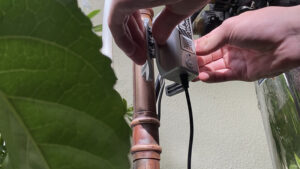
A refrigerator water leak is water escaping the appliance’s drainage or supply system and reaching your floor, usually from a clogged defrost drain, a cracked drain pan, or a failing water supply line. Most of it is fixable in an afternoon. The expensive part is not the repair, it is the weeks the leak ran before anyone noticed. A 50-W (Bluebot Mini) clamps onto the water line feeding your home, in a cabinet, a valve box, or a crawlspace, with no pipe cutting and no plumber, and tells you when water is moving that should not be.
That is the gap this page is about. An appliance water leak announces itself late. By the time you notice water pooling under the refrigerator, the problem is already in its second stage, and a puddle under the fridge is the symptom rather than the event.
Key facts
- 6 common causes. Clogged defrost drain, cracked drain pan, faulty water supply line, worn door gasket, frozen water line, and poor leveling.
- Most frequent single cause: a blocked defrost drain, which is also the cheapest to fix.
- Typical repair range: common professional work typically runs $150 to $400, and $500 to $800 when a major component goes.
- What waiting costs: subfloor replacement typically runs $3 to $8 per square foot plus labor, and professional mold remediation typically runs $2,000 to $6,000 or more.
- Detection floor: the Bluebot Mini reads flow down to 0.3 GPM (1.1 L/min), with field accuracy of 95% to 97% of flow reading.
- Scale of the problem: household leaks waste nearly 1 trillion gallons of water a year nationwide, according to EPA WaterSense (2026).
Every cost figure on this page is a typical range a homeowner is likely to encounter, not a survey result. Prices move with model, region, and how accessible the part is.
What Causes a Refrigerator to Leak Water?
Refrigerator leaks come from six places, and each announces itself differently. Knowing which symptom belongs to which cause saves you from pulling the unit out on a guess.
- Clogged defrost drain. Every frost-free refrigerator melts its own ice on a cycle and routes the meltwater down a defrost drain tube. Food debris and mineral scale block that tube. Water then backs up under the crisper drawers or runs out the front. A blocked or frozen defrost drain is the single most common reason for a refrigerator leaking water.
- Cracked or overflowing drain pan. The pan sits at the bottom rear and catches that meltwater so it can evaporate. A cracked pan drips straight onto the floor.
- Faulty water supply line. The ice maker line, the tubing behind the fridge, is the only pressurized water in the appliance. A loose fitting or a split line leaks continuously, not on a cycle.
- Worn door gasket. A perished door seal, the rubber seal around the door, lets warm, humid kitchen air in. That air condenses, and the drainage system was never sized for it.
- Blocked or frozen water line. Ice inside the supply tubing forces water out at the nearest weak joint.
- Poor leveling. An unlevel refrigerator drains toward the wrong corner and holds its doors slightly open.
The defrost drain is part of the refrigerator’s defrost system, alongside the defrost heater, the defrost thermostat, and the defrost control board. When any of those fail, ice stops clearing, the drain path blocks, and the symptom shows up as water rather than as a temperature complaint. That is why a leak is often the first visible sign of a defrost fault.
Supply faults behave differently from the rest of the list, and the difference matters. Drainage faults leak on the defrost cycle, a few times a day. A split supply line leaks whenever the house is pressurized, which is always. For the wider view, we cover the most common causes of household water leaks across every fixture.
How Do You Troubleshoot a Leaking Refrigerator?
Work from safest to most invasive. You are looking for the source, not the puddle.
Start here. Unplug the refrigerator and dry the standing water. Electrical components sit low at the back, so this is not optional.
Then note where the water appears: underneath, behind, or inside the compartment. Inside points to drainage. Behind points to supply.
Then check, in order:
- The drain pan. Bottom rear, usually behind a kick plate. Look at the pan under the fridge for cracks, for a tray knocked out of position, and for a waterline showing it overflowed.
- The water supply connections. Close the supply valve at the wall first. Then look for loose fittings, a kinked or split hose, and white mineral crust, which is dried evidence of a slow weep.
- The freezer drain. At the back of the freezer compartment, low down. Check the drain opening at the back of the freezer for ice or debris, then clear the drain line.
- The door seals. Run your hand around the door gaskets with the door closed on a dollar bill. If the bill slides out freely, the seal is done.
- The level. A spirit level across the top, front to back. Most refrigerators are meant to sit very slightly back-tilted. If it reads out of level, that is a two-minute fix.
Fixes you can do yourself: flush the defrost drain with warm water to clear debris, tighten loose water line connections, clean the gaskets with warm soapy water, adjust the leveling feet, and replace an accessible cracked drain pan.
An unlevel refrigerator differs from a component failure in a useful way: it is corrected with a wrench rather than a part. Try the free fixes first. If the symptom returns within a week, the cause is upstream of what you fixed. Our guides on how to find a water leak in your house and how to find a water leak inside a wall cover the case where the water surfacing in the kitchen did not start there.
Which Refrigerator Parts Fail Most Often, and What Do They Cost?
These are typical ranges a homeowner is likely to encounter, not survey results. Prices vary by model, region, and whether the part is accessible.
| Part | What goes wrong | Typical cost |
|---|---|---|
| Drain pan | Cracks, or sits out of position and misses the drip | $30 to $60 plus installation |
| Water inlet valve | Internal failure causes continuous flow | $150 to $300 replaced professionally |
| Door gasket | Rubber hardens, seal fails, condensation follows | $50 to $150 depending on model |
| Defrost heater or thermostat | Ice stops clearing, drain path blocks | Usually part of a $150 to $400 service call |
The drain pan, labeled the drip pan or evaporation pan in some manuals, relies on evaporation rather than drainage. It is a shallow tray over the compressor, using waste heat to boil off meltwater. When it cracks, nothing stands between the meltwater and your floor.
The water inlet valve is the valve that feeds the ice maker and water dispenser. It is most worth catching early, because its failure mode is continuous flow rather than a periodic drip. Symptoms are a constant trickle, an unfamiliar hum, and water pooling at the back.
The door gasket is the quiet one. A worn gasket produces excess condensation the drainage system cannot clear, so the visible symptom is a leak while the actual fault is a seal.
Replacement cost matters most when you weigh repair against replacement. Once a unit passes 8 to 10 years, multiple component failures usually point at the whole system rather than one part, and a $500 to $800 repair on a 12-year-old refrigerator rarely earns its keep.
What Happens If You Ignore a Refrigerator Leak?
This is the part that separates a $60 drain pan from a five-figure claim.
Progressive damage. Water wicks into flooring, cabinet bases, and wall framing. Wood flooring warps and cups, and laminate swells and separates at the seams.
Warped flooring and cabinet damage are the visible half. The secondary damage inside the cavity is the expensive half, and subfloor damage frequently requires full replacement at $3 to $8 per square foot plus labor. We trace the pattern in the early signs of water damage in walls.
Mold. According to the EPA’s guide to mold, moisture and your home (2026), materials dried within 24 to 48 hours of a leak will, in most cases, see no mold growth. Past that window the calculus changes, because the key to mold control is moisture control, and a leak under a refrigerator is moisture nobody is drying.
The EPA notes that molds produce allergens and irritants, and can trigger asthma attacks in people allergic to mold. EPA guidance on mold cleanup (2026) puts the do-it-yourself threshold at about 10 square feet. Beyond that, remediation is professional work, typically $2,000 to $6,000.
The claim. Water damage and freezing accounted for 27.6% of all homeowners insurance claims in 2022, and the five-year average payout across 2018 to 2022 was $13,954, per the Insurance Information Institute. About one in 60 insured homes files a property damage claim from water or freezing each year.
That severity is why insurers scrutinize gradual damage. A sudden burst is covered almost everywhere. A leak that ran for four months is frequently read as deferred maintenance. We cover both sides in does homeowners insurance cover water damage and how to make a successful water leak insurance claim.
The cost of a refrigerator leak is not the repair. It is the elapsed time.
What Are the Early Warning Signs?
A leak that has reached the floor has been running for a while. Early warning signs are produced by the same three faults as the leak itself: drainage, supply, and seal. These are the signals that arrive first.
- Damp or discolored spots under the refrigerator that appear and dry again.
- A musty odor near the kick plate with nothing visibly wet, which is the signature of hidden mold.
- Dripping, gurgling, or a run cycle that no longer stops.
- Temperature swings, which mean the cooling system is fighting a seal.
- Condensation on exterior panels or on the inside of the compartment.
- Mineral crust at a water line fitting, or a bowed cabinet toe kick.
- An ice maker producing less ice, or a dispenser running slow.
The last two are worth taking seriously. A dispenser that has slowed and a bill that has climbed are the same event seen from two ends of one pipe, which is why we wrote how to save money on your water bill. The same slow-first, visible-later pattern is exactly what causes a water heater to leak.
When Should You Call a Professional?
Call someone when the fault is behind a sealed system, when it is electrical, or when it keeps coming back. A sealed refrigeration system requires certified handling equipment and training, and that requirement is the real boundary between a homeowner repair and a technician’s.
- Sealed system work. Refrigerant lines and electronic control boards need certified tools and handling. Do-it-yourself attempts here void warranties and create real hazards.
- Recurring leaks. If a repair fails twice, the diagnosis was wrong. Repeated component failures usually indicate a system-level problem.
- Water plus electricity. Standing water near the compressor or a control board is a shock risk, full stop.
Ask the technician to confirm which fault they actually found. A second visit for the same symptom usually means the first repair treated a downstream effect rather than the cause, and that is worth knowing before you authorize a third.
On cost, common professional repairs run $150 to $400, and major component replacements run $500 to $800. Set that against a replacement refrigerator and the age of the unit, and the decision usually makes itself.
How a Bluebot Smart Water Meter Catches an Appliance Leak Early
Here is the honest structural problem with a refrigerator leak: the water is inside a cabinet, behind an appliance, on a floor nobody looks at. A puck-style moisture sensor only reports once water has reached it. By then the subfloor has already had it.
Bluebot measures the water instead of waiting for it. A clamp-on Bluebot Mini uses transit-time ultrasonic sensing, so it reads flow through the pipe wall and never touches the water.
The Mini reads flow down to 0.3 GPM (1.1 L/min), and Bluebot Mini field accuracy is 95% to 97% of flow reading, with a typical field tolerance of +/-3% to +/-5%. Every meter ships individually calibrated against NIST-traceable standards, with its own Calibration Certificate. That continuous flow measurement is what turns seeing your water in real time into a warning system.
What that buys you is a baseline. Once your Bluebot Mini knows what a normal night looks like in your house, a failed water inlet valve stops being invisible. It is flow, at an hour when there should be none, and usage pattern alerts put that on your phone.
A flow-based alert can arrive while the water is still inside the cabinet. As of 2026, a Bluebot Mini on the service line is $258.76 with the first year of data included.
Where it goes, and what it does not do. The Mini fits 3/4 inch and 1 inch pipe, in copper, PVC, PEX, or galvanized steel, indoors or out. Its IP68 rating suits an irrigation valve box as readily as an under-sink cabinet, and it clamps on in about 10 minutes with the Bluebot app, with no pipe cutting and no water shutoff.
It runs on built-in Wi-Fi straight to the cloud, so there is no gateway to buy. And it is a meter, not a valve: it tells you, it does not close the line for you. That is exactly why it can go where a valve cannot.
One practical tip, because a flow meter and a moisture sensor answer different questions. Water flow monitoring catches anything moving water continuously, which is the failure mode that does the real damage. A drip that never reaches 0.3 GPM is below what any flow meter reads, so pair the Mini with a puck-style moisture sensor under the refrigerator and you have both ends covered.
For how flow-based measurement compares to other approaches, we published a Bluebot and Flume comparison. The same logic applies outdoors, where an underground line gives you no visual warning, which is the case we make in detecting a sprinkler leak early and in how to find a leak in a sprinkler system.
Protecting Your Kitchen From the Next One
Monthly, take five minutes: check the door seals, wipe the gaskets, and flush the defrost drain with warm water. Quarterly, pull the unit out and inspect the supply fitting and the drain pan. Keep clearance behind the refrigerator so the coils can shed heat.
Then close the gap that maintenance cannot close. Preventive maintenance is part of protecting a kitchen from water damage, and continuous measurement is the other part. A monthly inspection is a snapshot. The Bluebot Mini water meter watching the line is continuous, and that difference is the whole of the advantage.
Fixing easily corrected household leaks saves about 10 percent on a water bill, per EPA WaterSense, but the larger number is the $13,954 average claim you never file.
A refrigerator leak is a small repair wearing a large disguise. Catch it as flow, and it stays small.
Frequently Asked Questions
Why is my refrigerator leaking water from the bottom?
Water at the bottom of a refrigerator almost always comes from one of two places: a clogged defrost drain backing meltwater up until it spills out the front, or a cracked drain pan at the rear letting it fall straight through. Check the pan first, because it takes 30 seconds and needs no tools. If the pan is intact and dry, the drain is the suspect.
What should I do first when I find water under my fridge?
Unplug the refrigerator, then dry the standing water. Electrical components sit low at the back of the unit, so power comes off before anything else. Next, note where the water is coming from, because the location narrows the cause immediately. Water inside the compartment points to drainage. Water behind the unit points to the supply line or the inlet valve.
How do I unclog a refrigerator defrost drain?
Empty the freezer and find the drain opening at the back of the freezer compartment, usually low and behind a panel. Clear any visible ice, then flush warm water down the drain line with a turkey baster until it runs freely. Do not push a wire coat hanger through it, since that punctures the tube. If it reblocks within a month, the defrost system needs a technician.
How long does it take a refrigerator leak to cause mold?
Roughly 24 to 48 hours. The EPA states that materials dried within 24 to 48 hours of a leak will in most cases see no mold growth, and that the key to mold control is moisture control. A fridge leak fails that test by default, because the water sits under an appliance nobody moves. That is why the elapsed time matters more than the size of the leak.
Will homeowners insurance cover a refrigerator water leak?
It depends on whether the damage reads as sudden or gradual. Water damage and freezing made up 27.6% of homeowners insurance claims in 2022 according to the Insurance Information Institute, and that volume is why insurers examine the timeline closely. A supply line that bursts is usually covered. Water leaking from your refrigerator for four months is frequently treated as deferred maintenance instead.
Can a smart water meter detect a refrigerator leak?
Yes, when the leak is moving water continuously, which is the failure mode that causes the real damage. The Bluebot Mini reads flow down to 0.3 GPM (1.1 L/min), so a failed inlet valve running behind the fridge shows up as flow at an hour when there should be none. A slow drip below that threshold is under what any flow meter reads, so pair the Mini with a moisture sensor under the unit.
Is it worth repairing a refrigerator that leaks water?
Usually yes, if the fridge leak traces to a drain, a pan, or a gasket, because those repairs sit between $30 and $400. The math changes past 8 to 10 years of service. A $500 to $800 component replacement on a unit that age often signals system-wide wear rather than one failed part, and replacement tends to be the better use of the money.