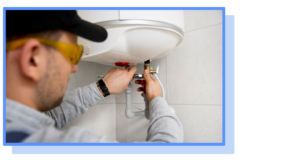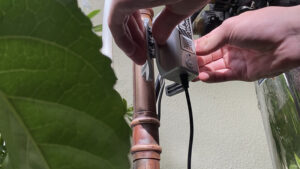
A water leak is water escaping a plumbing system, fixture, or appliance inside a building. Most household water leaks start small and stay hidden. A worn toilet flapper, a cracked washing-machine hose, or a rusting water heater can run for months. By the time anyone sees a puddle, household water damage is usually done. That is why monitoring matters. Bluebot clamps onto the outside of almost any pipe, with no cutting and no plumber, and reads the flow through it minute by minute. Put it on the main line, on the irrigation line in the valve box, or on the branch line feeding the appliance you are worried about, and a leak that nobody can see becomes a number you can watch. As of 2026, EPA WaterSense estimates the average household wastes nearly 10,000 gallons a year to leaks it never noticed.
The 9 Most Common Leak Sources, at a Glance
| # | Where the leak starts | The tell |
|---|---|---|
| 1 | Plumbing inside the wall | Musty smell, stained drywall, usage spike with no cause |
| 2 | Water heater | Rust at the base, hissing, a puddle under the tank |
| 3 | Washing machine supply hose | Cracked or bulging hose, mildew behind the washer |
| 4 | Sink and faucet | Drip that never stops, warped cabinet floor |
| 5 | Toilet | Water that runs on its own, phantom refills |
| 6 | Shower and tub | Lifting tiles, soft grout, weak water pressure |
| 7 | Refrigerator and ice maker | Slow warping of the floor beside the fridge |
| 8 | Dishwasher | Damp cabinet base, mold along the door seal |
| 9 | Irrigation and sprinklers | A water bill that jumps with no indoor change |
Key facts
- Nearly 10,000 gallons wasted per household per year, and 10% of homes waste 90 gallons or more per day (EPA WaterSense).
- 22.6% of all homeowners insurance claims are water damage and freezing, averaging $15,400 per claim (Insurance Information Institute, 2025 report on 2023 data).
- Nearly 55% of washing-machine water-damage claims trace back to a supply hose (IBHS).
- The average failed water heater is 10.7 years old, and by 12 years nearly 3 in 4 have failed (IBHS).
- A single leaking toilet can waste about 200 gallons a day (Denver Water, 2023).
Why leaks stay hidden for so long
Plumbing is built to be invisible. Supply lines run behind drywall, under slabs, beneath cabinets, and inside appliances. So the first evidence of a water leak is almost always indirect: a smell, a stain, a sound, or a bill. Water damage compounds quietly during that gap. According to EPA WaterSense, the most common leaks in houses are worn toilet flappers and leaking faucets and valves. Those are the two places homeowners are least likely to look.
It also helps to be precise about what counts. A water leak is water escaping the supply side of your plumbing: pressurized pipes, hoses, valves, and appliance connections. That differs from water intrusion, where rain or groundwater enters from outside. Both cause water damage. But only a supply-side leak shows up as flow, and that is exactly what a Bluebot on the line reads, minute by minute, so the two problems are found in very different ways.
What Are the Most Common Causes of Water Leaks in a Home?
The nine sources below account for the overwhelming majority of residential leaks. Each one has a distinct failure mode and its own early warning sign.
1. Plumbing leaks inside the wall
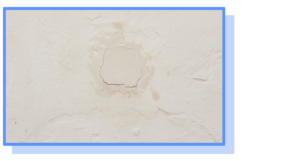
In-wall leaks are the hardest to find because nothing is visible until the drywall gives up the secret. Watch for standing puddles on or near a wall, discoloration or drips on the wall itself, foul or musty smells, and dripping sounds behind the drywall. If your water usage spikes but no appliance or fixture explains it, you may have a leak inside your wall, and it is time to bring in a professional. A Bluebot on the line confirms it before you open the wall. See finding a water leak inside a wall and early signs of water damage in walls.
2. Water heater leaks
Leaks in a hot water heater usually begin once the tank is past its expected life range. IBHS research on insurance claims found the average failed water heater is 10.7 years old. It also found that 69% of failures show up as either a slow leak or a sudden burst. If you have been using the same water heater for more than 20 years, you probably have rust and corrosion deterioration that can cause a slow leak or even a large burst. Keep up with maintenance. Listen for a hissing sound near the drain pipe, and check for a puddle under the tank. A Bluebot on that branch line catches the weep long before the floor does. See what causes a water heater to leak.
3. Washing machine supply hose leaks
Your washing machine accounts for a large share of household water use. Its supply hose is one of the highest-risk parts in the house. IBHS analyzed 525 washing-machine claims and found nearly 55% came from supply hoses that leaked or burst. The average failed hose was 8.7 years old, and failure rates climb sharply once a hose passes five years. Look for puddles behind the machine. Inspect hoses and seals for cracking or bulging, and treat mold or mildew as evidence of a slow leak. A Bluebot on that supply line catches the weep between cycles, before it floods the laundry room.
4. Sink and faucet leaks
Sinks are the most obvious place to check, which is exactly why the slow ones get ignored. A faucet left running, a valve that never seals fully, or caulking that has disintegrated all leak steadily. Check for puddling water, mildew, or discoloration under the sink and along the cabinet base. EPA WaterSense counts dripping faucets among the leaks that waste the most water in an average home. A Bluebot on that branch turns the drip into a number you can actually see.
5. Toilet leaks
A newly installed low-flow toilet can still be the largest leak in the house. Toilets often develop a faulty flapper, a high water level, or a water-logged float. Any of those keeps water running constantly and consumes hundreds of gallons every month if left unattended. Denver Water puts a single leaking toilet at roughly 200 gallons a day. EPA WaterSense recommends replacing flappers at least every five years. Confirm a silent leak with the dye test: add a few drops of food coloring to the tank, then check the bowl ten minutes later. If color appears, the flapper is leaking. Also check behind the toilet for mold, mildew, or drips at the flange and wax ring. A Bluebot on that line catches the same fault as flow, without you having to remember the dye test.
6. Shower and tub leaks
Showers and tubs are among the harder leaks to detect because the plumbing sits behind tile. Lower water pressure in the shower is a common signal, and tiles that begin to lift or grout that stays soft usually mean water is moving behind the wall. A Bluebot on that branch line is often the first sign you get, well before the grout.
7. Refrigerator and ice maker leaks
If your refrigerator has a water supply or an ice maker, it is susceptible to leaking. These leaks are hard to identify. They happen slowly, over long periods, and go unnoticed until the flooring warps. Bluebot measures total household flow continuously, so a slow ice-maker drip shows up as an overnight draw with nothing running, months before the floor warps.
8. Dishwasher leaks
A dishwasher fails much like a refrigerator: gradually and out of sight, damaging the floor beneath it. If you suspect a leak, unplug the appliance and check behind and under it for puddles, mold, or damage to the surrounding cabinetry and walls. A Bluebot on the kitchen’s branch line often catches the same failure as flow, before the cabinet base gets damp.
9. Irrigation and sprinkler leaks
Irrigation leaks get expensive fast, because they are easy to overlook until the water bill arrives. Sprinkler heads fail, and they usually fail in the part of the yard you walk past least. An irrigation leak differs from an indoor leak in one important way: it surfaces on your bill rather than on your floor. Clamp a Bluebot onto the irrigation line in the valve box and meter it on its own, so a broken sprinkler head shows up as flow the day it fails instead of on next month’s bill. See sprinkler leak detection.
How Do You Know If You Have a Hidden Water Leak?
You rarely find a hidden leak by looking. You find it by measuring. The water meter test is the fastest confirmation any homeowner can run. Turn off every water-using fixture and appliance in and around the house, then read the meter. If the leak indicator dial is spinning, or the reading changes after a few hours of zero use, water is escaping somewhere in your plumbing. A Bluebot on the line runs that same test automatically, all day. EPA WaterSense builds its annual Fix a Leak Week around this check, and the 2026 edition runs March 16 through 22.
Four supporting signals are worth trusting:
- An unexplained water bill spike. A bill that climbs while your habits stay flat is a strong indicator, and it is the signal EPA WaterSense points homeowners to first.
- Sound with no source. Running, hissing, or trickling when nothing is switched on means water is moving when it should not be.
- Stains and smells. Discoloration on ceilings, walls, or floors, plus any persistent musty odor.
- Outdoor tells. Soft or muddy ground, unusually green patches, or standing water in the yard.
See how to find a water leak in your house for the step-by-step walkthrough.
How Much Does a Water Leak Actually Cost?
The exposure lands in two places: the utility bill and the insurance claim.
On the bill, EPA WaterSense estimates the average household loses nearly 10,000 gallons a year to leaks, with 10% of homes wasting 90 gallons or more per day. Nationally that is close to 1 trillion gallons annually. Fixing the easily corrected leaks can cut a household’s water bill by about 10%, which on a typical bill is real money back every month: see saving on your water bill. Bluebot’s Dollarize(TM) view puts that 10% in front of you in dollars rather than gallons, so you can see what a running toilet is actually costing while it is still running.
On the claim side the numbers are steeper. In a 2025 report based on 2023 claims data, the Insurance Information Institute found water damage and freezing accounted for 22.6% of all homeowners insurance claims, with an average claim of $15,400 between 2019 and 2023 and roughly 1 in 67 insured homes filing one each year. Coverage varies by policy and by state, so read your declarations page before assuming a leak is covered: does homeowners insurance cover water damage explains the carve-outs, and how to make a successful water leak insurance claim covers documentation.
How Bluebot Catches a Leak Before It Becomes Water Damage
Every cause on this page shares one weakness. Each changes how much water moves through your home before it changes how your home looks. That gap is the window monitoring is built for.
Bluebot is a smart water meter that measures whole-home flow continuously. An unexplained overnight draw or a slow steady drip shows up as data, days or weeks before it shows up as a stain, which is the window you need to get it fixed. Bluebot clamps onto the outside of the pipe, so it goes on the line you actually care about: the main line coming into the house, a branch line, the irrigation valve box, or a point-of-use line under a sink. There is nothing to cut, no shutoff, and no plumber to book, and installation takes about 10 minutes with the bluebot Water app. The 100-W (Bluebot Hero) reads flow to 98%-99% of the true figure in the field and picks up flows as low as 0.1 gpm, though real accuracy varies with pipe material, pipe size, and installation quality; that is a drip you would never hear. It uses clamp-on transit-time ultrasonic sensing, with Bluebot’s patented robotic servo technology positioning the sensor to the pipe automatically. An irrigation line can be monitored separately, so outdoor waste is not buried in your indoor totals. Read more about how Bluebot works, or order a Bluebot.
Which Leak Should You Check First?
Start where the data says failures cluster. Check the toilet flappers first: EPA WaterSense identifies worn flappers and leaking valves as the most common leaks in houses, and the dye test costs nothing. Next, inspect the washing-machine supply hose if it is more than five years old, given the IBHS finding that nearly 55% of washer claims begin there. Then check your water heater’s age against the 10.7-year IBHS average. Finally, run the meter test to catch anything hidden in a wall or under the slab. That order covers the highest-probability failures in under an hour. A Bluebot on the main line runs that last check for you, continuously.
Frequently Asked Questions
How long can a hidden water leak go unnoticed?
Months, and sometimes years. A supply-side leak behind drywall or under an appliance produces no puddle you can see, so the first evidence is usually a smell, a stain, or a bill. EPA WaterSense estimates the average household loses nearly 10,000 gallons a year this way, and reports that 10 percent of homes waste 90 gallons or more per day. A Bluebot on the line would have caught it in hours, not months.
Why is a small water leak worth fixing right away?
Because the damage compounds faster than the leak grows. A slow drip feeds mold and rot inside cavities you cannot inspect, and the repair bill scales with time rather than with flow rate. The Insurance Information Institute reports that water damage and freezing make up 22.6 percent of all homeowners insurance claims, averaging $15,400 per claim between 2019 and 2023. Continuous Bluebot monitoring closes that gap by flagging the flow the moment it starts.
What should I do first if a pipe is actively leaking?
Shut off the water before anything else. Close the fixture’s local shutoff valve if it has one, and if it does not, close the main shutoff where the supply enters the house. Then cut power to any circuit near standing water, photograph the damage for a possible claim, and call a licensed plumber.
Who should I call when I find a water leak?
Call a licensed plumber first, because stopping the source comes before drying anything out. If water has soaked drywall, insulation, flooring, or cabinetry, add a water damage restoration contractor. Notify your insurer early if the loss looks likely to exceed your deductible, since carriers typically require prompt notice and their own documentation.
Does homeowners insurance cover a slow water leak?
Often it does not. Most policies cover sudden and accidental water damage but exclude damage that developed gradually from a leak the owner could reasonably have found. Coverage varies by policy and by state, so read your declarations page and exclusions rather than assuming. The Insurance Information Institute reports roughly 1 in 67 insured homes files a water damage or freezing claim each year. A Bluebot flow record gives you dated proof if a claim is ever disputed.
Can a smart water meter detect a leak I cannot see?
Yes, because a hidden leak still moves water. Bluebot clamps onto the outside of the pipe and uses transit-time ultrasonic sensing to measure whole-home flow continuously, so an overnight draw with nothing running shows up as data. You can put it on the line you want measured, whether that is the main line coming into the house, a branch line, or the irrigation line running out to the yard.