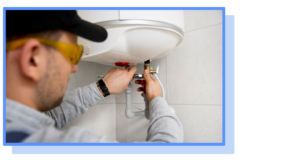
A water heater leak is water escaping from the tank, its valves, or its pipe connections, and it comes from one of nine causes: internal corrosion, a worn drain valve, a faulty temperature and pressure relief valve, water pressure above 80 PSI, sediment buildup, a spent anode rod, loose inlet and outlet connections, a cracked tank, or a failed internal lining. Which one you have decides everything, because some are a 10 dollar part and some mean the unit is finished. A puddle under the tank tells you almost nothing on its own.
The money is why water heater leaks are worth understanding before one happens. Repair and remediation commonly runs $3,000 to $5,000 or more once the water has had a few days to travel. As of 2026, the Insurance Information Institute (2026) puts the average water damage and freezing claim at $13,954, using ISO claims data from 2018 through 2022. That same category accounts for roughly 23 percent of all homeowners claims. The gap between a $200 valve and a $13,954 claim is almost always time, which is the one variable you can still control.
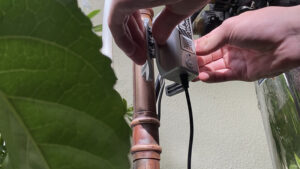
That is where Bluebot fits. Bluebot meters clamp onto the outside of a pipe. One can go on the cold supply line feeding your water heater, in the valve box, on the tenant line, or on the commercial main. No cutting, no shutoff, no plumber, and about 10 minutes to install. Bluebot does not stop a leak. It tells you one is running, which is what turns a $13,954 story back into a $200 one.
What is leaking: the tank shell, a valve, or a fitting
Repairable: drain valve, T&P valve, anode rod, pipe connections
Not repairable: a cracked tank or a failed internal lining
Typical tank service life: 8 to 12 years, and 15 to 20 years for a well-maintained unit
Component repair range: $50 to $300
Installed replacement range: $800 to $3,000
First move on any leak: cut the power or gas, then the cold-water inlet
What Causes a Water Heater to Leak?
Nine failure modes account for nearly every water heater leak. They are listed here in rough order of how often they show up. Each one leaks in a recognizable place, so a leak from the water heater usually tells you which part failed by where the water appears. That is how you narrow it down before anyone bills you for a diagnosis.
Age and Internal Corrosion
A corroding steel tank is the single most common reason a water heater reaches the end of its life. A storage tank water heater rusts from the inside out, and time is the only ingredient it needs. Standard tank water heaters generally last 8 to 12 years. Well-maintained units can reach 15 to 20 years, depending on water quality and how hard the household runs them.
Rust inside the tank thins the metal until microscopic cracks form, usually at the base where sediment and heat stress concentrate. That is rust-through, and an age-corroded tank leaks as steady seepage from the bottom of the unit. Once corrosion of the tank wall has cracked the shell, the tank cannot be repaired and the unit has to be replaced.
A Loose or Damaged Drain Valve
The drain valve at the base of the tank exists so the unit can be flushed. Repeated use loosens its seal, and the plastic-bodied versions crack outright. You will see a slow drip at the valve spigot, moisture around the hose connection, and leaking that gets worse when the tank is full and pressure against the valve is highest. Tightening the valve with a wrench often ends it. A corroded or split valve body can be replaced on its own, without touching the rest of the water heater.
A Faulty Temperature and Pressure (T&P) Relief Valve
The T&P relief valve is the safety device that dumps water when the tank’s internal temperature or pressure passes a safe limit. It is the component standing between an overheating tank and a rupture. When it leaks, water discharges from the side of the tank, usually down the drain pipe that runs to floor level. Sometimes the valve itself has failed. Just as often it is working correctly and reacting to a real problem somewhere else, such as a stuck thermostat or high incoming supply pressure, which means replacing the valve would hide the actual fault.
Testing deserves respect. You can briefly lift the test lever to confirm the valve opens and snaps shut, standing clear of the discharge pipe. Diagnosis and replacement belong to a licensed plumber.
Water Pressure Above 80 PSI
High supply pressure stresses every seal, fitting, and tank wall in the house at once. Model plumbing codes (2021) set the ceiling at 80 PSI. Above that, the code calls for a pressure-reducing valve rated to the ASSE 1003 standard. Code editions and local rules vary, so check what applies where you live.
The tell is breadth: leaks at the pipe connections on top of the tank, repeated T&P discharge, and dripping fixtures in more than one room at the same time. A pressure gauge costs under $15 at any hardware store and threads straight onto a hose bib. If your reading sits above 80 PSI, a pressure-reducing valve on the main supply line protects the whole system, and a closed system with a backflow preventer or check valve may also need a thermal expansion tank.
Sediment Buildup in the Tank
In hard-water areas, dissolved minerals settle into a layer on the tank floor. That layer insulates the bottom from the burner or the lower heating element. The system then runs longer and hotter to heat the water sitting above it. Water heating is already one of the largest energy uses in a home according to ENERGY STAR (2026). A sediment-fouled tank therefore costs you twice, once on the gas or power bill and once on the tank’s life. The overheating weakens the metal until it cracks.
Rumbling and popping during a heating cycle is the sound of water flashing to steam underneath that mineral layer. Flushing the tank annually clears it. Draining 2 to 3 gallons from the drain valve every six months is the lighter version that keeps buildup down between full flushes. Once sediment has cracked the tank bottom, replacement is the only option left.
A Depleted Anode Rod
The anode rod is a sacrificial magnesium or aluminum rod hanging inside the tank. Its entire job is to corrode so the tank lining does not. It works until it is consumed. After that, tank corrosion moves straight to the tank walls with nothing in its way. Rust flakes in the hot water and a sulfur or metallic smell are the signals that the rod is finished and internal rust has started on the tank itself.
Replacing the anode rod every 3 to 5 years, or every 2 to 3 years on hard water, is the highest-return maintenance on the entire appliance. The rod itself costs $20 to $50 and comes out through a hex-head fitting on top of the tank. The catch is timing: if the tank has already started corroding, a new rod does not undo it.
Inlet and Outlet Pipe Connection Leaks
The cold-water inlet and hot-water outlet at the top of the tank expand and contract every time the unit cycles. Over years, that movement loosens fittings and works thread sealant loose. Water pooling on top of the tank, or dripping at a joint during and just after a heating cycle, points here. Tightening the fitting with a wrench usually solves it. Visible corrosion at a connection means the fitting itself has to come out and be replaced.
A Cracked or Damaged Storage Tank
A cracked tank is the failure mode with no repair path. It follows from long-term internal corrosion, a manufacturing defect, or extreme temperature swings. The signs are unmistakable: water leaving the base of the unit, large-volume pooling, and water loss fast enough to see on a meter. A cracked tank must be replaced, and it should be taken out of service now rather than at the weekend, because a full rupture releases 40 to 80 gallons of hot water into the house in minutes.
Internal Tank Lining Failure
Inside the steel shell sits a glass or enamel lining that adds a second layer of corrosion protection. Thermal stress or a manufacturing inconsistency cracks it, water reaches bare steel underneath, and corrosion accelerates in the space between the lining and the outer shell. This one is genuinely hard to spot, because moisture can collect inside the insulation or under the outer jacket long before anything appears on the floor. Rust bubbles on the outer shell, or persistent dampness with no drip at any fitting, are the usual indicators. Lining failure is not repairable.
What Are the Warning Signs a Water Heater Is About to Leak?
Knowing why a water heater leaks is only half the job. The other half is catching one early, and water heaters rarely fail without notice. The performance changes show up weeks or months ahead of the first drop. Reading them is the difference between a scheduled replacement and a flooded utility room.
Sound. Rumbling, popping, or cracking during a heating cycle means sediment has built up thickly enough to trap water underneath and flash it to steam. Left alone, that repeated overheating weakens the tank bottom.
Water quality. Rust-colored or cloudy hot water suggests corrosion inside the tank or a spent anode rod. A metallic taste or smell in the hot water only, and not the cold, points to the same place.
Recovery. Less hot water than the unit used to deliver, or temperature that wanders, usually means sediment is displacing volume or insulating the element.
Appearance. Look for rust on the fittings, the valves, and the shell of the hot water tank. Rust staining around the pipe connections on top often marks slow seepage that has not started dripping yet. Minor dampness at the base can be simple condensation. That is common when cold water enters a tank in a warm, humid room, and it clears on its own. Moisture that keeps returning to the same spot is worth chasing.
Small internal corrosion spots become cracks, and performance drops usually arrive before a full tank failure. Acting during the warning window is what keeps a water heater problem from becoming a floor, drywall, and mold restoration project.
What Should You Do First When You Find a Leak?
A water heater that is leaking is still a live gas or electrical appliance. Shut off the energy source before you inspect anything. On an electric water heater, switch off its dedicated breaker at the panel. On a gas unit, turn the gas control valve to off. Both remove the risk of shock or ignition while you are working around water.
Next, close the cold-water inlet valve at the top of the tank so no more water feeds the leak. If that valve is stuck or will not close fully, shut off the main supply to the house.
Then wait. The tank and its fittings hold heat long after the power or gas is off, and the water inside is hot enough to injure. The U.S. Consumer Product Safety Commission has long advised setting a water heater to 120 degrees Fahrenheit. Its tap water scald guidance explains why: most adults suffer third-degree burns after roughly two seconds at 150 degrees, six seconds at 140 degrees, or thirty seconds at 130 degrees. Opening a nearby hot-water faucet relieves tank pressure and speeds cooling. Do not drain the tank unless you are confident in the procedure and have a safe discharge path for scalding water.
Should You Repair or Replace a Leaking Water Heater?
Not every water heater failure condemns the unit. A leaking drain valve, a worn T&P valve, corroded pipe connections, and a spent anode rod are all component-level repairs. Each runs in the $50 to $300 range, depending on the part and on whether you do it yourself or hire a plumber.
Replacement wins when the tank itself is leaking, when the unit is past 10 years old and showing more than one symptom, or when the repair quote approaches half the cost of a new heater. As of 2026, a replacement storage water heater runs $600 to $2,500 for the unit alone according to NerdWallet (2025), with tank-style labor at $150 to $450. Installed replacement typically lands between $800 and $3,000 once fuel type, capacity, and local labor rates are counted.
Two things tip a borderline call. First, an older unit that has been leaking or underperforming is usually also burning more energy to deliver the same hot water, so the running cost is already climbing. Second, check the warranty before you decide: many manufacturers offer a 6 to 12 year tank warranty, and a covered tank failure can mean the unit itself costs little or nothing to replace.
How Do You Prevent the Next Water Heater Leak?
Maintenance is what buys the back half of that 15 to 20 year range on a conventional tank unit.
Flush the tank once a year. Connect a garden hose to the drain valve, run it to a floor drain or a bucket, and open the valve until the water runs clear. That clears the mineral layer that overheats and weakens the tank bottom. On hard water, every six months is worth the hour.
Inspect and replace the anode rod on schedule. It comes out through the hex-head fitting on top of the water heater tank. If the rod is down to a thin wire or crusted in calcium, it has stopped protecting the tank and needs replacing.
Test the T&P valve once a year. Lift the lever briefly, confirm water flows freely through the discharge pipe, and confirm it snaps shut when released. A valve that keeps dripping afterward, or that will not open at all, needs to be replaced by a plumber.
Watch the pressure. A $15 gauge on a hose bib, checked once a season, catches a creeping supply pressure problem before it takes out the water heater and everything else.
Maintenance has one real limit, though: all of it is scheduled, and a water heater does not fail on a schedule. Every one of those checks tells you the state of the tank on the day you performed it, and says nothing about the Tuesday four months later when a fitting finally lets go.
How Bluebot Catches a Water Heater Leak Before the Floor Does
Bluebot’s answer to that gap is placement. A Bluebot meter clamps onto the outside of the pipe using transit-time ultrasonic sensing, so it never touches the water and never needs the pipe opened. That means it can go where a cut-in meter cannot: on the cold supply feeding the water heater, in an irrigation valve box, on a tenant line, on an under-sink branch, or on a commercial main. No pipe cutting, no water shutoff, no plumber, and about 10 minutes with the bluebot Water app.
Once it is on, it watches flow continuously rather than on a schedule. A water heater leak has a distinctive signature: continuous, low-volume flow that never stops, including at 3am when the house should be drawing nothing. The 100-W (Bluebot Hero) resolves flow as low as 0.1 GPM (0.38 L/min) with field flow accuracy of 98 to 99 percent of reading, a typical field tolerance of +/-1 to +/-2 percent. The 50-W (Bluebot Mini) resolves down to 0.3 GPM (1.1 L/min), at 95 to 97 percent of reading. It fits the 3/4 inch and 1 inch pipe that feeds most home water heaters. Those figures are ranges, not single numbers, for a reason. Real accuracy in the field shifts with pipe material, pipe size, install quality, straight pipe, flow profile, water temperature, and operating conditions. Every Bluebot meter is calibrated one at a time against NIST-traceable standards, and each ships with its own Calibration Certificate.
Be clear about what that buys you. Bluebot is a meter, not a valve. It does not shut the water off and it does not stop a leak, and that is exactly why it can be clamped anywhere in about 10 minutes instead of being plumbed into the main. What it does is send the alert to your phone while the leak is still a seep. For coverage right at the base of the tank, smart water leak sensors add a localized alarm that pairs with whole-line flow monitoring, and Bluebot’s leak detection overview walks through how the two layers work together.
The economics run in your favor twice. Many carriers now credit a premium for an installed leak detection device. Amica (2026), for one, publishes a discount for all-in-one water leak systems, while noting that discounts are not available in every state and vary by state. Carriers rarely publish the size of the credit, so ask yours what its discount is and which devices qualify rather than assuming a figure. Separately, water utility rebates of up to $200 are offered in many service areas, with the amount set by the individual utility. Against a $13,954 average claim, a monitored main line is a cheap piece of insurance you actually control.
The Bottom Line
A leak at the water heater is either a $50 to $300 part or a $800 to $3,000 replacement. The thing that decides which is how long the water ran before anyone noticed. Knowing the nine causes, reading the warning signs, and keeping up the annual flush, the anode rod, and the T&P test handles the failure modes that announce themselves in advance.
For the ones that do not, continuous monitoring covers the interval that maintenance cannot. Bluebot smart water meters watch the line around the clock and alert you when abnormal flow appears. That is usually well before there is anything visible on the floor.
The EPA’s Fix a Leak Week (2026) figures put the scale of it plainly. The average household already wastes more than 9,300 gallons a year to leaks it cannot see, 9 percent of homes waste 50 gallons or more a day, and fixing those leaks trims about 10 percent off a water bill. A water heater is only one of the places that water can be going. Our guide to the most common causes of household water leaks covers the rest of the house. If you are not yet sure the water heater is the source, our step-by-step detection guide walks through finding it.
Frequently Asked Questions
Is a leaking water heater an emergency?
It depends on where the water is coming from. A drip at the drain valve or a fitting can wait for a scheduled repair. Water leaving the base of the tank cannot, because a cracked tank can rupture and release 40 to 80 gallons of hot water into the house in minutes. In either case, shut off the power or gas first, then the cold-water inlet.
Why is my water heater leaking from the bottom but not the top?
Where the water appears tells you which part failed. Leaks at the bottom point to internal corrosion, a worn drain valve, or a tank cracked by sediment, and the first and third of those mean replacement. Leaks at the top point to the cold-water inlet and hot-water outlet fittings, which loosen through years of thermal cycling and usually only need tightening or a new fitting.
Can a leaking water heater tank be repaired, or does it have to be replaced?
A leaking tank has to be replaced. Once internal corrosion or a failed glass lining has cracked the steel shell, there is no repair that restores it. Component leaks are a different matter entirely: a drain valve, a temperature and pressure relief valve, corroded pipe connections, and a spent anode rod are all replaceable parts in the $50 to $300 range.
How often should you flush a water heater to keep sediment from cracking the tank?
Flush the tank once a year, and every six months on hard water. Run a garden hose from the drain valve to a floor drain and open it until the water runs clear. Between full flushes, draining 2 to 3 gallons every six months keeps the mineral layer down. Once sediment has cracked the tank bottom, flushing no longer helps.
Does a leaking T&P valve always mean the valve is bad?
No, and that is why it matters. The temperature and pressure relief valve is doing its job when it discharges, so a leak can mean the valve has failed, or it can mean the valve is correctly reacting to real overheating or excess supply pressure. Replacing it without checking the thermostat and the incoming pressure hides the actual fault. A licensed plumber should diagnose it.
How do you find a slow water heater leak before it reaches the floor?
Watch the flow, not the floor. A slow water heater leak shows up as continuous, low-volume flow that never stops, including overnight when the house should be drawing nothing. The 100-W (Bluebot Hero) resolves flow as low as 0.1 GPM (0.38 L/min) and alerts your phone when that pattern appears, which is well before a seep becomes a puddle.