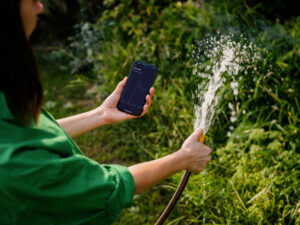
Water damage is a prevalent and costly home disaster, with the average claim exceeding $10,000. Yet, many homeowners are still vulnerable to this silent threat. At Bluebot, we recognize that early detection is the cornerstone of preventing catastrophic water damage. This is why we’ve developed a comprehensive guide to smart water leak sensors, emphasizing their crucial role in early detection and prevention.
In this all-encompassing article, we’ll delve into the workings of these innovative devices, compare the various types available, and guide you in finding the perfect solution for your home’s unique needs. Whether you’re a smart home enthusiast or simply looking to safeguard your property, you’ll find everything you need to know about implementing an effective water leak detection system.
What is a Water Leak Sensor?
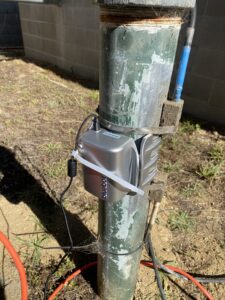
A water leak sensor is a device designed to detect unwanted water presence in your home and alert you before significant damage occurs. These sensors serve as an early warning system, monitoring for leaks around appliances, fixtures, and plumbing systems that could potentially cause serious water damage.
Basic Function and Purpose
At their core, water leak sensors have one primary goal: to detect water where it shouldn’t be and notify you immediately. This early warning can mean the difference between a simple fix and thousands of dollars in damage. Modern smart water leak sensors go beyond basic detection, offering:
- Real-time notifications sent directly to your smartphone
- Integration with smart home systems for automated responses
- Historical data tracking to identify patterns and potential problem areas
- Temperature and humidity monitoring to prevent freezing pipes and mold growth
How Smart Leak Sensors Differ from Traditional Systems
Traditional water alarms have existed for decades, typically as standalone devices that emit a loud sound when water is detected. While better than nothing, these basic alarms have significant limitations:
- They only alert you if you’re within hearing range
- They provide no remote notification if you’re away from home
- They can’t automatically take action to mitigate damage
- They lack data collection capabilities for preventive analysis
Smart water leak sensors overcome these limitations by connecting to your home network and leveraging advanced technology. As Bluebot’s water leak detection system demonstrates, modern sensors can monitor your entire water system continuously, sending alerts to your phone and even integrating with automatic shutoff valves to prevent damage when leaks occur.

Types of Water Leak Sensors
Water leak detection technology has evolved significantly, offering various approaches to protecting your home. Understanding the differences between these technologies will help you select the right system for your needs.
Standalone Point Sensors
What they are: Small, battery-powered devices placed in specific locations where leaks are likely to occur.
How they work: These sensors contain metal probes or contacts that detect water presence. When water bridges these contacts, it completes an electrical circuit, triggering an alert.
Best applications:
- Under sinks and around toilets
- Near washing machines and water heaters
- Under refrigerators with water dispensers
- Around HVAC condensate lines
Limitations:
- Only detect water that physically reaches the sensor
- Require multiple units for comprehensive coverage
- May miss leaks occurring away from sensor placement
Water Sensing Cables/Rope Sensors
What they are: Flexible cables that can be routed around water-using appliances or along perimeters.
How they work: These specialized cables contain conductive elements that detect water along any point of their length, triggering an alert when moisture is detected.
Best applications:
- Around water heaters and washing machines
- Along basement perimeters
- Under dishwashers and refrigerators
- Around sump pumps
Limitations:
- Higher cost than point sensors
- Limited by cable length
- Still require physical contact with water
Flow-Based Sensors (Like Bluebot)
What they are: Sophisticated devices that monitor water flow throughout your entire plumbing system.
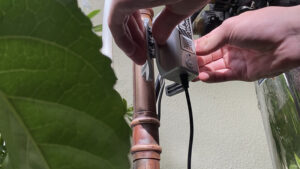
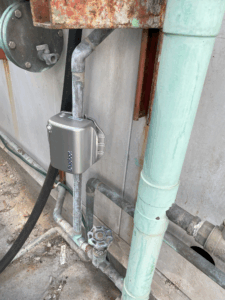
How they work: Unlike contact-based sensors, flow meters like Bluebot’s water leak detector clamp onto your main water line and use ultrasonic technology to monitor water usage patterns in real-time, identifying abnormal flow that could indicate a leak.
Best applications:
- Whole-home protection
- Detection of hidden leaks in walls or underground
- Vacation homes or properties with intermittent occupancy
- Monitoring flow patterns and water usage
Advantages:
- Can detect leaks anywhere in your plumbing system, not just at sensor locations
- Provides data on water consumption and usage patterns
- Capable of detecting very small leaks before visible damage occurs
- Can integrate with automatic shutoff systems
Bluebot’s flow-based system stands out for its ability to detect leaks throughout your entire water network from a single installation point. Unlike simple moisture sensors that only detect water after it has pooled, our ultrasonic technology can identify abnormal water flow patterns that indicate a leak might be occurring behind walls, under floors, or in other hidden areas.
Hybrid Systems
What they are: Comprehensive protection solutions that combine multiple sensor types.
How they work: These systems integrate flow monitoring at the main water line with strategically placed point sensors around the home for comprehensive protection.
Best applications:
- Homes with multiple potential leak sources
- Properties with both modern and legacy plumbing
- Maximum protection with redundant detection methods
Key Features to Look for in a Leak Sensor
When evaluating water leak sensors for your home, consider these essential features to ensure you get the protection you need:
Alert Capabilities
The most important aspect of any leak sensor is how it notifies you when a problem is detected. Look for:
- Push notifications: Immediate alerts sent to your smartphone
- Email alerts: Documentation of when issues occur
- Audible alarms: Local notification for anyone in the home
- Text message alerts: Reliable notifications even with spotty internet
- Customizable thresholds: Ability to set sensitivity levels to reduce false alarms
Bluebot’s system delivers robust alert capabilities with customizable parameters. As noted on our website, “Bluebot allows you to customize your alerting parameters, enabling you to receive alerts according to your definition of a leak. You can set thresholds for flow rate or usage and choose the type of notification you prefer.”
Connectivity Options
How your sensor connects to your network and other smart devices is crucial:
- Wi-Fi: Direct connection to your home network for reliable alerts
- LoRa/LoRaWAN: Long-range wireless communication ideal for remote areas
- Bluetooth: Direct connection to your smartphone when in range
- Hub-based systems: Central connection point for multiple sensors
Bluebot offers versatile connectivity options, including Wi-Fi for direct connection and LoRa technology for extended range. As our website explains, “By leveraging LoRa long-range telemetry, no Wi-Fi is needed at the water meter install location. Wi-Fi versions are also available.”
Power Source Considerations
The way your sensor is powered affects its reliability and maintenance requirements:
- Battery-powered: Offers placement flexibility but requires regular replacement
- Hardwired: Eliminates battery concerns but may limit placement options
- Battery backup: Ensures protection during power outages
- Long battery life: Reduces maintenance frequency
Smart Home Integration
Modern leak sensors should work with your existing smart home ecosystem:
- Voice assistant compatibility: Integration with Alexa, Google Home, or Siri
- IFTTT support: Create custom automated responses
- Smart home platform integration: Works with systems like SmartThings or Home Assistant
- API access: Allows for custom integration with other systems
Data Monitoring and Analysis
Advanced systems provide insights beyond simple leak detection:
- Usage tracking: Monitor water consumption patterns
- Historical data: Identify trends and potential issues
- Cost estimation: Translate water usage into projected utility costs
- Comparative analysis: Benchmark your usage against similar households
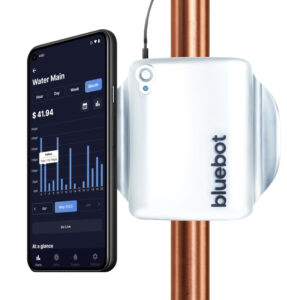
Bluebot’s remote water monitoring system provides comprehensive data analysis through its dedicated mobile app and web dashboard. Users can track historical usage, set budgets, and even “Dollarize™” their water usage by converting gallons to dollars based on local utility rates.

Where Should You Place Leak Sensors in Your Home?
Strategic placement is crucial for maximizing the protection offered by your water leak sensors:
High-Risk Areas
These locations should be your top priority for sensor placement:
Water Heater
Water heaters are among the most common sources of catastrophic leaks, especially as they age. Place sensors around the base of the unit and near pressure relief valves.
Washing Machine
The high-pressure hoses connected to washing machines are prone to failure. Position sensors beneath supply lines and around the machine’s perimeter.
Dishwasher
Hidden leaks from dishwashers can damage flooring and cabinets before becoming visible. Place sensors in the cabinet beneath the unit.
Toilets
Failing wax rings and leaking supply lines can cause significant damage over time. Position sensors around the base of each toilet.
Under Sinks
Both kitchen and bathroom sinks are high-risk areas. Place sensors in cabinets beneath plumbing connections.
Secondary Protection Zones
These areas also benefit from monitoring:
Refrigerator Water Lines
Water lines to ice makers and dispensers can leak undetected. Place sensors beneath refrigerators with water connections.
HVAC Systems
Condensate lines and drain pans can overflow. Position sensors near air handlers and condensate pumps.
Basement Perimeters
External water intrusion often occurs along basement walls. Place sensors or water sensing cables along perimeter areas.
Utility Room
Multiple water connections make this area vulnerable. Place sensors near utility sinks, water softeners, and filtration systems.
Flow-Based Sensor Placement
If you’re using a flow-based system like Bluebot’s, proper installation is essential for accurate monitoring:
- Main Water Line: Install on the incoming water supply after the meter but before any branch lines
- Clean, Straight Pipe Section: Ensure at least 4 inches of straight, unobstructed pipe for optimal performance
- Accessibility: Position for easy access if maintenance is needed
- Power Source: Ensure power outlet availability for the device
Bluebot’s smart water meter is designed for easy installation on various pipe types and sizes. As noted on our website, “Bluebot adjusts itself to fit eighty (80) pipe size and type combinations. It does this through patented Robot AI serving guided by the mobile App and Bluebot smart flow cloud during commissioning.”

Integration with Smart Home Systems
Modern water leak sensors can become an integral part of your smart home ecosystem, offering enhanced protection through automation:
Popular Smart Home Platforms
Water leak sensors can integrate with various smart home systems:
- Amazon Alexa: Voice control and alerts through Echo devices
- Google Home: Integration with Google’s ecosystem and voice assistants
- Apple HomeKit: Seamless operation with Apple devices
- Samsung SmartThings: Centralized control and automation capabilities
- Home Assistant: Open-source platform for advanced customization
Automation Possibilities
Smart integration enables powerful automated responses:
- Automatic Water Shutoff: Trigger smart water valves to close when leaks are detected
- Smart Lighting Activation: Turn on lights to guide you to the leak location
- HVAC Control: Turn off systems that might be causing condensation issues
- Custom Notifications: Send different alerts to different family members
- Remote Monitoring: Check system status when away from home
Real-World Automation Examples
Consider these practical applications of smart leak sensor integration:
- Vacation Protection: When your home is in “away” mode and a leak is detected, automatically shut off the main water supply and send alerts to both you and a trusted neighbor.
- Freeze Prevention: When temperature sensors detect readings approaching freezing, activate smart thermostats to warm vulnerable areas and prevent pipe bursts.
- Maintenance Reminders: Set up automated maintenance reminders based on water usage patterns, such as water heater flushing or washing machine hose inspections.
- Water Conservation: Receive alerts when water usage exceeds normal patterns, helping identify potential waste sources.

Cost Comparison: Sensors vs. Water Damage Repair
Understanding the financial implications of water leak detection systems versus the potential cost of water damage repairs makes the investment decision clearer:
Typical Sensor Costs
The price of leak detection systems varies based on type and capabilities:
- Basic Point Sensors: $15-50 per sensor
- Smart Point Sensors: $50-100 per sensor
- Water Sensing Cables: $70-150 depending on length
- Flow-Based Metering Systems: $300-700 for whole-home protection
- Automatic Shutoff Systems: $500-1,000+ for integrated detection and shutoff
Bluebot’s smart water meter represents an excellent value proposition, offering whole-home protection without requiring professional installation or pipe cutting.
Water Damage Repair Expenses
The costs associated with water damage can be staggering:
- Average Insurance Claim: $10,000+
- Flooring Replacement: $7-25 per square foot
- Drywall Repair: $40-100 per panel
- Mold Remediation: $2,000-6,000 for an average-sized area
- Structural Repairs: $10,000-30,000+ for significant damage
- Personal Property Loss: Often irreplaceable or only partially covered by insurance
Hidden Costs of Water Damage
Beyond direct repair costs, water damage includes many hidden expenses:
- Increased Insurance Premiums: Claims often lead to higher rates
- Temporary Relocation: Hotel costs during extensive repairs
- Lost Work Time: Time off needed to manage repairs
- Health Impacts: Respiratory issues from mold exposure
- Decreased Property Value: History of water damage can impact resale value
Return on Investment
When viewed as an investment, water leak sensors offer compelling value:
- Prevention vs. Reaction: A few hundred dollars in prevention can save thousands in repairs
- Insurance Discounts: Many insurers offer premium discounts for homes with leak detection systems
- Water Conservation: Identifying minor leaks can reduce water bills by 10% or more
- Peace of Mind: The intangible but valuable assurance that your home is protected
Insurance Benefits and Potential Discounts
Many homeowners are unaware that installing water leak detection systems can lead to insurance benefits:
Insurance Company Perspectives
Insurance providers increasingly recognize the value of leak detection:
- Risk Reduction: Insurance companies understand that early detection significantly reduces claim severity
- Data-Driven Assessment: Systems that track and document water usage provide valuable information for assessing risk
- Proactive Approach: Insurers reward homeowners who take preventative measures
Available Discounts
Many major insurers offer incentives for leak detection systems:
- Premium Reductions: Typically 3-15% off annual premiums
- Deductible Reductions: Some offer lower deductibles for water damage claims
- Installation Rebates: Partial reimbursement for system costs
- Free or Subsidized Devices: Some insurers provide sensors to policyholders
Documentation Requirements
To qualify for discounts, be prepared to provide:
- Proof of Purchase: Receipts for your leak detection system
- Installation Verification: Documentation that the system is properly installed
- System Specifications: Information about capabilities and features
- Ongoing Monitoring: Evidence that the system is active and maintained
How to Apply for Discounts
Follow these steps to maximize insurance benefits:
- Contact Your Insurer: Ask specifically about water leak detection discounts
- Compare Policies: Different insurers offer different incentives
- Document Your System: Maintain records of your installation
- Annual Review: Verify your discount is applied at policy renewal

Setup and Installation Tips
Getting the most from your water leak sensors starts with proper installation:
Point Sensor Installation
For standalone sensors, follow these best practices:
- Test Before Placing: Verify sensors work by touching water to contacts
- Clean Surfaces: Ensure placement areas are dry and free of debris
- Position Correctly: Place sensors with contacts firmly against the surface
- Check Signal Strength: Verify wireless sensors have adequate connection to hub or router
- Document Locations: Keep a record of where each sensor is placed
Flow Sensor Installation
For Bluebot’s flow-based system, follow these guidelines:
- Identify Optimal Location: Find a clean, straight section of your main water line
- Follow App Guidance: The Bluebot app provides step-by-step installation instructions
- Ensure Clean Surface: Clean the pipe surface thoroughly before attaching
- Check Connection: Verify the device connects properly to your network
- Configure Alerts: Set up appropriate thresholds based on your home’s water usage patterns
As noted on our website, “The Bluebot app provides step-by-step instructions, guiding you through selecting the best installation location, clamping the device onto the water line, and scanning for water flow.”
Troubleshooting Common Issues
Be prepared to address these frequent challenges:
- False Alarms: Adjust sensitivity settings or relocate sensors prone to false positives
- Connectivity Problems: Check network signal strength and consider range extenders if needed
- Battery Issues: Establish a regular schedule for checking and replacing batteries
- Alert Configuration: Fine-tune notification settings for optimal balance between awareness and annoyance
- Seasonal Adjustments: Water usage patterns change seasonally; update monitoring thresholds accordingly

Bluebot’s Comprehensive Water Monitoring Solution
While there are many leak detection options available, Bluebot’s system offers unique advantages through its advanced ultrasonic flow monitoring technology:
Advanced Technology
Bluebot’s smart water meter utilizes sophisticated technology that sets it apart:
- Ultrasonic Transit-Time Technology: Measures water flow without cutting into pipes
- Patent-Protected Design: Proprietary technology ensures accurate measurement
- Self-Adjusting Capability: Automatically calibrates to various pipe types and sizes
- High-Resolution Data: Captures detailed flow information for precise analysis
Key Benefits of Bluebot’s System
Our approach to water leak detection delivers significant advantages:
- Non-Invasive Installation: Clamps onto existing pipes without cutting or professional installation
- Whole-Home Protection: Monitors your entire water system from one device
- Real-Time Monitoring: Continuous data streaming and instant alerts
- Customizable Alerts: Define what constitutes a leak based on your usage patterns
- Historical Data Analysis: Track trends and identify potential issues before they become problems
Who Benefits Most from Bluebot
While valuable for all homeowners, our system is particularly beneficial for:
- Vacation Homeowners: Monitor water usage remotely to detect issues when you’re away
- Large Properties: Single-point monitoring for extensive plumbing systems
- Older Homes: Early detection of issues in aging plumbing
- Smart Home Enthusiasts: Integrate water monitoring into your connected home ecosystem
- Conservation-Focused Households: Track and optimize water usage to reduce consumption
Getting Started with Bluebot
Ready to protect your home with advanced water leak detection? Here’s how to begin:
- Select Your Model: Choose from Wi-Fi or LoRa connectivity options based on your home’s setup
- Easy Installation: Follow our guided setup process with no plumbing modifications required
- Configure Alerts: Set custom thresholds based on your water usage patterns
- Monitor and Analyze: Use our intuitive app to track usage and stay alert to potential issues

Conclusion
Water leak sensors represent one of the most valuable investments you can make in protecting your home. From preventing catastrophic damage to providing peace of mind when you’re away, these smart devices deliver protection that far exceeds their cost.
As water damage remains one of the most common and expensive home insurance claims, implementing an effective detection system isn’t just smart—it’s essential. Whether you choose point sensors for specific high-risk areas, sensing cables for broader coverage, or a comprehensive flow-based system like Bluebot’s, you’re taking a crucial step toward safeguarding your property.
Bluebot’s innovative approach to water monitoring combines the best of modern technology with user-friendly design, offering protection that extends throughout your entire plumbing system from a single installation point. By detecting abnormal water flow patterns before visible damage occurs, our system provides the earliest possible warning of potential issues.
Don’t wait until after a leak has caused thousands in damage to think about protection. Invest in smart water leak sensors today and enjoy the confidence that comes from knowing your home is protected against one of its most common threats.
Shop our recommended water leak sensors or schedule a smart home water protection consultation to learn more about how Bluebot can help protect your home from costly water damage.