Bluebot vs Flume: Choosing a Smart Water Meter
Bluebot and Flume both install in minutes with no plumber, and both send leak alerts and water usage to your phone. After that they diverge. Flume straps a battery sensor onto your utility’s water meter and reads the magnetic field as the meter spins. Bluebot is a smart water meter in its own right. It clamps onto the pipe and measures the water directly with ultrasonics. Flume reads a meter. Bluebot is one. That one difference decides where each device works, what it can actually measure, and whether it survives the day your utility swaps your meter.
Table of Contents
Flume reads a meter someone else installed. Bluebot measures your water directly
Flume reads a meter someone else installed. Bluebot measures your water directly.
Flume’s sensor sits on top of your utility’s water meter and interprets the magnetic field that shifts as the meter turns. It’s a clever trick, and it only ever works as well as the meter beneath it. It can also measure just one thing: whatever that single meter sees, which is total water into the home, at the street, in one fixed spot.
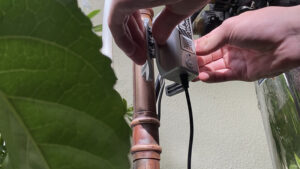
Bluebot measures the water itself. It clamps to the outside of the pipe and reads flow through the pipe wall with transit-time ultrasonics, on more than 80 pipe types and sizes, calibrating to whatever pipe it’s on. Say your water bill spikes and you don’t know why. Bluebot can sit on the cold supply to your bathrooms, the hot water branch off your heater, or the kitchen line, so you know exactly which one is the problem. Flume gives you one number for the whole property. Bluebot tells you which line it’s coming from. The how Bluebot works page walks through the full setup.
Bluebot meters where you want; Flume meters where the utility put the meter
Because Flume reads the utility meter, it lives in one place and reports one number: total water into the home. You can’t aim it at an irrigation branch, a single tenant’s line, a hot-water line, a well, or a commercial run, because none of those is the utility meter.
Bluebot goes wherever there’s an accessible pipe. If you want coverage across multiple lines, the Mini is made for that, running one on the main, one on irrigation, one per tenant line, and every reading lands in FloDash under one login. It’s the same idea as Sonos: separate devices under one system.
Not sure which model fits your pipe? Find My Bluebot sorts it out in two questions.
Why Bluebot keeps working when your utility upgrades its meters
They only function by reading your utility’s meter, and that meter is utility property. Some water companies have ordinances that limit your ability to open the meter box or attach a device to the meter, which is why their device tells customers to check with their local water company before installing one. They also keep a published list of the agencies that have certified its device for use on their meters, so in plenty of places it isn’t pre-approved and you have to ask first.
The bigger catch is mechanical. Magnetic sensors read the magnetic field of a spinning meter, so it can’t read a meter that has no moving parts. In their own words, the device “is incompatible with any ultrasonic or multijet meters”. Utilities across the country are now replacing old mechanical meters with ultrasonic AMI meters, and when they do, magnetic censors stops working.
That’s not a hypothetical. AMI rollouts are happening now, and most customers don’t find out their Flume is incompatible until it stops reporting. There’s no firmware fix or adapter. The sensor physically cannot read the new meter type. The device you installed and relied on for leak detection becomes obsolete the day the utility crew leaves your street.
- The Alameda County Water District tells customers their Flume devices aren’t compatible with the ultrasonic meters it’s installing and have to come off before the upgrade (ACWD), as of June 2026. For those customers, that means a device they bought, set up, and trusted for leak detection is now sitting in a box. Not because it broke, but because the infrastructure it depended on changed underneath it.
- North Coast County Water District went a step further in a July 2025 notice: its installers will physically remove each customer’s Flume during the meter swap and leave it on the doorstep, because the new meters “will no longer be compatible with the Flume device” (NCCWD notice).
Bluebot reads the pipe, not the meter. It doesn’t sit on utility property, doesn’t rely on a magnetic field, and doesn’t care whether your utility runs a mechanical meter, an ultrasonic meter, or no utility meter at all- it just needs access to your main pipe, and pipe branches. When the utility crew shows up to modernize the street, your Bluebot keeps measuring. See how it works.
Flume needs a compatible utility meter; Bluebot needs a pipe
Their device says it works with about 95% of homes, which is real coverage for ordinary single-family houses. The flip side of that number is every home where it doesn’t: a meter it can’t read, a property on a private well with no utility meter, or any case where the thing you want to measure isn’t the street meter.
Bluebot doesn’t depend on your utility meter or its type. It reads the pipe, so it works on wells, private systems, irrigation lines, and sub-lines that have no meter of their own. The water has to flow through a pipe. That’s the only requirement.
Only an independent meter can check the utility
They read the same meter the utility bills from, so its numbers match your bill closely. That’s handy for tracking, and it’s also the ceiling: a device reading the utility’s instrument can’t tell you that instrument is wrong. Bluebot measures on its own, separate from the street meter. That independence is exactly what lets one Bluebot exposed a $13,000 billing error and almost six years of overbilling at a single property.
Flume inherits the meter's error
Flume’s sensor talks to a Bridge over radio, and the Bridge needs your home Wi-Fi. On a property with no Wi-Fi, Flume has nothing to connect to.
Bluebot runs on Wi-Fi, and the ProLink models add long-range LoRaWAN with optional 4G cellular. Bluebot’s LoRaWAN model reaches up to about 2 km in urban areas and up to 5 km with clear line of sight (Bluebot Model 100-RF-WAN spec sheet). A Bluebot reports from places no home network touches, whether that’s a remote utility site, an irrigation system, a building with obstructions, or a meter sitting in a faraday cage.
Connectivity: Bluebot connects anywhere. Wi-Fi only versus Wi-Fi, LoRaWAN, and cellular
Flume’s sensor talks to a Bridge over radio, and the Bridge needs your home Wi-Fi. On a property with no Wi-Fi, Flume has nothing to connect to.
Bluebot runs on Wi-Fi, and the ProLink models add long-range LoRaWAN with optional 4G cellular. Bluebot’s LoRaWAN model reaches up to about 2 km in urban areas and up to 5 km with clear line of sight (Bluebot Model 100-RF-WAN spec sheet). A Bluebot reports from places no home network touches, whether that’s a remote utility site, an irrigation system, a building with obstructions, or a meter sitting in a faraday cage.
Can it sub-meter units or tenants? One home, or a whole portfolio
Flume is built for a single home, and it can’t sub-meter the units in a building, because it reads one utility meter and that meter covers the whole property. Bluebot runs from one house up to hundreds of sites through its FloDash dashboard, where a manager reads every meter from one login and sub-meters water by unit for fair tenant billing. Utilities and large operators use it to read remote sites without sending a truck. The Commercial program is built around those cases.
Reading water as dollars instead of gallons
Flume shows you gallons. Bluebot can show you dollars through Dollarize, turning flow into the cost it’s adding to your bill as it happens. People don’t budget in gallons. A running toilet that reads as money is the one that actually gets fixed.
Maintenance: Flume needs upkeep, Bluebot doesn't
Flume’s sensor runs on replaceable AA lithium batteries, rated at roughly one and a half to three years and often shorter in a hot or cold meter pit. When they run down, you get an email, you order and swap them, and then you have to recalibrate the sensor in the app, or it won’t report accurately. The reading also depends on a clean contact with the meter glass, so dirt or debris between the sensor and the meter face has to be kept clear (Residential Tech Today, 2021)
That maintenance cycle is manageable in a clean indoor install. In a curbside meter pit, wet, cramped, and exposed to temperature swings, it’s a different job. Batteries drain faster in the cold, dirt builds up on the meter glass, and nobody wants to crouch over a sidewalk vault to recalibrate an app.
Bluebot is USB-C powered, with no batteries to replace and nothing to wipe down. Plug it in once and leave it.
Every battery swap breaks the seal that keeps water out
Flume’s sensor is sealed against moisture, but that seal only holds until the first time you open it. Changing the batteries means unlatching the case, and Flume’s own instructions tell you to pull the device off the meter, carry it indoors, and clean and dry it before you crack it open. Their warning is blunt: if dirt gets on the seal and the sensor doesn’t close back up right, “there is a high chance moisture will get into the sensor,” which damages it.
That’s a hard seal to keep clean where Flume actually lives. A curbside meter pit is wet, and Flume says as much itself: pits with metal lids and pits that fill with water drain the batteries faster. So you open the case more often, in a damper spot, each time trusting a rubber gasket to reseat against grit and film.
And water on battery contacts doesn’t wait. Once moisture reaches the terminals it starts corroding them, and the lithium salts inside the cells react with any water present to form hydrofluoric acid, which eats the metal faster. It gets worse in a box that keeps swinging between cold nights and warm afternoons. Every time the humidity inside climbs past about 60%, water condenses on the cool surfaces of the enclosure, so a case that reads as shut is still sweating onto the wiring. The corrosion doesn’t announce itself. It shows up as a sensor that quietly stops reporting.
Bluebot never opens. It’s sealed at the factory and runs on USB-C, so there’s no battery door to unlatch and no gasket to reseat every couple of years.
Bluebot vs Flume at a glance
Bluebot vs Flume at a glance
Feature | Bluebot | Flume | Why It Matters |
|---|---|---|---|
Product type | Smart water meter (clamps on, measures flow directly) | Monitor that reads your utility’s meter | You own the meter, so the data is yours. The utility can’t limit it, cap it, or shut it off. |
What it measures | Flow through the pipe wall, transit-time ultrasonic | Magnetic field of your existing meter | It measures the water in your pipe directly, so accuracy doesn’t ride on how old or worn your utility’s meter is. |
Independent of the utility meter | Yes | No (it reads that meter) | The only way to independently verify what your water bill is. |
Keeps working after a utility ultrasonic/AMI meter upgrade | Yes | No (Flume is incompatible with ultrasonic meters) | Water companies everywhere are swapping old meters for new digital ones, and that swap can leave Flume dead. Bluebot keeps working. |
Needs utility permission to attach | No (clamps to your own pipe) | Sometimes (utility ordinances; Flume says check first) | Nothing to ask permission for. It clamps to your pipe, not the utility’s meter. |
Install | Clamp on any accessible pipe, minutes | Strap sensor to meter, plus a Wi-Fi bridge | No plumber, no shutting off the water, and no recalibrating. It’s on in minutes. |
Power | USB-C powered | Battery-powered sensor, batteries to replace over time | No battery means nothing to replace. |
Placement | Any pipe, 3/4″ to 2″, up to 4″ with Prime | Only the utility meter, whole-home | Put it on almost any pipe you want, not just wherever the utility meter happens to sit. |
Compatible meter required | No, it reads the pipe | Yes (Flume cites ~95% of homes) | As water companies switch to newer meters, Flume works on fewer and fewer homes. Bluebot isn’t affected |
Connectivity | Wi-Fi, LoRaWAN, optional 4G cellular | Bridge to home Wi-Fi; no cellular | Works far from the house where Wi-Fi drops out. Flume stops the moment it loses the home network. |
Works with no Wi-Fi on site | Yes (LoRaWAN / ProLink) | No | Reports from up to 5 km away in the open, and walls or distance won’t kill the signal. Flume can’t connect at all without home Wi-Fi. |
Meter where you choose (irrigation, unit, well, kitchen vs. bathroom) | Yes | No, reads the utility meter only | A single whole-house number can’t tell you which pipe is leaking. Bluebot points you to the exact line. |
Sub-meter tenants / multi-site | Yes (FloDash, hundreds of devices) | No (one utility meter per home) | Bills each unit for what it actually used, instead of guessing or splitting the bill evenly. |
Catches utility billing errors | Yes (independent reading) | No (mirrors the utility meter) | The only way to catch it when the utility’s meter is overcharging you. |
Water shown in dollars | Yes (Dollarize) | No | Shows your water in dollars, not gallons, so you know what a leak is actually costing you to ignore. |
Best fit | Homes, businesses, utilities, multi-site portfolios | Single-family home with a compatible mechanical meter | Allows flexibility on where you can install the meter. |
Ongoing maintenance | None (USB-C powered, no batteries, nothing to clean) | Replace proprietary batteries, then recalibrate in the app; keep the meter face clear | Flume’s compatibility list shrinks as utilities modernize. |
Flume details come from Flume’s public help center, pricing, and product pages, and from water-agency notices; see Sources below. Compare the full Bluebot lineup on the comparison charts.
Bluebot vs Flume FAQ
Flume reads your existing utility meter from one spot and fits most standard houses with a compatible mechanical meter. Bluebot is its own meter that clamps to any pipe, measures independently, scales to buildings and utilities, and keeps working when your utility swaps out its aging mechanical meter for a smart ultrasonic one. If you want a meter you can put anywhere, trust to read independently, and expand across a building or portfolio, Bluebot does more.
Flume doesn’t attach to a pipe. It straps to your utility meter and needs a compatible one, which Flume puts at about 95% of homes. Bluebot clamps to the pipe itself, from 3/4-inch up to 4-inch with Prime, so it also works on wells, irrigation lines, and spots Flume can’t reach.
No. Both are DIY and go in within minutes, no cutting and no shutoff. Bluebot clamps to the pipe; Flume straps to the meter, if your utility allows a device on it.
Flume’s Bridge needs home Wi-Fi, so a property without it is out. Bluebot’s ProLink meters use long-range LoRaWAN with optional 4G cellular and report from sites with no Wi-Fi at all.
Bluebot is built for it. FloDash manages hundreds of meters from one account, and you can sub-meter water by unit for fair tenant billing. Flume reads one utility meter per home, so it can’t separate usage by unit. The Commercial program covers property managers and utilities.
Find the Bluebot smart water meter that fits your pipe
If you want a smart water meter you can clamp on any pipe, one that measures independently, runs without Wi-Fi, scales from your house to a whole portfolio, and keeps working after your utility modernizes its meters, start with Find My Bluebot and answer two quick questions. You can also see how it works, compare every Bluebot model, or reach the team through the Commercial program.