A water submetering system measures water consumption for each individual unit, tenant, or zone inside a multi-unit property that the utility serves through a single master meter. The master meter still produces one building-level bill. Submeters tell you who used what behind it. That distinction is what turns water from an uncontrolled operating expense into a line item you can measure, allocate, and manage, and it is why submetering has become standard practice across apartment communities, condominium associations, and multi-tenant commercial buildings. The current generation of clamp-on ultrasonic water meters reads flow from outside the pipe, so a multifamily property can add unit-level water metering without cutting plumbing, shutting off water, or sending anyone around with a clipboard.
Key facts
What a submeter does | Measures actual water use per unit behind one master meter |
The measured alternative it replaces | RUBS, which allocates the bill by a formula instead of measuring |
Documented savings | 15.3 percent less water than water-in-rent properties (EBMUD and Aquacraft, 2004) |
Rate pressure | Combined U.S. water and sewer bills rose 5.1 percent between 2024 and 2025 (Bluefield Research, 2026) |
Two install methods | Cut-in mechanical meters, or clamp-on ultrasonic meters that never touch the water |
Typical clamp-on install | About 10 minutes per meter, no pipe cutting, no shutoff, no plumber |
Before you bill | Submetered billing is regulated at state and local level. Verify your jurisdiction first. |
What Is a Water Submetering System?
A water submetering system is the metering layer that sits between a building’s master meter and its occupants. The utility bills the property owner once, for everything that crossed the master meter. A water submeter measures what each unit actually drew, so that single bill can be divided by measurement instead of by assumption.
The alternative most properties start from is a ratio utility billing system, usually shortened to RUBS. A RUBS formula splits the master meter bill by occupancy, square footage, bedroom count, or a blend of those. It is cheaper to set up because it needs no hardware. It also measures nothing. A resident who runs a running toilet for six weeks pays the same share as the neighbor who does not, which is both the fairness complaint and the conservation problem in one.
That difference is not a matter of opinion. The most-cited study on the question, the National Multiple Family Submetering and Allocation Billing Program Study run by the East Bay Municipal Utility District and Aquacraft in 2004 and funded in part by the U.S. Environmental Protection Agency, the National Apartment Association, and the National Multi Housing Council, found that submetered properties used 15.3 percent less water than properties that include water in the rent, about 21.8 gallons per day per unit. The same study found that allocation billing produced no statistically significant reduction in water use at all. Measurement changed behavior. A formula did not.
Why Submetering Changes the Economics of a Multi-Unit Property
Two things have made this a live decision rather than a background one.
The first is price. Bluefield Research’s U.S. Municipal Water and Sewer Rate Index, published in March 2026, records that combined household water and sewer bills across 50 benchmarked U.S. cities rose 5.1 percent between 2024 and 2025, ahead of inflation, with water rates up 6.0 percent and wastewater up 4.8 percent. Over five years the index shows a 24.2 percent cumulative increase. On a master-metered building, every one of those increases lands on the owner’s operating expense line, and on net operating income, with no counterweight.
The second is visibility. A master meter tells you what the building used, not which riser, which unit, or which irrigation zone moved the number, and it tells you nothing until the bill arrives. Per-unit metering turns a monthly lump sum into a continuous signal, which is what makes leak detection possible at all. A steady overnight flow on a line that should be idle is a recognizable pattern, and catching it in hours instead of at the next billing cycle is the difference between a washer fitting and a ceiling.
Benchmarking has caught up too. The EPA’s WaterSense program and ENERGY STAR Portfolio Manager jointly publish a 1-to-100 Water Score for multifamily housing, released in October 2017, that rates a property’s water use against comparable buildings nationwide. It is available to properties with 20 or more units and needs a year of metered utility bills. If your ownership reports on sustainability performance, metered data is what makes that reporting possible.
What Types of Water Submetering Systems Are Available?
There are two families in the field, and they differ less in what they measure than in what they cost you to own. A multi-tenant building can be metered with either.
Mechanical submeters
Positive displacement and multi-jet meters have measured water for decades and measure it well. Both work by putting a moving element into the flow path and counting how much water passes through it. That design is proven, and it is also the source of its constraints. An inline meter has to be plumbed in, which means cutting the supply line, fitting shutoff valves, and taking the water off while the work is done. Moving parts in the flow path also wear, and an impeller design can foul with sediment over time. Mechanical submeters are commonly replaced on a 10 to 15 years cycle and typically need periodic accuracy verification.
The bigger operational cost is usually the reading. Unless the meter is paired with pulse-output or encoder-register infrastructure, someone has to read it every month, on foot or through a billing service. That is recurring labor, a recurring chance of transcription error, and a lag between the water being used and the bill being issued.
Clamp-on ultrasonic submeters
An ultrasonic water meter measures flow by timing sound pulses sent with and against the current and comparing the difference. That is transit-time ultrasonic technology, and because it reads through the pipe wall, a clamp-on ultrasonic meter never touches the water. There is nothing in the flow path to restrict it, nothing for sediment to foul, and no wear surface. That is the architectural argument for the technology, and it is the reason this is the practical route for an occupied building.
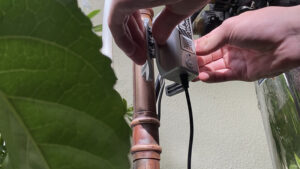
Bluebot builds clamp-on transit-time ultrasonic meters, and our clamp-on installation mounts on the existing pipe with no cutting, no shutoff, and no plumber. Typical installation time is approximately 10 minutes per meter using the Bluebot mobile app. Every meter is individually calibrated against NIST-traceable standards and ships with a Calibration Certificate recording its serial number, calibration date, and measured performance across the operating flow range.
Three non-invasive meter models cover the range a multi-unit property actually encounters:
- The 50-W (Bluebot Mini) fits 3/4 inch and 1 inch pipe, carries an IP68 environmental rating, reads flow from 0.3 GPM (1.1 L/min), and delivers 95 to 97 percent field flow accuracy. It connects over built-in 2.4 GHz Wi-Fi with no gateway. Note that the Mini supports a shorter list of pipe materials than the other two models: copper, PVC, PEX, and galvanized steel, but not CPVC, PE, or stainless steel.
- The 100-W (Bluebot Hero) covers 3/4 inch through 2 inch pipe in its Standard configuration, is rated IP65, resolves flow down to 0.1 GPM (0.38 L/min), and delivers 98 to 99 percent field flow accuracy. It uses built-in Wi-Fi and, like the Mini, needs no gateway.
- The 100-WAN (Bluebot ProLink) is the same sensing platform as the Hero and delivers identical flow measurement performance. The only difference is how it reports: LoRaWAN long-range wireless instead of Wi-Fi. Every ProLink installation requires a Bluebot Gateway.
For pipe above 2 inch, the Hero Prime and ProLink Prime variants reach 2-1/2 inch through 4 inch, which is the range most commercial mains and irrigation feeds sit in.
Two accuracy figures get quoted for ultrasonic meters and they are not interchangeable. Laboratory calibration accuracy, measured under controlled conditions, is 99 percent on the Mini and 99.7 percent on the Hero and ProLink. Field accuracy is the number to plan around: 95 to 97 percent on the Mini, 98 to 99 percent on the Hero and ProLink. Real performance varies with pipe material, pipe size, installation quality, available straight-pipe length, flow profile, water temperature, and operating conditions. Any vendor quoting only a laboratory figure is quoting the easier number.
How Do You Choose a Submetering System for Your Property?
Four inputs decide it, and only one of them is the meter.
Pipe. Measure the supply lines you intend to meter and note the material. Pipe size sets the model tier before anything else does, and straight-pipe length at the mounting point matters for a clamp-on meter, so identify the accessible runs early.
Connectivity. This is the input most properties underestimate. If reliable Wi-Fi already reaches every metering point, a Wi-Fi meter connects straight to the cloud with no extra infrastructure. If it does not, and in concrete-frame buildings, detached irrigation valve boxes, and garden-style campuses it frequently does not, LoRaWAN is the answer. Each Bluebot Gateway supports up to 100 ProLink meters, application dependent, with typical LoRaWAN range up to 1.2 miles (2 km) in urban environments and up to 10 miles (15 km) with clear line of sight, depending on terrain, buildings, vegetation, and antenna placement. The gateway backhauls over Ethernet, Wi-Fi, or optional 4G LTE, which is what lets a ProLink deployment work on a site with no usable building network.
Scale. Below roughly 20 metering points with good Wi-Fi, the Hero is the simplest thing that works. Above that, or on a multi-building property, one gateway serving many ProLink meters is usually cheaper and easier to administer across a portfolio than extending a wireless network to every riser.
Total cost of ownership, not hardware price. Compare the installed, five-year cost. A cut-in mechanical meter is cheaper as hardware and more expensive as a project, because it carries plumbing labor, shutoff coordination, and a monthly reading obligation. Traditional cut-in submeter retrofits are commonly quoted in the range of $300 to $800 per unit for labor, materials, and plumber coordination, and published industry guidance puts the wider band as high as roughly $1,500 per unit in complex retrofits. Treat any of those as a planning range to test against your own quotes, not as an established figure.
For reference, as of the August 2026 catalogue capture, the Bluebot Mini is $258.76, the Bluebot Hero is $558.34, and the Bluebot ProLink is $613.84, each including 12 months of prepaid premium data. A ProLink price on its own is incomplete: the required Bluebot Gateway is a separate purchase from $399.00 for the LG-63, so a working first-year ProLink installation starts at $1,012.84. See the full Bluebot lineup and gateway options together, and Bluebot for commercial and enterprise operations for multi-site deployments.
What Do Installation and Ongoing Monitoring Involve?
Installation is where the two technologies separate most sharply for an occupied property. Cutting a supply line means notifying residents, scheduling a shutoff that usually affects more than one unit, and accepting whatever the open pipe reveals about the plumbing behind it. Phased across a full property, that turns a hardware purchase into a multi-week construction project. A clamp-on meter mounts on the outside of the pipe instead, so maintenance staff can typically handle installation after basic training. That mechanism is the honest way to describe the cost difference, because the actual saving depends on your local labor rates and building layout.
Ongoing monitoring is the half of the system that RUBS never had. Bluebot meters report to the cloud continuously and surface in the FloDash(TM) web dashboard and the bluebot Water mobile app, with per-unit consumption, historical trends, and configurable alerts on abnormal or continuous flow. That data does the four jobs a property manager needs: defensible tenant billing, a leak alert while the leak is still cheap, identification of the high-consumption units worth a fixture upgrade, and real numbers to budget against instead of last year’s estimate plus a margin.
The data plan is worth understanding before you scale. The first year of premium data streaming is included in the meter price. From year two, continued premium streaming is optional at $4.98 per month, and renewal is not mandatory.
Bluebot meters detect and alert. They do not shut water off and they will not stop a failure on their own. Pairing the alert with a response plan is what converts the signal into avoided damage.
What Does Submetering Actually Return?
Published payback ranges for submetering are close to meaningless, because the answer is driven by inputs that differ by an order of magnitude between properties: your rate per gallon, your unit count, your current allocation method, and whether your jurisdiction lets you bill residents at all. Here is the calculation to run on your own numbers instead.
Start with the annual water and sewer spend on the master meter. Take a 200-unit apartment complex using 8 million gallons annually at a combined water and sewer rate of $0.008 per gallon. That is $64,000 per year in utility cost. Apply the 15.3 percent reduction the EBMUD and Aquacraft study measured and consumption spend falls by roughly $9,800. Apply a more aggressive 25 percent assumption, which some properties reach and many do not, and the saving is $16,000.
Then add the second, usually larger, term: cost recovery. Where local rules permit usage-based billing, the share of the bill you can pass through moves from an allocation estimate to a measured invoice. What that is worth depends on your leases and your jurisdiction, so calculate it from your own rent roll rather than a published average.
Against that, set the installed cost of the system, the reading and billing administration you avoid, and the leak losses you catch. On the last item Bluebot has one documented datapoint worth more than a projection: a single Bluebot meter exposed a $13,000 billing error, water a property had been charged for and never used. You can read that and other deployments in the Bluebot case studies. That outcome is not typical, promised, or repeatable on demand, but it is the kind of thing that only becomes findable once the water is measured.
What Do the Rules Require Before You Bill a Tenant?
This is the step properties skip, and it is the one with legal consequences. Billing a tenant for water is regulated, the rules differ materially by state and by municipality, and the following is general information rather than legal advice. Confirm your own position with local counsel before you invoice anyone.
Two examples show the range. In California, Senate Bill 7 requires water submeters in newly constructed multiunit residential and mixed-use buildings that applied for a new water connection on or after January 1, 2018, and it governs how an owner may bill a tenant for submetered service. The National Apartment Association’s 2018 summary describes the intent plainly: bills based on actual usage rather than estimation. In Texas, the requirement is procedural as well as technical. The Public Utility Commission of Texas requires an owner who intends to bill tenants for water or wastewater on a submetered or allocated basis to register the property first, under 16 Texas Administrative Code Chapter 24, Subchapter I and Texas Water Code Chapter 13, Subchapter M.
Several jurisdictions also restrict or condition allocated billing specifically, which can make individual unit metering the only lawful route to cost recovery. Others cap administrative fees, dictate what a bill must disclose, or bar passing common-area use to residents. None of that is nationwide, which is the point: check before you commit to a billing model, not after the meters are on the wall.
Where to Start
The practical sequence for a submetering program is short. Confirm what your jurisdiction allows. Walk the property and record pipe sizes, materials, accessible straight runs, and where a wireless signal actually reaches. Pick the connectivity path before you pick the meter. Then run the payback on your own rate, your own unit count, and your own utility cost recovery rules.
If clamp-on metering fits the building, the sizing mostly answers itself: good Wi-Fi coverage points to the Bluebot Hero, patchy or absent coverage points to the ProLink and a gateway, small-bore lines point to the Mini, and anything above 2 inch points to a Prime model. Call 1-888-258-4119 or email CX@bluebot.com to have the sizing checked against your own riser drawings before you buy.
Frequently Asked Questions
Is water submetering legal in every state?
No. Submetered billing is regulated at state and local level and the rules differ. California requires submeters in qualifying new multiunit construction under Senate Bill 7. Texas requires an owner to register with the Public Utility Commission of Texas before billing tenants. Confirm your own jurisdiction with local counsel.
How much does water submetering cost per unit?
It depends far more on the install method than on the meter itself. Traditional cut-in retrofits are commonly quoted between $300 to $800 per unit once plumbing labor and coordination are counted. Clamp-on ultrasonic meters cost more as hardware and less installed, because they need no plumber.
Can you submeter an occupied apartment community?
Yes. A cut-in mechanical meter needs a water shutoff that usually affects several units, so it is disruptive in occupied stock. A clamp-on ultrasonic meter mounts on the outside of the existing pipe in about 10 minutes, and residents keep their water on throughout.
Do water submeters need Wi-Fi in every unit?
No. The 100-W (Bluebot Hero) and 50-W (Bluebot Mini) use Wi-Fi and suit properties with reliable coverage at each metering point. Where coverage is patchy, the 100-WAN (Bluebot ProLink) reports over LoRaWAN to a Bluebot Gateway that supports up to 100 meters.