Renters insurance is a policy that covers your belongings, your personal liability, and your extra living costs if you are forced out of your home. It usually does cover water leak damage, as long as the leak was sudden and accidental. A supply line bursts overnight and soaks your mattress and laptop? That is what a renters policy is for.
What it will not pay for is water that crept in slowly, arrived from outside as a flood, or backed up through a sewer line. Your personal property coverage protects what you own. The walls, floors, and plumbing belong to your landlord. That one distinction, sudden versus gradual, decides most water damage claims.
That distinction is also why what you can prove matters: Bluebot clamps a meter onto the water line you can reach, with no cutting and no plumber, so you have a dated flow record of when the water started moving rather than an argument about it.
Key facts at a glance
- Covered: sudden, accidental damage to your belongings from an inside source. A burst pipe, a failed appliance hose, a ceiling leak from upstairs.
- Not covered: gradual leaks and slow seepage, neglect, outside flooding, and sewer backup without an endorsement.
- How common: water damage and freezing made up about 22.6% of home insurance claims in Insurance Information Institute (Triple-I) data (2026). The average claim runs about $15,400, and roughly 1 in 60 insured homes files one yearly.
- What renters pay: about $150 to $290 a year, per Triple-I and Forbes Advisor figures current as of 2026. Even so, only about 4 in 10 U.S. renters carry a policy.
- The two gaps to close: flood coverage (a separate policy, protecting renters’ belongings up to $100,000 through the National Flood Insurance Program) and a water backup endorsement (commonly $50 to $250 a year).
This guide is general education, not insurance advice. Policy forms, exclusions, deadlines, and appeal rights vary by policy and by state. Confirm details with your own documents, your agent, or your state Department of Insurance.
What Does Renters Insurance Cover for Water Leak Damage?
Renters insurance covers water damage that is sudden and accidental, and it pays for your belongings, not the building. According to coverage guidance published by carriers including GEICO (2026), a standard policy typically responds when a pipe ruptures without warning, an appliance hose fails, a washing machine overflows, or a fixture suddenly leaks from a covered peril.
Five situations come up most often:
- A burst pipe. If a supply line bursts and soaks your furniture, your renters insurance coverage may pay to repair or replace it, less your deductible.
- An accidental appliance leak. Damage from a failing washing machine or dishwasher is commonly covered. Knowing how much water a washing machine uses helps you notice when one starts misbehaving.
- A ceiling leak from upstairs. If a neighbor’s plumbing sends water through your ceiling, your policy may reimburse you for the belongings it ruins.
- Rain or ice after storm damage. You may be paid when rainwater gets in because a covered storm breached the building. Rising floodwater is different.
- Additional living expenses. If the damage makes your unit uninhabitable, additional living expenses coverage, also called loss-of-use or Coverage D, can pay for temporary housing.
Personal liability coverage is the piece renters most often overlook. If water starts in your unit, spreads downstairs, and ruins a neighbor’s things, your liability protection may answer the claim they file, subject to your limits.
What Water Damage Does Renters Insurance Not Cover?
The exclusions fall into four predictable groups.
Gradual leaks and slow seepage are typically excluded. A supply line dripping behind a cabinet for weeks is treated as a maintenance issue, not a sudden loss. Policies often word it as “continuous or repeated seepage or leakage over a period of time.” Learning the early signs of water damage in walls is your practical defense, because the exclusion turns on duration, not severity. A Bluebot meter on the line you can reach timestamps flow continuously, so if a claim turns on when the water started, you have a dated record instead of an argument.
Neglect is a separate basis for denial. Did you see a dripping fixture, a spreading stain, or moisture under the sink and do nothing? An insurer can argue you failed to take reasonable care.
Outside flooding sits entirely outside a standard renters policy. Floodwater from heavy rain, storm surge, or rising groundwater is excluded. Covering it takes a separate flood insurance policy through the National Flood Insurance Program or a private insurer.
Sewer and drain backup is also commonly excluded unless you add a water backup endorsement. This one catches people out. The damage looks identical, but the water came up through a drain rather than down from a pipe, which can put it outside your coverage. For the practical boundary, see our guide on how to stop a water leak.
Who Pays for What: Your Belongings, the Building, and Your Neighbor’s Unit
Your renters policy protects three things: your personal property, your personal liability, and your additional living expenses. The building is your landlord’s responsibility under their property insurance. That is the difference between renting and owning, covered in our guide to whether homeowners insurance covers water damage.
Here is the split. A pipe inside the wall fails, damaging the flooring and your belongings. Your contents coverage handles your belongings. Your landlord’s property insurance handles the flooring, the drywall, and the pipe.
When water crosses a unit boundary, responsibility gets decided, not assumed. Damage that starts in your unit and reaches the apartment below may trigger your liability coverage. An overflowing bathtub upstairs may trigger your neighbor’s instead. A failure in a common riser is usually a building matter. Document everything, report promptly, and let the claims process assign fault.
Why the Cause of the Leak Decides Your Claim
The source of the water matters more than the amount. Insurers look at how and where the water entered, whether the damage was sudden or slow, and whether you acted once the problem was visible.
A burst supply pipe is a sudden event. Rainwater through an open window generally is not. A dishwasher hose that fails abruptly may well be covered. The same hose, visibly cracking for months and never replaced, is far more likely to be called neglect. Water heaters cut both ways, so it helps to know what causes a water heater to leak before yours does.
Use a four-part test. Was the event sudden, accidental, internal to the building, and caused by a covered peril? Four yeses point toward coverage. Gradual damage, outside floodwater, or a known problem left alone all point the other way. Hidden leaks are hardest, since they are gradual by definition, so knowing how to find a water leak inside a wall and how to find a water leak in your house can decide whether a claim is paid. A Bluebot meter on that same line keeps the same dated flow record, so a hidden leak’s start time does not come down to a guess.
What Should You Do Immediately After Water Damage?
Acting fast protects your safety and your claim. These six steps apply no matter how small the damage looks. For the full claims walkthrough, see our step-by-step guide to making a successful water leak insurance claim.
Step 1: Notify your landlord immediately
Report the leak the moment you find it, especially if it involves shared plumbing or could reach other units. Prompt notice sets a clear timeline and shows you acted.
Step 2: Document everything before you touch it
Photograph and film the water source, the affected areas, and every damaged item. Take close-ups and wide shots, and leave your camera’s date stamp on. A Bluebot meter on the line adds a timestamped flow record to sit alongside those photos.
Step 3: Review your renters insurance policy
Check what your policy covers, what your deductible is, and which endorsements you carry. A water backup rider or replacement-cost coverage will change your outcome.
Step 4: File your claim promptly
Send your insurer the photos, a factual description, and any receipts. Deadlines vary by policy and state, and delay is a common reason claims get cut or denied.
Step 5: Mitigate further damage
Move belongings out of standing water, contain the moisture, and shut off the supply if you can do it safely. Most insurers reimburse reasonable costs if you keep receipts.
Step 6: Keep every record
Save receipts for cleanup, replacements, and temporary housing, and keep your written messages with your landlord and insurer. That paper trail is what supports an appeal.
Do Renters Need Flood Insurance or a Water Backup Endorsement?
Standard renters insurance leaves two real gaps. Price them rather than guess.
Flood insurance is a separate policy. Live near a coast or river, or anywhere with heavy seasonal rain, and your base policy leaves your belongings exposed. The National Flood Insurance Program (2026), run by FEMA, sells contents-only coverage built for renters. It protects belongings up to $100,000, and contents-only policies commonly start near $100 a year as of 2026, scaling with flood zone and value insured. Private flood coverage is also available.
A water backup endorsement costs less than most renters expect. It covers the sewer and drain backups your base policy excludes. Industry pricing compiled by Insurance.com (2026) puts it at roughly $50 to $250 a year. About $30 to $70 buys a $5,000 limit, and each extra $5,000 adds roughly $25 to $35. On a renters policy the cost often lands under $50 a year, with limits from $5,000 to $25,000.
Ask your agent about your building’s age, plumbing history, and flood zone. Those facts decide whether either add-on is worth it. Availability and pricing vary by state and carrier, so verify locally.
How a Bluebot Meter Helps Renters Catch a Leak Before It Becomes a Claim
The best protection is catching a problem early, which also keeps you clear of the gradual-damage exclusion.
Check the plumbing you can reach. Look under sinks, behind the toilet, and at the supply lines to your dishwasher and washing machine. Water stains, mineral crust, soft cabinet floors, or standing moisture are early warnings. Report them to your landlord the same day.
Knowing your normal water use helps you spot the abnormal. Washing machines are a leading source of renter water damage, and a failed supply hose can release hundreds of gallons in minutes. If your usage spikes for no reason, investigate. The same habit tends to save money on your water bill.
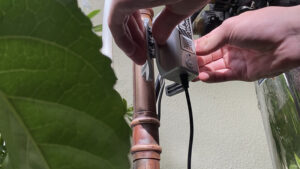
Real-time monitoring closes the gap your eyes cannot. Bluebot smart water meters clamp onto the line you can actually reach, under the sink, on the washing machine supply, on the dishwasher line, without cutting anything or calling a plumber. That is what lets them watch flow 24 hours a day on plumbing you do not own. When they see unusual or continuous flow, they alert your phone through the bluebot Water app. See how Bluebot’s monitoring works, or weigh it against other monitors in our Bluebot vs Flume comparison.
Want something compact? The 50-W Bluebot Mini is built for the 3/4-inch and 1-inch branch lines an apartment actually has, and catches flow as low as 0.3 GPM. As of 2026, Bluebot Mini starts at $258.76 with a year of Premium Data. Because it clamps on instead of cutting in, you are not altering your landlord’s plumbing, and it comes off and moves with you at the end of the lease. Put it on the washing machine or dishwasher supply line, or on the branch line under the sink, rather than the main. Tell your landlord what you are doing first: most say yes to a device that leaves no mark, and a written note is one more dated record if a claim ever turns on when the water started. One Bluebot uncovered a $13,000 water-billing error the same way. Because continuous monitoring shortens how long a leak runs before anyone knows, some insurers offer premium credits for it. Each carrier sets its own rules, so confirm with yours and check current rebates and insurance discounts. If you also manage irrigation, the same logic covers detecting a sprinkler leak early and finding a leak in a sprinkler system.
Understanding Water Damage Coverage Starts Before the Leak
Renters insurance covers sudden, accidental water damage from inside sources. It excludes gradual leaks, neglect, outside flooding, and sewer backup unless you add the right endorsements. The building is your landlord’s. Your belongings and your liability are yours. When damage happens, prompt reporting and thorough documentation move the outcome most.
The cleaner path is simple. Read your policy before you need it, price the two add-ons that close its gaps, and catch problems early. A Bluebot meter on the line you can reach watches your water around the clock and alerts you when something looks wrong, so you can act while it is still a drip. Because terms differ by policy and by state, treat this guide as a map, then verify with your carrier or your state Department of Insurance.
Frequently Asked Questions
Does renters insurance cover mold caused by a water leak?
Mold is typically covered only when it results from a sudden, accidental loss your policy already covers, such as a burst supply line you reported and dried promptly. Mold traced to a gradual leak, ongoing humidity, or a problem you knew about is usually excluded as maintenance. Many policies also cap mold remediation at a sub-limit well below the main coverage amount, so check that number in your own documents.
How long do I have to report water damage to my renters insurance company?
Most policies require prompt notice, and many insurers expect to hear from you within a few days of discovering the damage. The exact deadline is set by your policy language and your state, not by a universal rule, so confirm yours before you need it. Late reporting is one of the most common reasons a water damage claim gets reduced or denied outright.
Will filing a water damage claim raise my renters insurance rates?
It can. Insurers weigh your claim history when they set renewal pricing, and a paid water loss may affect what you pay next term. Whether it does, and by how much, varies by carrier and by state. For small losses it is worth comparing your likely payout against your deductible first, because a claim below or near your deductible often costs more in future premium than it returns.
Does renters insurance cover water damage if the leak was my fault?
Usually yes, provided the loss was sudden and accidental rather than the result of neglect. Leaving a tub running and flooding your unit is an accident, and personal property coverage generally still responds. What insurers push back on is damage from a problem you knew about and ignored, such as a fixture you watched drip for months. Intentional damage is never covered.
Does renters insurance cover a leaking roof in my apartment?
Your renters policy covers the belongings the water ruins, not the roof itself. The roof is part of the building, which sits under your landlord’s property insurance. If rainwater enters because a covered storm damaged the roof suddenly, your contents coverage may pay for your damaged property; if the roof has simply been failing for years, an insurer can treat the loss as gradual and deny it.
Who pays when a leak from my unit damages my neighbor’s belongings?
Your personal liability coverage is the part of your policy that responds when water originating in your unit damages someone else’s property. In practice your neighbor may claim on their own renters insurance first, and their insurer can then seek recovery from you or your carrier, a process called subrogation. Their deductible may come back to you as well, so report the incident to your insurer rather than settling privately.
What should I do if my renters insurance water damage claim is denied?
Ask for the denial in writing with the specific policy language behind it, then compare that wording against your documentation and timeline. Many denials turn on the sudden-versus-gradual question and can be reversed with dated photos, repair records, and a clear discovery date. If the insurer holds its position, you can escalate through its formal appeal process and then file a complaint with your state Department of Insurance.