Sprinkler leak detection, also called irrigation leak detection, is the job of finding hidden water loss in an irrigation system. You run one zone at a time, watch what it does, then confirm the result at the water meter.
This guide walks you through the whole routine. You will learn the warning signs and a seven-step check you can finish in an afternoon. You will also learn how to tell a broken head from a buried pipe break. And because a check you run twice a year cannot see the 6 cycles in between, you will learn how a Bluebot meter clamps onto the irrigation line, no cutting and no plumber, and watches it the rest of the time.
The scale of the waste is why this matters. EPA WaterSense (2026) reports that an irrigation leak just 1/32 of an inch wide, about the thickness of a dime, wastes roughly 6,300 gallons a month. It also finds that leaks waste more than 10,000 gallons a year in the average home.
Outdoors, the picture is bigger. U.S. homes use nearly 8 billion gallons a day on landscape watering. The agency estimates as much as half of that is lost to waste and overwatering.
A cracked pipe buried eight inches under the lawn does not announce itself. It shows up on the bill. Most systems run before dawn, on a timer, in corners nobody walks. That is why leaks hide for weeks.
Detection closes the gap. You compare what the system should use against what it really uses.
At a glance
- Time: 45 to 90 minutes for a normal home system
- Skill level: beginner to intermediate, and no digging is needed to diagnose
- Cost: $0 to do it yourself, or $150 to $400 for a pro visit
- When to run it: spring startup, then again at peak summer
- Stop point: call a pro before digging near a foundation, hardscape, or any utility line
What You Will Need Before You Start
Sprinkler leak detection needs very little hardware. Most of the tool list is already on the property.
- The irrigation controller, so you can start and stop each zone by hand
- Access to the water meter, usually at the curb or in a box near the street
- A lid key or flathead screwdriver to lift box lids and reach the manifold
- Flags, stakes, or marking paint to tag wet ground as you find it
- A phone or notepad for readings and zone notes
- Optional: spare heads and nozzles, so you can fix a clear failure on the spot
- Optional: a Bluebot smart water meter, clamped to the irrigation line, if you want the system watched between checks
Pick a dry window. Run this a day or two after rain and soggy ground means nothing. You will chase symptoms that are not leaks.
Warning Signs That Should Trigger a Leak Check
Evidence shows up in two places, and each tells you something different.
In the yard, look for soggy patches that stay wet after a cycle ends. Watch for pooling around a valve box. Look for washed-out soil along a trench line. Check for muddy runoff on a sidewalk or driveway.
Note any stripe of grass that is greener or taller than the lawn around it. Water follows the easiest path. A wet spot often sits downhill of the real break, not on top of it.
In how the system behaves, watch for low water pressure in one zone while the rest look fine. Look for a short throw on a rotor, or spray heads that mist instead of throwing a clean arc. Note any that fail to pop up, or that geyser off a snapped riser. Listen for hissing near the manifold when a zone is pressurized.
The money signal counts too. A summer bill spike of $50 to $200 or more, with no change in schedule or weather, is a strong clue that water is escaping.
What Causes Sprinkler System Leaks
Six failure modes explain most of what you will find.
- Cracked or broken heads. Sun, mowers, and foot traffic split the plastic. You get a drip, a crooked spray, or a head that will not retract.
- Worn zone valves. A diaphragm that no longer seats lets water seep past even when the zone is off. This is a common cause of a system that leaks while idle.
- Failed fittings. Glued joints break down and threaded ones work loose. They weep long before they burst.
- Roots and shifting soil. Roots crush or pierce PVC laterals. Clay soils swell and shrink, which stresses rigid joints until they crack.
- Freeze damage. Water left in the lines over winter expands and splits elbows, tees, and fittings. That is why cold-climate leaks show up at spring startup.
- Yard equipment strikes. Aerators and edgers reach shallow parts. A nicked line can weep for months before anyone notices.
How to Find a Sprinkler Leak: A Seven-Step Walkthrough
Work in order. Each step shrinks the search area, and the zone isolation test in Step 6 depends on what you record earlier. Skipping ahead usually costs time instead of saving it.
Step 1: Walk the yard with the system off
Do not turn anything on yet. Walk the whole property and look for standing water, sunken ground, mud, and cracked parts you can see. Check around each valve box for seepage.
Flag what you find and write down the time. Anything still wet after 24 dry hours is a strong lead.
Step 2: Open and inspect every valve box
Lift each lid and look in. Water sitting in a box the system has not fed in a day points to a bad solenoid valve. It can also mean a cracked fitting on the manifold. Clear the debris while you are there. The next check will go faster.
Step 3: Run one zone at a time and watch every head
Start a single zone from the controller. Walk its whole coverage area while it runs. Watch each head for misting, geysering, an odd angle, or a failure to pop up.
Look for water bubbling out of the ground between heads. That usually means a broken lateral rather than a failed part. Repeat for every zone and write down what you see.
Step 4: Compare performance from zone to zone
Line up your notes. Does one zone throw shorter or spray weaker than the rest? Then water is escaping before it reaches those heads.
Even behavior across all zones points away from a break. A single weak zone narrows the problem a lot.
Step 5: Run the water meter leak test
Switch the system off at the controller. Make sure no tap or appliance inside is drawing water. Write down the meter reading, wait 30 to 60 minutes, then read it again. Any movement means water is going somewhere it should not.
Run this test after the zone walk, not before. It confirms a hunch far better than it creates one.
Step 6: Narrow it down with zone isolation
Leave the leak running. Close one zone valve at a time and recheck the meter after each. When the dial stops, the last one you closed feeds the leaking line. Reopen that zone, run it, and walk the area slowly.
Step 7: Pinpoint, mark, and call 811 before you dig
Flag the suspected break. If the fix needs digging, call 811 first. Most states require notice before you dig, and the wait is often about two business days.
Here is the catch worth knowing. The 811 system marks public utilities, but it does not locate private lines. Your irrigation piping, low voltage lighting, and private water line will not be flagged. Dig by hand near anything you cannot account for.
Broken Head or Underground Pipe? How to Tell
This one distinction changes the repair, the cost, and whether you need help.
A broken head makes local symptoms. One head sprays at a strange angle. Or it mists from a split nozzle. Or it geysers off a snapped riser. Or it drowns one small patch of soil.
The evidence appears while the zone runs, and it disappears when you swap the part. If the wet area dries and pressure returns to normal after a replacement, you found it.
An underground pipe leak makes spread-out symptoms. Soil stays wet where no head sits. Pressure drops across several heads on the same zone. The meter keeps moving even though every one looks fine.
Sometimes the surface gives up just one clue: a damp stripe along the old trench line. In sandy soil there may be no clue at all.
A clean test is substitution. Cap or swap the suspect head. If the symptom outlives the swap, the break is below grade. If water moves while the system is idle, suspect the valve instead of the pipe.
Tips and Troubleshooting: When the Leak Will Not Show Itself
Zone isolation settles most cases. When it does not, the key is to tell a real leak apart from a design problem. Not every wet patch is a break, and chasing the wrong one costs you a weekend.
- The meter moves, but no zone is the culprit. The leak may sit upstream of them, on the main line, or inside the house. Shut off the irrigation supply and repeat the meter test.
- A whole zone is weak, but nothing is wet. Check for a half-closed valve, a clogged filter, or too many heads on one line first.
- Symptoms come and go. Suspect a solenoid valve that seats only some of the time, not a pipe.
- The same wet spot returns each spring. Treat it as freeze damage at a fitting until you prove otherwise.
- Do not dig on a hunch. Confirm at the meter. Narrow it by zone. Then dig. Each step is cheaper than the one after it.
When to Call a Professional
Irrigation leak detection is mostly a do-it-yourself job. It solves most surface failures and many zone-level ones. Bring in help in four cases:
- You have confirmed a leak but cannot find it.
- The problem sits on the main irrigation supply instead of a lateral.
- Digging near a foundation, wall, driveway, or utility line cannot be avoided.
- Repeated fixes on the same zone keep failing.
As of 2026, a pro diagnostic visit commonly runs $150 to $400 before digging and repair are added. Weigh that against the cost of doing nothing. An unresolved leak runs about $50 to $200 a month in wasted water at typical rates.
Add landscape damage, soil erosion, and, in drought areas, city penalties for heavy use. Those rules vary by state and utility, so check your local restrictions first.
For a rigorous review, look for a Certified Landscape Irrigation Auditor. The Irrigation Association (2026) runs the CLIA credential. EPA WaterSense recognizes it as the standard for professional irrigation auditors.
A Bluebot meter helps here too: a flow record to hand the pro beats a guess from the bill.
How to Prevent the Next Sprinkler Leak
Routine inspection costs nothing but time, and it catches problems while they are still small.
- Walk each zone once a month during the watering season. Look for the same signs listed above.
- Test the full system at spring startup, before growth hides anything. Check elbows, tees, and fittings, where ice does its damage.
- Straighten heads that got knocked askew, swap cracked ones, and clear out the boxes while you are there.
- Blow out or drain the lines before the first hard freeze. Winterization is the standard defense where frost reaches pipe depth.
- Match runtime against schedule each summer. If a zone runs long, or use outruns the schedule, look into it before the next bill.
Better hardware helps too. EPA WaterSense (2026) reports that swapping a plain clock timer for a WaterSense labeled irrigation controller can save an average home up to 15,000 gallons a year, which at typical rates is real money off the summer bill rather than an abstraction.
A Bluebot meter adds continuous watch between these monthly walks, catching a drift before the next one is due.
How a Bluebot Meter Closes the Gap Between Inspections
Everything above is a snapshot. It tells you what is happening while you stand in the yard. It tells you nothing about the 6 cycles between one check and the next. A lateral that cracks Tuesday night can run unchecked until Saturday morning.
Continuous monitoring closes that window. It is also why EPA WaterSense published a dedicated leak detection and flow guide in 2026 aimed at homeowners.
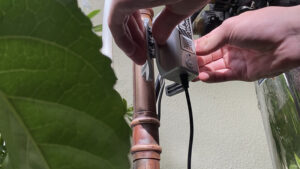
A clamp-on meter solves this. A Bluebot smart water meter clamps onto the outside of the pipe, so it goes where a cut-in meter cannot: right in the irrigation valve box, on the irrigation main, or on a dedicated line you want read on its own. There is nothing to cut, no shutoff, and no plumber to book, which is roughly $500 of plumbing you do not pay. Once it is on, it samples flow every 2 seconds, and when the pattern shifts, you get an SMS alert on your phone. That covers a zone running long, a spike outside its window, or water moving when nothing is scheduled.
Different properties need different gear. The 50-W (Bluebot Mini) is the entry point for real-time flow alerts and irrigation tracking. The 100-W (Bluebot Hero) handles larger pipe sizes, 3/4 inch through 2 inch.
For a meter far from the router, the 100-WAN (Bluebot ProLink) reports over long-range LoRaWAN, up to 1.2 miles in urban settings, with no Wi-Fi needed at the meter. It pairs with a Bluebot Gateway, sold separately, and property managers and HOAs with large grounds can network up to 100 ProLink meters across a campus or community through one, application dependent.
One honest limit. What a meter sees depends on where the irrigation line sits in your plumbing. If irrigation branches off a dedicated line, a meter there gives you direct irrigation data.
If it shares the main with the house, the meter reads combined flow and flags odd patterns inside it. Either way, moving from monthly spot checks to constant watch is the real change. A 3 a.m. break gets flagged that morning, not at the next walkthrough.
Next Steps
Run the seven-step walkthrough this weekend. If the meter confirms a leak you cannot place, work through the deeper material in the full irrigation system leaks guide. To compare detection methods more broadly, read this water leak detector overview.
To put the system on permanent watch instead of a monthly reminder, browse Bluebot smart water meters. Bring pipe fit or install questions to the FAQ.
Frequently Asked Questions
How much water does a sprinkler leak waste in a month?
EPA WaterSense reports that an irrigation leak about the width of a dime wastes roughly 6,300 gallons a month. The agency also finds that leaks waste more than 10,000 gallons a year in a typical home, and that one home in ten loses 90 gallons a day or more. A cracked lateral under pressure can waste far more before anything shows on the surface.
Why does my sprinkler system leak when it is turned off?
A leak that runs with the controller off almost always sits upstream of the sprinkler heads. Check the zone valves first. A worn diaphragm stops sealing and lets water seep past continuously. Cracked fittings on the manifold behave the same way. Open each valve box and look for standing water inside, since a box that stays wet between cycles points straight at the failed part.
Do I need to call 811 before digging up my own sprinkler line?
Yes, in most states. The 811 one-call system is the national call-before-you-dig program, and most states legally require notice before any excavation, commonly about two business days ahead. One limit matters here: 811 marks public utilities but generally does not locate private lines, so your irrigation piping will not be flagged. Dig by hand near anything the locate does not cover.
Can a Bluebot meter tell me which zone is leaking?
Not on its own. A Bluebot meter measures total flow on the line it is clamped to, so it tells you that water is moving when it should not, and when it started, within seconds. Narrowing that to a specific zone still takes the zone isolation test in Step 6. Clamp the meter onto a dedicated irrigation line and the data gets much easier to read, which is the kind of placement a clamp-on meter makes possible and a cut-in meter does not.
Is it worth fixing a small sprinkler leak?
Usually yes, because the running cost outweighs the part. An unresolved irrigation leak commonly adds about $50 to $200 a month in wasted water at typical rates, while a replacement head or nozzle is a few dollars. Add soil erosion, landscape damage, and drought-season penalties in some areas, and even a slow seep tends to pay for its own repair within a season.
When during the year do sprinkler leaks usually show up?
Two windows account for most of them. Spring startup exposes freeze damage, because water left in the lines over winter expands and splits elbows, tees, and fittings. Peak summer exposes the rest, when longer run times and higher pressure turn a small weep into a visible failure. Walking each zone at both points catches most problems while they are still cheap.