Disclosure: Bluebot publishes this guide and sells the first product on the list. Prices and specs for every device come from the manufacturer or the retailer, and each ranking below states the criterion it is based on so you can judge it yourself.
A remote vacation home monitoring system is a connected set of sensors (water, climate, power, and access) that reports what is happening at an unoccupied property to your phone. It exists to solve one problem: at a second home, nothing is watching. A pinhole leak that a full-time resident would notice in an hour can run for six weeks before anyone opens the door.
That gap is not rare. As of the second quarter of 2026, the U.S. Census Bureau’s Housing Vacancy Survey counted 2.3% of American housing units as vacant for seasonal use. Harvard’s Joint Center for Housing Studies puts the national second-home stock near 6.5 million properties.
The risk is just as well measured. The Insurance Information Institute (2026) reports that roughly 1 in 60 insured homes files a water damage or freezing claim each year. The average claim runs about $15,400. Water and freezing together make up close to a quarter of all homeowners claims.
The math is unkind to empty houses: the same failure costs far more when no one is there to shut the valve.
What “best” means on this list
Seven systems, seven different failure modes. Nothing here is “the best device” in the abstract, because a water meter and a floodlight camera do not compete. Every pick below is the best fit for one specific job within a remote vacation home monitoring setup, judged on four criteria:
- Unattended-failure coverage: does it catch a problem that would otherwise run for weeks?
- Install effort: can an owner fit it without a trade, on a weekend visit?
- Alert path: does it reach you when you are 800 miles away, and does it still work if the Wi-Fi drops?
- Total cost: hardware plus any subscription, not just the sticker.
Pricing note: the Bluebot and Nest figures below were re-verified in August 2026. The other five prices are the figures recorded at this guide’s last review and are labeled as such. Confirm current pricing with the retailer before you buy.
|
# |
System |
Job it does |
Price |
Best for |
|---|---|---|---|---|
|
1 |
Bluebot Smart Water Monitoring System |
Whole-house water usage + leak alerts |
$558.34 |
Catching the failure that costs the most |
|
2 |
Google Nest Learning Thermostat |
Remote temperature control |
$279.99 |
Freeze prevention and energy waste |
|
3 |
Schlage Z-Wave Connect Deadbolt |
Keyless guest access |
$469.90* |
Turning over guests without keys |
|
4 |
Ring Video Doorbell |
Seeing who is at the door |
from $135* |
Deliveries and unexpected visitors |
|
5 |
Blink Outdoor 4 |
Wire-free perimeter cameras |
$479.98* (6-cam) |
Covering a property with no wiring |
|
6 |
MarCELL Cellular Multisensor |
Power, temperature, humidity |
$223* + $8.25*/mo |
Homes with no reliable internet |
|
7 |
Ring Floodlight Cam Pro |
Light + camera + siren in one |
$269.98*/$449.99* |
Deterrence at the driveway |
* Price recorded at last review; confirm current pricing with the retailer.
Best Remote Vacation Home Monitoring Systems
Water is the failure this list exists for. A burst supply line or a running toilet turns a $40 water bill into a five-figure claim. It is also the one failure a thermostat, a camera, and a lock all miss completely.
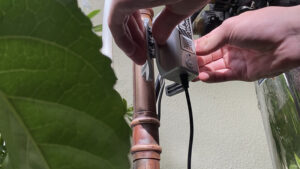
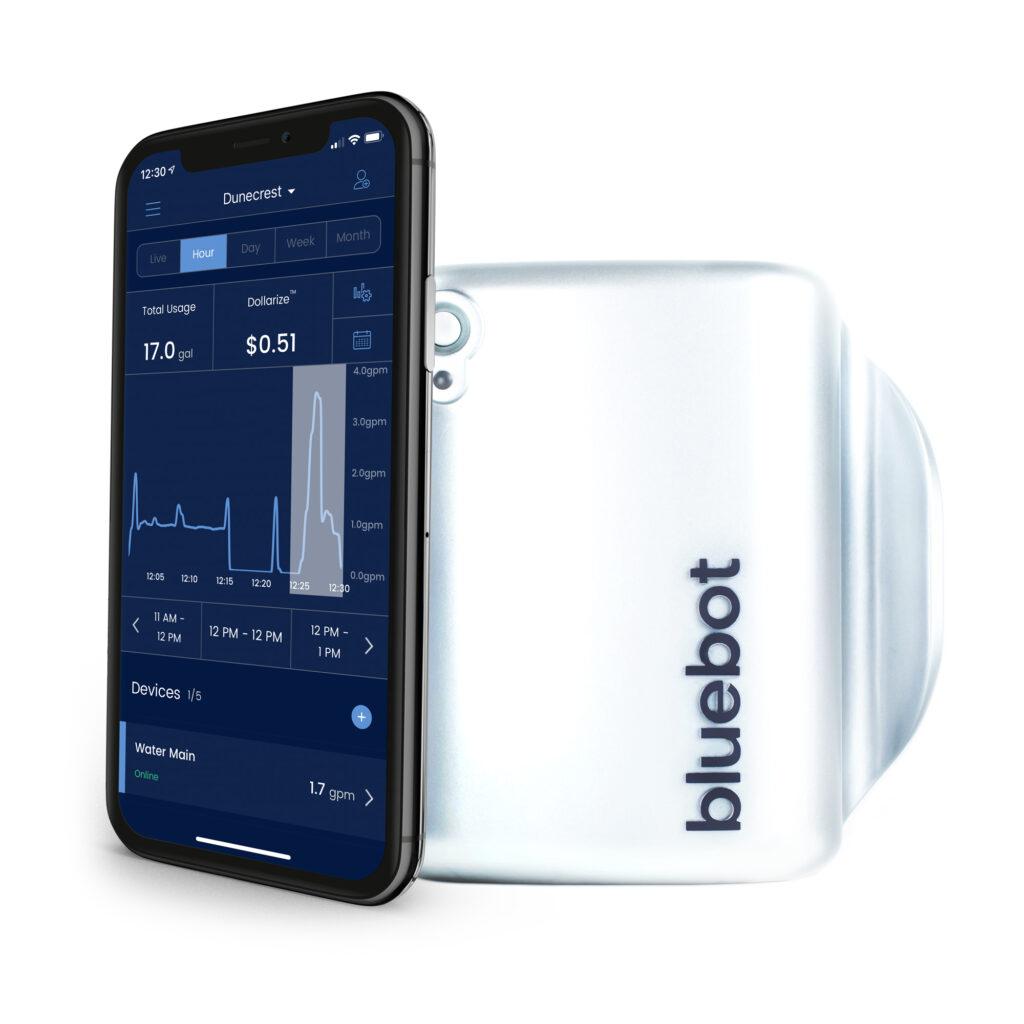
The Bluebot smart water meter is a clamp-on ultrasonic water meter. It reads true flow from outside the pipe, so there is no cutting, no plumber, and no water shutoff. The 100-W (Bluebot Hero) fits 3/4 inch to 2 inch pipes across more than 80 pipe size and material combinations, including copper, PVC, CPVC, PEX, PE, galvanized steel, and stainless steel.
It is IP65 rated, so it works in an unheated crawlspace or outdoors at a well head. Readings run continuously to the FloDash(TM) dashboard and the bluebot Water app. Alerts arrive by notification and SMS when usage looks wrong for the time of day.
Simplicity. Installation is a clamp and a plug, typically about 10 minutes with the bluebot Water app, without touching the plumbing. It leads this list because water is the failure with the highest average claim cost, and a clamp-on meter is the only way to watch it that does not need a plumber. See how it works and the sensing technology for the detail.
What it does not do. Bluebot does not shut the water off. It is a meter, not a valve, and that is deliberate: it is what lets one device clamp onto the irrigation line, the well head, or a single branch instead of only the main. On an empty house that trade matters, because an alert at 2 a.m. reaches the neighbor with the key hours before a weekly drive-by would.
Cost. The Bluebot Hero (Model 100-W) lists at $558.34 with no installation fee, verified August 2026 on the Bluebot Hero product page. It carries a 12-month warranty, and the price includes the first 12 months of Premium Data for the FloDash dashboard and the bluebot Water app. After that, streaming continues at $4.98 a month and renewal is optional. (An earlier edition of this guide listed $539; that figure is superseded.)
Reviews. Bluebot’s own customer reviews page shows a 4.7 average across 43 reviews, with installation speed and reading accuracy the two most repeated themes. If you want a head-to-head against another monitor rather than this guide’s summary, read the Bluebot vs Flume comparison.
Heating and cooling is the largest single line in most energy bills. The U.S. Energy Information Administration’s Residential Energy Consumption Survey (2023) puts it at roughly half of a typical U.S. home’s energy use. Older estimates ran as high as 58%.
That is where the widely quoted claim that your thermostat controls up to 60% of your energy bill comes from. Treat 60% as an upper bound, not a typical case.
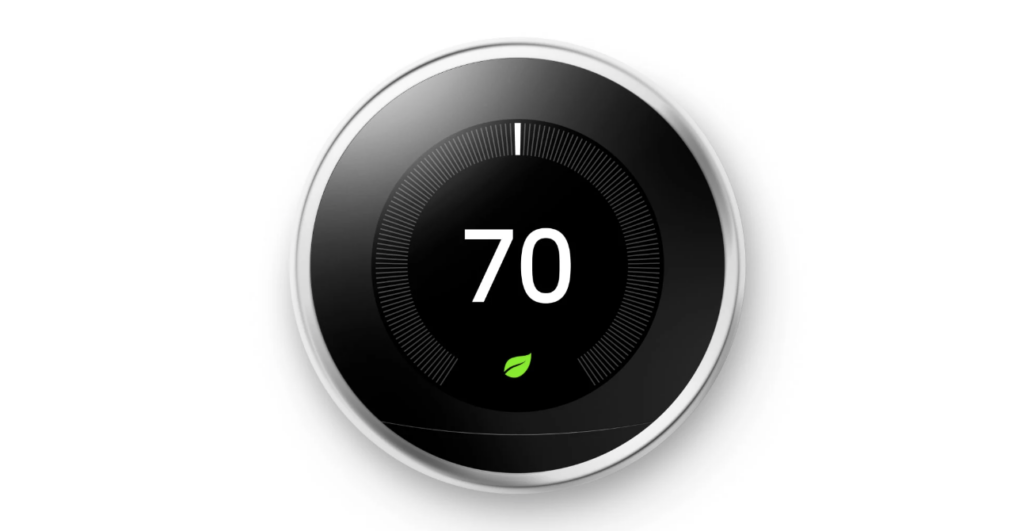
For a vacation home, the thermostat is really freeze insurance. Letting a house drift below freezing to save money is how supply lines burst. Most policies also expect a property to be heated or properly winterized. The Nest Learning Thermostat (2026) lets you hold a safe minimum from your phone, then raise it the morning before guests arrive.
Simplicity. Installation is straightforward.
Cost. The current fourth-generation Nest Learning Thermostat lists at $279.99 on the Google Store as of 2026, and ships with a temperature sensor. (A previous edition of this guide cited approximately $300 for the discontinued third generation.) ENERGY STAR (2023) estimates that certified smart thermostats save around 8% of heating and cooling costs, or roughly $50 a year. Treat the energy payback as slow. The freeze protection is the real return.
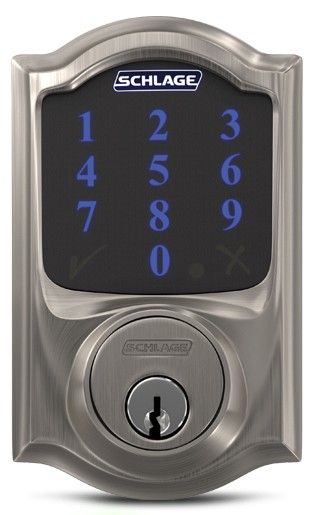
Handing out physical keys does not scale across a season of guests. A connected deadbolt replaces the lockbox with codes you issue and revoke from your phone.
The Schlage Z-Wave Connect deadbolt (2026) meets ANSI Grade 1, the top residential durability tier defined by ANSI/BHMA (2025). It stores up to 30 access codes, enough for a full rental calendar plus the cleaner, the plumber, and the neighbor. A built-in alarm offers three sensitivity modes, and the lock works with Alexa and Z-Wave hubs. A forced-entry attempt triggers a notification rather than a discovery on your next visit.
Simplicity. Fitting it takes longer than the other picks, but the through-bolt adjusts to most existing door prep, so you usually avoid drilling a new hole.
Cost. Listed at $469.90 at last review, alarm included. Confirm current pricing with Schlage or your retailer.
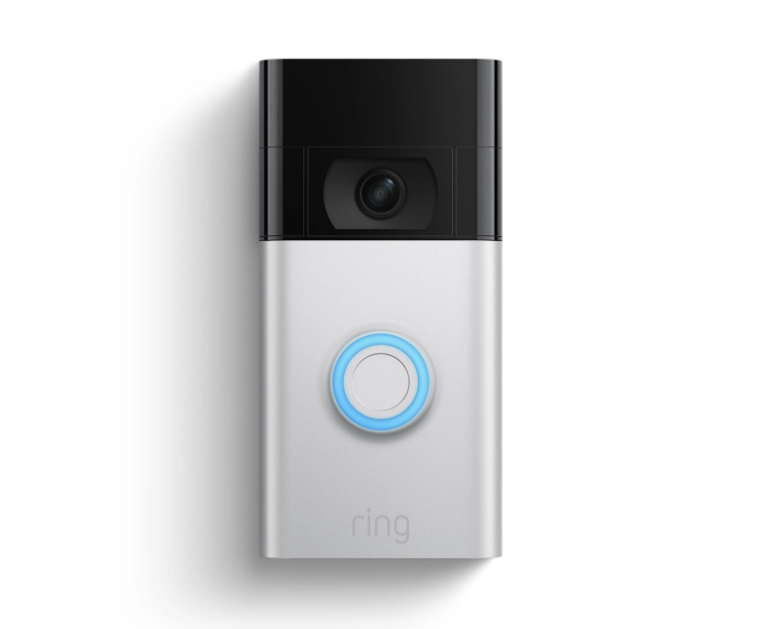
A doorbell camera is the least expensive way to see who is on your porch. Guest, contractor, or package thief, you can also speak to them from anywhere.
The Ring Video Doorbell (2026) records 1080p video with two-way talk. It runs on a rechargeable battery or existing doorbell wiring. Motion zones can be narrowed so passing traffic does not trigger alerts.
With a Ring Protect plan, saved video history runs up to 180 days. That matters when you review footage after a stay ends rather than the same evening.
Simplicity. Battery installation needs no wiring and takes minutes. Notification tuning is the part worth doing carefully on a rental.
Cost. Entry options started around $135 at last review, rising with resolution and power options. Subscription is extra.
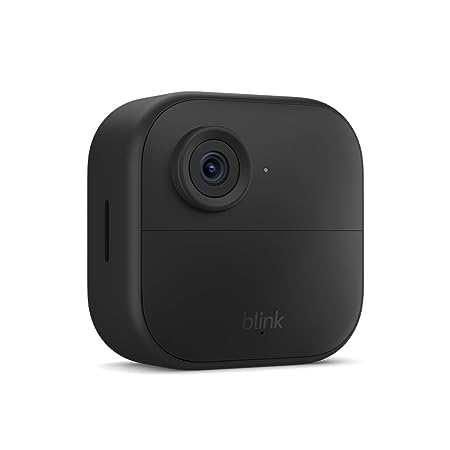
Inside coverage is not enough on a property with a driveway, a dock, or an outbuilding. The Blink Outdoor 4 (2026) is a wire-free, weather-resistant camera rated for up to 2 years of battery life. It adds built-in motion detection and cloud clip storage on a Blink subscription.
Because there is no wiring, you can put cameras where power does not reach. That is the practical advantage on rural and lakefront properties, where the useful vantage points are rarely near an outlet.
Simplicity. Self-install, no wiring, per-camera motion sensitivity in the app.
Cost. The six-camera kit was $479.98 at last review; smaller and larger kits exist and subscription fees are separate.
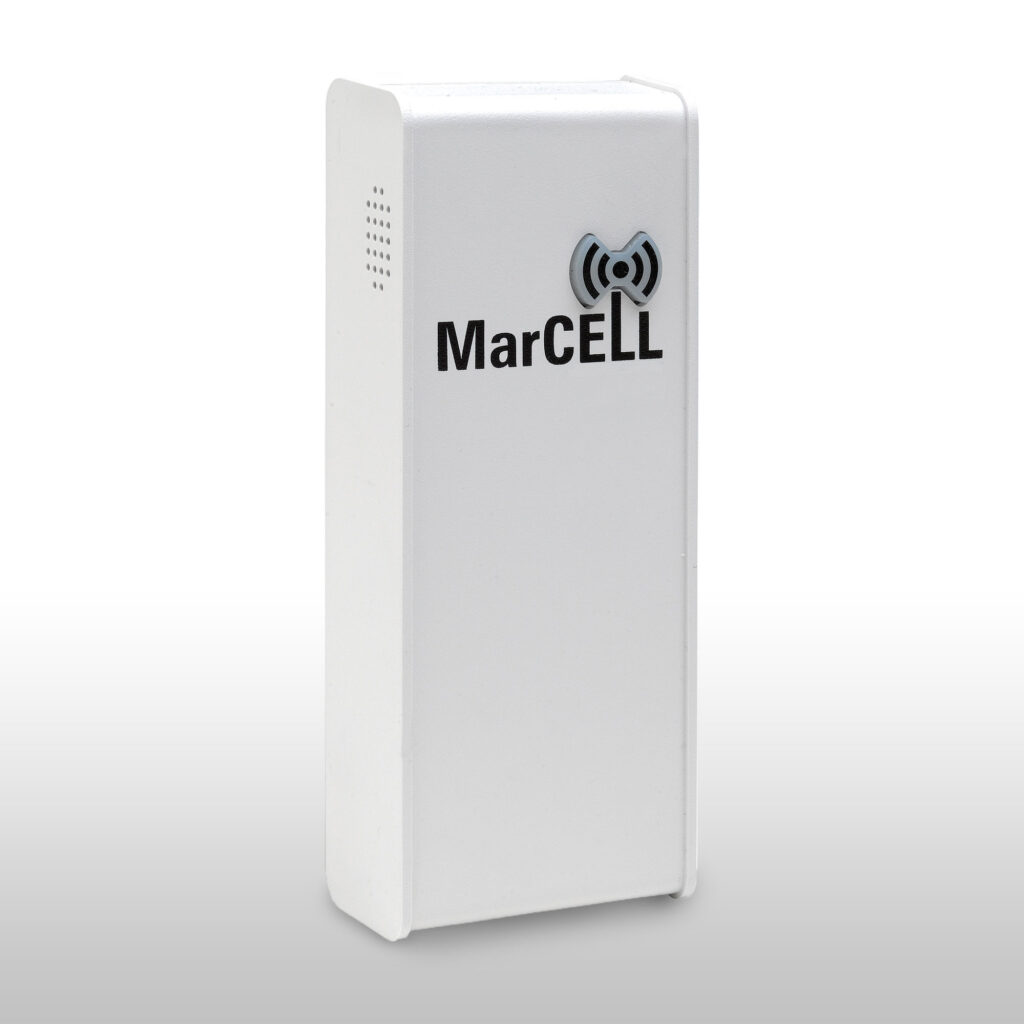
Every device above assumes the internet is up. At a remote cabin it often is not. A power cut takes the router with it, so the outage that matters most is the one your other sensors cannot report.
The MarCELL Cellular Multisensor (2026) solves that by reporting over a cellular network instead of home Wi-Fi. It tracks temperature, humidity, and power loss, and sends alerts by text, call, or email. A furnace failure in January reaches you even when the house has neither power nor broadband.
Simplicity. Register it, plug it into a standard outlet, and it starts logging. Historical readings live in the app dashboard.
Cost. About $223 at last review, with data plans from $8.25 per month.
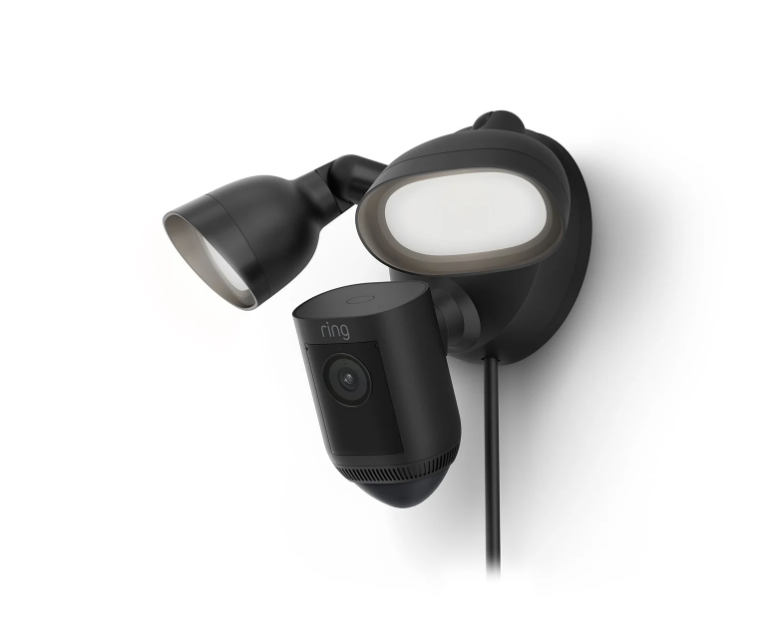
Light is a deterrent on its own. Combining it with a camera means motion at the driveway both illuminates the area and starts recording.
The Ring Floodlight Cam Pro (2026) pairs motion-activated floodlights with a camera, two-way talk, and a 110dB siren, and adds Bird’s Eye View for tracking movement across the property. Video history extends to 180 days with a Ring Protect plan. It ships with a 20-foot power cable, which usually reaches an existing exterior outlet without an electrician.
Simplicity. Plug-in mounting, no hardwiring, Wi-Fi setup in the app.
Cost. $269.98 for one and $449.99 for two at last review.
Building a layered setup instead of buying seven boxes
These devices are not alternatives to each other; they are layers of one remote vacation home monitoring system, and the ordering matters more than the total spend. Cover water first, because it is the failure with the highest average claim cost and the longest silent runtime. Cover climate and power second, because a freeze is a water failure waiting to happen and a cellular sensor is the only layer that survives an outage. Cover access and cameras last: they protect against the event you are most likely to be warned about by a neighbor anyway.
A workable minimum for most second homes is three devices. That is a smaller smart home monitoring setup than most owners expect: a smart water meter on the main line, a connected thermostat holding a safe minimum, and a cellular sensor as the fallback alert path when Wi-Fi drops. Cameras and a smart lock are phase two.
Add them once the failure modes that flood a house are covered. If you are diagnosing an existing problem rather than preventing the next one, start with how to stop a water leak.
Bluebot Hero specifications
|
Specification |
Detail |
|---|---|
|
Model |
Bluebot Hero, Model 100-W |
|
Sensing |
Ultrasonic flow, Adaptive Angle self-alignment |
|
Pipe compatibility |
3/4 inch to 2 inch; 80+ pipe types |
|
Installation |
Clamp-on: no pipe cutting, plumber, or shutoff |
|
Connectivity |
Built-in Wi-Fi, direct to the Bluebot Cloud (no gateway required) |
|
Ingress protection |
IP65, indoor or outdoor |
|
Warranty |
12 months |
|
Price |
$558.34, no installation fee (August 2026) |
What monitoring does and does not do for an insurance claim
Monitoring reduces how long a failure runs. It does not decide how a claim is paid. Homeowners coverage for water damage and frozen pipes varies by policy and by state. Carriers commonly look at whether the property was heated or properly winterized when the loss occurred.
No device on this list guarantees a covered claim, and none should be described that way.
Three practical steps: read your policy, ask your carrier what it expects of an unoccupied property, and keep the alert history. A timestamped record of when a leak started and when it was shut off is useful evidence. Bluebot keeps that record for you: FloDash logs flow continuously, so the start time, the duration, and the shutoff are already timestamped when the adjuster asks.
Start with Bluebot: the layer that costs the most to miss
If you add one device to a second home this season, make it the one that watches the water. It carries the highest average claim cost and the longest silent runtime, and no camera, lock, or thermostat sees it coming. Everything else here is worth owning; this is the layer worth owning first.
The Bluebot smart water meter clamps onto the main line in minutes, reads flow continuously, and alerts you while a slow leak is still small: no plumber, no pipe cutting, no shutoff. Check current pricing and data plans on the product page, or follow release notes in Bluebot News.
Sources
U.S. Census Bureau, Quarterly Residential Vacancies and Homeownership (2026) · Harvard Joint Center for Housing Studies, second-home stock · Insurance Information Institute (2026), water damage and freezing claim data · U.S. Energy Information Administration (2023), Residential Energy Consumption Survey · ENERGY STAR (2023) smart thermostat savings · ANSI/BHMA (2025) residential lock grading · manufacturer product pages for Bluebot, Google, Schlage, Ring, Blink, and MarCELL.
Written by Matthew Olin, Founder & CEO of Lookout Lab, Inc. / Bluebot. Bluebot builds clamp-on ultrasonic smart water meters for homes and businesses.
Frequently Asked Questions
What are the best devices for monitoring a vacation home remotely?
The right mix depends on which failure you are guarding against. For water, a clamp-on smart water meter such as the Bluebot Hero watches the main supply line. For freeze risk, a connected thermostat like the Nest Learning Thermostat holds a safe minimum temperature. For outages, a cellular sensor such as the MarCELL Multisensor reports without home Wi-Fi.
How much does a full vacation home monitoring setup cost?
A three-device core runs roughly $1,060 at current listed prices: a Bluebot smart water meter at $558.34, a Nest Learning Thermostat at $279.99, and a MarCELL cellular sensor near $223 at last review. Adding cameras and a smart lock roughly doubles that. Data plans and video subscriptions are billed separately from the hardware.
Where should sensors go in a vacation home?
Put the water meter on the main supply line where it enters the building, upstream of every branch, so a single sensor covers the whole property. Mount the cellular temperature sensor near the furnace or the most freeze-prone exterior wall. Cameras belong at the driveway and at whichever door guests actually use.
When should I set up monitoring at a seasonal property?
Before the property sits empty for its first long stretch, and ideally ahead of the first freeze of the season. Installation is a weekend job, but the protection only starts once the house is unoccupied. A clamp-on flow sensor needs no pipe cutting and no shutoff, so it fits into a normal visit.
Can I get real-time alerts for unusual activity at my vacation home?
Yes. These devices push alerts to your phone by notification, SMS, email, or phone call. A flow sensor on the main line flags unusual usage, Ring and Blink cameras send motion alerts, and the MarCELL sensor reports power loss over a cellular network even when the router is down. Most alert rules are adjustable.
Will remote monitoring lower my homeowners insurance premium?
Sometimes, but do not count on it. Some carriers offer a discount for approved water leak detection devices, and the terms vary by policy and by state. Ask your carrier directly before you buy, and confirm what it expects of an unoccupied property. No device guarantees a discount or a covered claim.