LoRa and LoRaWAN are not competitors, and most real deployments run both. LoRa is the physical layer, a radio modulation technique that moves small amounts of data over long distances at very low power. LoRaWAN, short for Long Range Wide Area Network, is the network protocol that runs on top of it, adding addressing, encryption, device management, and a route to the cloud. The practical question is not which one wins. It is whether your deployment needs the network layer at all.
That distinction matters commercially, because it decides whether you are buying two radios or building an entire network. A pair of sensors talking to one receiver across a yard needs LoRa and nothing else. A campus with 60 water meters, three buildings, and a facilities team that expects one dashboard needs LoRaWAN.
LoRa vs LoRaWAN: What is LoRa?
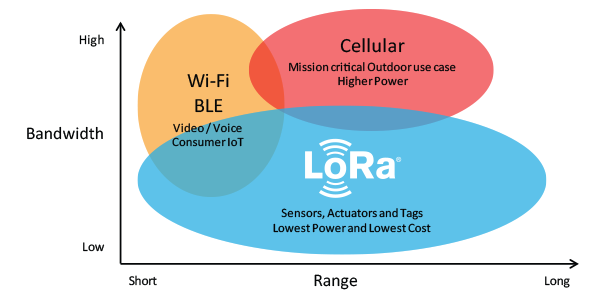
The LoRa Alliance publishes and maintains the LoRaWAN specification, and the protocol carries formal international recognition: the ITU adopted it as Recommendation ITU-T Y.4480 in December 2021, making LoRaWAN the first low-power wide-area networking standard transposed into an ITU-T Recommendation (LoRa Alliance, 2021). The specification is still actively revised. The current Regional Parameters document, RP002-1.0.5, was published in October 2025 (LoRa Alliance, 2025).
LoRa vs LoRaWAN at a Glance
Question | LoRa | LoRaWAN |
|---|---|---|
What layer is it? | Physical layer (the radio) | Link and network layer (the protocol) |
Who defines it? | Semtech, as a proprietary modulation | LoRa Alliance, as an open specification |
Topology | Point-to-point, point-to-multipoint, or mesh | Star-of-stars: devices, gateways, network server |
Built-in security | None | Two layers of AES-128 session keys |
Needs a gateway? | No | Yes |
Best for | A handful of devices, one owner, one site | Fleets, multi-site rollouts, centralized management |
What Is LoRa?
LoRa, short for Long Range, is a radio modulation technique. It uses Chirp Spread Spectrum (CSS) modulation, which spreads each symbol across a wide band of frequency as a rising or falling sweep. That sweep is what lets a receiver pull a signal out from below the noise floor, which in turn is what buys the range and the low power budget. LoRa modulation operates in unlicensed sub-GHz ISM bands, so there is no spectrum license to buy and no per-device carrier fee.
What LoRa technology does not include is just as important. The LoRa physical layer defines how bits cross the air and nothing beyond that. The radio layer carries no addressing scheme, no encryption, no acknowledgment logic, no device onboarding, and no way to hand data to an application. Two LoRa radios can hold a direct link, and for a point-to-point or point-to-multipoint job that is often the entire requirement. Beyond a handful of nodes, every one of those missing pieces becomes something you build and maintain yourself.
What Is LoRaWAN?
LoRaWAN is the open network protocol that sits above LoRa radio. Its link-layer specification, TS001, defines message formats, device classes, join procedures, and the rules devices follow when they talk to a network (LoRa Alliance, 2020). Because channel plans, duty-cycle limits, and transmit-power ceilings differ by regulator, those regional rules live in a separate companion document, RP002, which is revised independently of the LoRaWAN standard itself (LoRa Alliance, 2025).
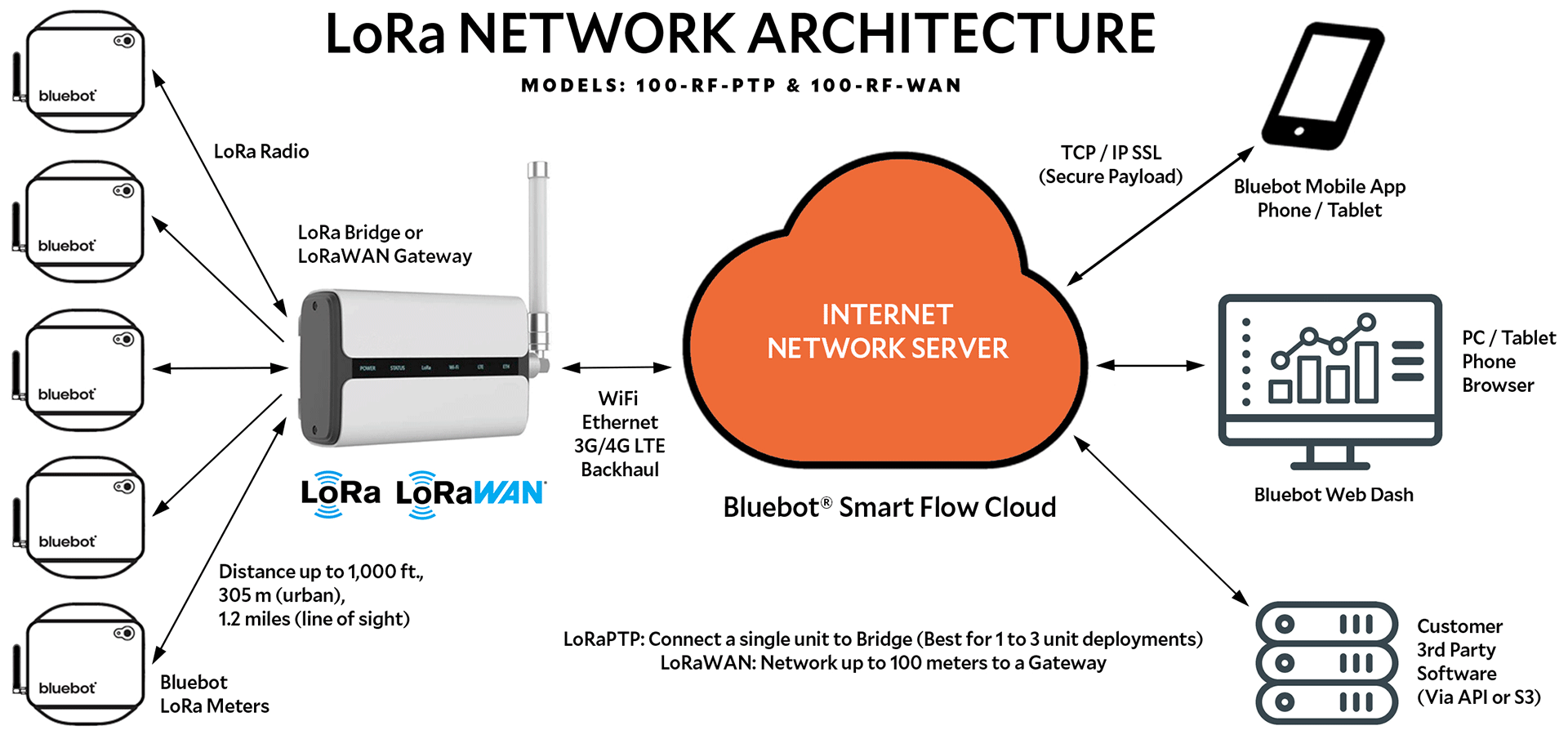
A LoRaWAN network has three tiers. End devices transmit over LoRa radio. Gateways listen on multiple channels at once and forward everything they hear upstream. A network server deduplicates those uplinks, handles security, manages data rates, and passes clean data to the application. Devices are not bound to a single gateway: any gateway in range picks up the transmission, and the network server sorts it out. That is why the topology is described as star-of-stars rather than a simple star.
Scale is the payoff. LoRaWAN has been deployed by more than 155 mobile network operators, with connectivity available in more than 170 countries (LoRa Alliance, 2021).
At Bluebot, we have a LoRa water meter that gives you total control of your water usage from anywhere with ultimate connectivity and unmatched reliability.
It offers real-time alerts for leaks or overuse, eliminating surprises on your water bill and providing efficient water management for various applications.
What Are the Technical Differences Between LoRa and LoRaWAN?
Communication protocol
LoRa is responsible only for modulation and demodulation of the radio signal. The LoRaWAN protocol defines the communication rules layered on top: how a message is framed, how a device joins a network, how downlink windows open, and how the server and device stay in step. One is the transport. The other is the traffic law.
Network architecture
LoRa supports point-to-point, point-to-multipoint, and mesh arrangements, and the designer decides which. LoRaWAN fixes the architecture at star-of-stars, with gateways as transparent bridges rather than routers. Fixing it is the point: a known topology is what makes thousands of devices manageable from one server, and what lets you add a gateway to a weak corner of a site without touching a single device configuration.
Data transmission
LoRa gives you a raw link with a range of data rates and spreading factors. It does not manage retransmission, acknowledgment, or rate selection. LoRaWAN adds all three, including adaptive data rate, which lets the network server tune each device’s spreading factor and transmit power to its actual link quality. A meter close to a gateway is moved to a faster, lower-power setting; one at the edge of coverage keeps the slower, more robust setting. Across a fleet, that is the difference between a network that stays inside its duty-cycle budget and one that does not.
Security
LoRa has no security mechanism of its own. LoRaWAN specifies end-to-end encryption using two independent AES-128 keys: a network session key that authenticates the device to the network, and an application session key that protects the payload itself (LoRa Alliance, 2026). The separation is deliberate. A network operator can route your traffic without being able to read it, which is the property that makes shared and operator-run LoRaWAN networks viable for metering data.
What Are the Advantages and Limits of Each?
LoRa is strong on range through obstacles, on power draw, and on cost, since unlicensed spectrum means no licensing fee and no carrier contract. It is also flexible, because you choose the topology. Its limits are structural rather than incidental: low data rates that rule out anything resembling streaming, no network management of any kind, and exposure to interference from everything else sharing an unlicensed band.
LoRaWAN is strong on scale, management, and security. The LoRaWAN network layer gives you device provisioning, key management, adaptive data rate, and a single integration point for the application, which is what a multi-site rollout actually runs on. Its limits are the cost of that structure. You need gateway infrastructure and a network server, which is capital and configuration that a two-device link does not require. Bandwidth is still modest, because LoRaWAN inherits the LoRa radio’s constraints rather than escaping them, and a device is subject to regional duty-cycle limits that cap how often it may transmit.
Where Are LoRa and LoRaWAN Used?
In practice the two run together across the same set of industries.
- Smart cities: street lighting that dims on measured conditions, waste-container fill sensors, parking occupancy, and district water metering.
- Agriculture: soil moisture probes, weather stations, tank levels, and irrigation-line monitoring spread across acreage that no Wi-Fi network reaches.
- Industrial operations: asset tracking, equipment condition monitoring, and preventive-maintenance sensing across a plant or yard.
- Environmental monitoring: air quality, water quality, river and reservoir levels, often at sites with no mains power and no local network.
- Utilities and facilities: sub-metering water, gas, and electricity across buildings, campuses, and remote pumping stations.
The pattern is consistent. Wherever assets are dispersed, powered independently, and reporting small readings on a schedule, the LoRa radio provides the reach and LoRaWAN provides the management. Bluebot’s IoT sensors and water-saving technology sit in that last category.
How Do You Choose Between LoRa and LoRaWAN?
Four questions settle it.
- How many devices, and who runs them? Under roughly ten devices on one site with one owner, plain LoRa is defensible. Past that, you are rebuilding LoRaWAN badly.
- Do you need centralized management? Remote provisioning, over-the-air configuration, per-device data-rate control, and one integration surface are LoRaWAN features. They are not available in raw LoRa at any price.
- What is the data sensitive to? If readings are billable, contractual, or tenant-attributable, the two-key AES-128 model is not optional in practice.
- Where will it be deployed? Regional parameters differ by regulator, so confirm the channel plan, duty cycle, and power limits that apply in your jurisdiction before committing to a design. RP002-1.0.5 is the reference (LoRa Alliance, 2025).
For most commercial and municipal deployments the answer is LoRaWAN, because the requirement that pushed you toward long-range radio in the first place, sites too large or too remote for site Wi-Fi, is usually the same requirement that makes centralized management necessary.
What This Means for Water Monitoring
Water is a clear case. Meters sit in valve boxes, mechanical rooms, and irrigation mains, which is exactly where Wi-Fi is unreliable. Typical indoor Wi-Fi range runs about 30 feet (9 meters), depending on building construction and signal strength.
The 100-WAN (Bluebot ProLink) is Bluebot’s LoRaWAN meter, built for that gap. Each Bluebot ProLink reports over LoRaWAN to a Bluebot Gateway, which is a required part of every ProLink installation and carries data onward to the Bluebot Cloud over Ethernet, Wi-Fi, or optional 4G LTE. One gateway supports up to 100 ProLink meters, depending on gateway model and application, and gateways are available from the Bluebot shop in indoor, IP65, and IP67 variants. The ProLink meter itself carries an IP65 environmental rating. Typical LoRaWAN performance reaches up to 1.2 miles (2 km) in urban environments and up to 10 miles (15 km) with clear line of sight, though actual distance depends on terrain, buildings, vegetation, antenna placement, and other environmental conditions.
Measurement does not change with the radio. The ProLink uses the same clamp-on transit-time ultrasonic sensing platform as the 100-W (Bluebot Hero) and delivers identical flow measurement performance: 98% to 99% of flow reading in the field, from 99.7% laboratory calibration accuracy under controlled conditions, with low-flow sensitivity down to 0.1 GPM (0.38 L/min). Field performance varies with pipe material, pipe size, installation quality, available straight-pipe length, flow profile, water temperature, and operating conditions. Calibration standards are NIST-traceable and every meter ships with an individual Calibration Certificate. Where reliable Wi-Fi is available and you are monitoring one or a small number of meters, the Hero communicates straight to the Bluebot Cloud over built-in 2.4 GHz Wi-Fi instead.
If you are scoping a multi-site rollout, the commercial deployment guide covers coverage planning and integration, and you can contact the Bluebot team to size a gateway plan against your site map.
Real-World Applications of LoRa and LoRaWAN
Frequently Asked Questions
What is the difference between LoRa and LoRaWAN in one sentence?
LoRa is the radio, and LoRaWAN is the network built on that radio. LoRa is a physical layer modulation technique using Chirp Spread Spectrum, and it defines only how bits cross the air. LoRaWAN is the open protocol above it, adding addressing, two-key AES-128 encryption, adaptive data rate, and a network server. You can run LoRa on its own, but LoRaWAN always runs on LoRa underneath.
Can you use LoRa without LoRaWAN?
Yes, and for small deployments it is a reasonable choice. A direct point-to-point or point-to-multipoint LoRa link uses neither a gateway nor a network server, which makes it inexpensive for a handful of devices on one site under one owner. Past roughly ten devices you end up rebuilding addressing, security, and device management yourself, which is exactly what the LoRaWAN standard already specifies.
How far can a LoRaWAN water meter transmit?
Typical LoRaWAN performance reaches up to 1.2 miles (2 km) in urban environments and up to 10 miles (15 km) with clear line of sight. Actual distance depends on terrain, buildings, vegetation, antenna placement, and other environmental conditions, so coverage should be verified on site rather than assumed. For scale, typical indoor Wi-Fi range is only about 30 feet (9 meters).
Why does a LoRaWAN network need a gateway?
The gateway is the bridge between the radio and the internet. End devices transmit over LoRa, and a gateway listens across multiple channels at once, then forwards every uplink it hears to a network server that handles deduplication, security, and data rate management. Devices are not tied to one gateway: any gateway in range receives the transmission, which is why the topology is called star-of-stars.
How many devices can one LoRaWAN gateway support?
That depends on the gateway model and the traffic pattern rather than a fixed ceiling. In the Bluebot product family, one Bluebot Gateway supports up to 100 Bluebot ProLink meters, depending on gateway model and application. Gateways are offered in indoor, IP65, and IP67 variants, and each carries data onward to the Bluebot Cloud over Ethernet, Wi-Fi, or optional 4G LTE.
Does LoRaWAN work the same way in every country?
No. LoRaWAN channel plans, duty-cycle limits, and transmit-power ceilings are set per regulatory region, which is why the LoRa Alliance publishes them in a separate Regional Parameters document that is revised independently of the protocol. The current revision is RP002-1.0.5, published in October 2025. Confirm the parameters for your jurisdiction before committing to a hardware or coverage design.