Reading a water meter means recording the running total shown on the meter’s register, converting that total into your utility’s billing unit, and comparing the result against the consumption printed on your bill. It takes about 10 minutes, needs only a flashlight, and is the only way to confirm that what you were charged matches what actually flowed through your service line.
Most homeowners never take a water meter reading until a bill arrives that looks wrong. By then the billing period is closed and the evidence is gone. Learning to read the meter face turns a monthly guess into a measurement you can check, contest, and act on. It is the fastest way to catch a silent leak before it becomes a repair.
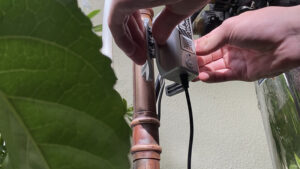
You can also stop taking the reading by hand. Bluebot clamps onto any pipe, anywhere it runs, in the valve box, under the sink, or on the tenant line, with no cutting and no plumber, and reads that same flow continuously.
Key Facts at a Glance
- Time required: about 10 minutes, plus 20 minutes for the optional leak test
- Units you’ll see: cubic feet (CU FT) or gallons: 1 cubic foot = 7.48 gallons
- Standard billing unit: 1 CCF = 100 cubic feet = 748 gallons
- Meter accuracy standard: 98.5% to 101.5% at normal and high flow under ANSI/AWWA C700-2020
- Why it pays: the EPA’s WaterSense program (2026) reports that average household leaks waste nearly 10,000 gallons a year, and fixing them trims roughly 10% off the water and sewer bill
What You Need Before You Start
Gather four things:
- A flashlight: meter boxes are dark even at midday.
- A meter key or long flathead screwdriver to lift the lid; never pry with your fingers.
- Your most recent water bill, to confirm which unit your provider bills in.
- A phone or notepad for the reading, date, and time.
One safety note: a curb box near the street is utility-owned infrastructure in most service areas. Lift the lid, look, close it. Never climb into a meter pit, and call your provider if the meter vault is flooded or will not open.
How to Read Your Water Meter, Step by Step
Step 1: Locate the meter
In older homes the meter usually sits in the basement where the main supply line enters the foundation; in newer construction, in a utility room beside the water heater. Outside, look for a rectangular or round concrete box near the curb, frequently stamped “WATER” or marked with your water utility’s initials.
Basements

Water meters are often located in basements, particularly in older homes. They are typically installed near the main water supply line, which enters the home through the foundation.
Utility rooms

In newer homes, water meters are often found in utility rooms, such as the laundry room or the room where the water heater is located.
Street

Step 2: Open the meter box safely
Slide the meter key into the notch on the meter lid and lever it up and aside. Wipe the lens clean: condensation and silt hide the digits more often than anything else. Outdoor units add a hinged cap over the dial face.
Step 3: Identify your register type
A mechanical water meter, an analog water meter, and a digital water meter can each carry one of two register families, read differently.
- Straight-reading (odometer) register. A single horizontal row of digits, exactly like a car odometer, printed under the words CUBIC FEET or GAL. Home Water Works (2026), the Alliance for Water Efficiency’s guide, calls the straight-reading meter the most common U.S. residential type; LADWP (2026) documents the same odometer-style register. The register is a lifetime totalizer: it counts everything that has passed through since installation and never resets.
- Round-reading (dial) register. A six-dial meter (the round-reading meter) carries small clock-style dials labeled 100,000 · 10,000 · 1,000 · 100 · 10 · 1. Contra Costa Water District‘s guidance is to start at the 100,000 dial and work clockwise, writing down the number each needle on the analog dials has last passed.
Look also for a small triangle, star, or gear on the meter face. That leak indicator (the low-flow indicator, or leak-detection triangle on some faces) exists to reveal flow too small to move the main sweep hand.
Step 4: Record the digits
Recording your meter reading means writing down every digit from left to right, plus the date and time. On a straight-reading register, digits on a black background are whole units; fixed trailing zeros are fractions your utility ignores. Take a photo: a timestamped image beats a handwritten note if you contest a charge.
Step 5: Convert the reading into billing units
This is where a reading becomes money. One cubic foot of water equals 7.48 gallons, so a meter that advanced ten cubic feet since your last check represents 74.8 gallons. Utilities rarely bill by the single cubic foot; the common unit is CCF: one hundred cubic feet, or 748 U.S. gallons, as California Water Service (2026) defines it. Some providers bill in 1,000-gallon units, so your own bill is the reference, not a generic conversion chart.
Step 6: Compare your reading against your water bill
Accurate water billing starts with billing verification: take one reading now and another after a full billing cycle. The difference is your true water consumption for that period, in the meter’s native unit. Convert it to your provider’s billing unit and set it beside the statement figure. They should agree within one billing unit. Anything wider is a billing accuracy problem worth raising.
The dollar stakes are real. As of the fiscal year that began July 1, 2025, New York City’s Department of Environmental Protection (NYC DEP) bills metered water at $5.05 per 100 cubic feet, and $13.07 per 100 cubic feet once sewer is included, so a single misread CCF is a real charge. Billing errors are rare but real, and rates, billing units, and dispute windows vary by jurisdiction, so confirm yours with your provider.
Step 7: Run a leak test before you dispute a charge
Before assuming the meter is wrong, rule out your own plumbing. Shut off every fixture and appliance that uses water, including ice makers and irrigation controllers. Record the reading, wait 15 to 20 minutes, and read it again. If the number moved (or the low-flow indicator is turning), you have a hidden leak, one of the water leaks this test exposes.
Portland Water Bureau (2026) recommends this: close the house shut-off valve and watch the meter again. If it stops, the leak is inside. If it keeps advancing with the valve closed, you have a service-line leak between the meter and the shut-off, which is usually a call to your utility rather than a weekend project.
How Accurate Is a Residential Water Meter?
Accuracy is a specification, not an opinion. ANSI/AWWA C700-2020, the current American Water Works Association standard for displacement-type cold-water meters in sizes ½ in. (13 mm) through 2 in. (50 mm), requires registration between 98.5% and 101.5% at normal and high flows, and 97% to 101% at the specified low flow.
A positive displacement meter is mechanical: a nutating disc or oscillating piston displaces a fixed volume per cycle, and the C700 standard sets the accuracy tolerance and registration accuracy it must hold. Worn parts almost always under-register rather than over-register, so a genuinely over-billing meter is uncommon.
If your readings still disagree with the statement after a clean leak test, ask for a meter test. Most utilities publish their meter testing procedure and refund the fee if the unit fails. While you wait for that test, a second meter settles it: the 100-W (Bluebot Hero) reads 98% to 99% of actual flow in the field, and 99.7% under laboratory calibration, with real performance varying by pipe material, pipe size, and installation quality. Two independent readings on the same line is evidence a utility has to answer.
How Often Should You Take a Reading?
- Monthly suits most households and maps normal water usage and consumption patterns.
- Weekly is worth it if you irrigate, run a pool, or manage a rental.
- Daily is right during a suspected leak, a vacancy, or the weeks after plumbing work.
The U.S. Environmental Protection Agency’s WaterSense program estimates 10% of U.S. homes have leaks wasting 90 gallons per day or more, enough to distort average daily usage in any household.


Put Meter Reading on Autopilot with Bluebot
Manual reading has one weakness: it samples once, while a leak runs continuously. A Bluebot smart water meter closes that gap: it measures flow around the clock and alerts you when the pattern breaks, instead of waiting for the next statement.
The Bluebot Hero clamps onto the outside of the pipe, so there is nothing to cut and no plumber to book, and self-configures to more than 80 pipe size and material combinations: copper, PVC, CPVC, PEX, PE, galvanized steel, and stainless steel. The 50-W (Bluebot Mini) covers a shorter list, copper, PVC, PEX, and galvanized steel, on 3/4-inch and 1-inch pipe. No water shutoffs or batteries are required to install either one, and Dollarize™ reports usage in dollars rather than cubic feet.
Check your pipe size against the material list above, and the Bluebot that fits it. Our scoped write-ups cover the trade-offs: The Top 5 Flo by Moen Alternatives, The 5 Best Flume Water Monitor Alternatives, and a head-to-head Bluebot vs Flume comparison.

Tips and Troubleshooting
- The digits are fogged. Condensation under the lens means a failed seal. Report it. An unreadable register makes an accurate water bill impossible.
- Your statement says “estimated.” That is a skipped read, not a measurement (the most common source of billing errors). Submit your own dated reading so the next utility bill trues up.
- The reading is lower than last time. Registers never run backward. You read a different unit or photographed the wrong meter (common in duplexes and condos).
- Everything is off and the triangle still spins. Treat it as a live leak and start with the toilet flapper, the culprit EPA WaterSense names most often.
Frequently Asked Questions
Who owns the water meter, me or my utility?
In most service areas the meter and the box it sits in are utility property, while the plumbing downstream of the meter belongs to the homeowner. That boundary is why a leak on the house side is your repair and a failed register is usually theirs. Responsibility for the service line itself varies by jurisdiction, so confirm the dividing line with your provider before paying for any excavation.
What should I do if the meter box is stuck, buried, or full of water?
Stop and call your water utility. A lid that will not lift is often corroded or paved over, and a flooded meter pit can hide an unsafe drop. Utilities send a technician for exactly this, and most will read the register for you and note the obstruction on your account so the next bill is not estimated.
Where is the meter in an apartment or submetered building?
Look for your unit’s submeter rather than the building’s main register. Master-metered properties measure the whole building at one point and then allocate or submeter the charge per unit, so the number on the street meter will never match your statement. Ask your property manager which device serves your unit and where the reading on your bill comes from.
How much water can a running toilet waste before I notice it?
Enough to change a bill without ever being audible. The EPA’s WaterSense program names worn toilet flappers among the most common household leaks and reports that 10% of U.S. homes lose 90 gallons a day or more. A leak that size moves the low-flow indicator continuously, which is why the 15-minute meter test catches it long before your ear does.
Can I check my usage without walking out to the meter?
Yes, in two ways. Some utilities run advanced metering infrastructure and publish daily or hourly reads in an online account portal. Otherwise the Bluebot Hero clamps to your own pipe and streams flow to the bluebot Water app, so a spike shows up the same minute it starts.
How do I dispute a water bill after my own reading disagrees?
Bring evidence, not an opinion. Submit two dated readings taken a full billing cycle apart, timestamped photos of the register, and the result of a clean 15-to-20-minute leak test showing no flow. Then request a meter test. Most utilities publish that procedure and refund the fee if the unit fails, though dispute windows and adjustment rules vary by jurisdiction.
Join the 1,000+ bluebot users that save an average of 30% on their water bill