Washing machine water usage is the amount of water a clothes washer draws for one wash cycle. Most home models fall between 10 and 45 gallons. The spread is that wide because design drives it. A standard top-loader can use 30 to 45 gallons. A high-efficiency washer often uses a third of that. As of 2026, ENERGY STAR puts the average certified model at about 13 gallons, against about 23 for a standard machine.
That gap matters more than it looks, because washer water usage compounds every week. Laundry water use accounts for about 17 percent of what a household consumes indoors, according to EPA WaterSense, which also puts average household use near 300 gallons a day. So the appliance in your laundry room is one of the largest single draws in the house.
Key Facts: Washing Machine Water Use at a Glance
- Share of indoor water use: about 17 percent (EPA WaterSense)
- Typical U.S. laundry volume: about 300 loads a year (ENERGY STAR)
- Certified benchmark: about 13 gallons, versus about 23 for a standard unit (ENERGY STAR)
- Labeled-product threshold: no more than about 14 gallons per load, versus about 20 for a standard unit
- Federal efficiency cap: Integrated Water Factor of 6.5 for top-loading and 4.7 for front-loading designs (U.S. Department of Energy)
|
Machine type |
Gallons per load |
Yearly gallons at 300 loads |
|---|---|---|
|
Standard top-loader with agitator |
30 to 45 gallons |
9,000 – 13,500 |
|
High-efficiency top-loader |
10 to 25 gallons |
3,000 – 7,500 |
|
Front-loader |
10 to 20 gallons |
3,000 – 6,000 |
|
Certified efficient model |
about 13 gallons |
about 3,900 |
How Many Gallons Does a Washing Machine Use Per Load?
Design is the biggest factor by far. Here is how the main categories compare.
Standard top-loaders draw about 30 to 45 gallons. They fill the tub to a set level no matter how much laundry is inside. A half-empty drum still gets a full fill. That is where most of the waste comes from.
High-efficiency top-loaders use 10 to 25 gallons. These HE washers drop the center agitator and add a water level sensor. That sensor reads the load and fills only as far as it needs to.
Front-loaders sit at 10 to 20 gallons, and the most efficient reach 10 to 15 gallons. They lift and drop clothes through a shallow pool instead of soaking them.
Two federal programs give you a benchmark to check any model against. ENERGY STAR reports that a certified unit averages about 13 gallons, while a conventional one averages about 23. WaterSense sets a similar bar: a labeled model stays at or under 14 gallons, against roughly 20 for a standard design.
Drum size shifts these figures as well. A large-capacity tub holds more clothes, so it draws more on each fill. It can still be the better buy, because one big load beats two small ones on total water. What matters is gallons per pound of laundry, not gallons per cycle.
Why Do Top-Loaders Use So Much More Water Than Front-Loaders?
The mechanics explain the gap. A tub with a central agitator has to cover the clothes in water, and covering a load takes volume. The other design tumbles those same clothes through a shallow pool again and again. It reaches the same result on far less.
High-efficiency models close much of that distance. Remove that part, add load sensing, and consumption falls toward front-loader levels. If you still own an older one, the efficiency jump to a current one is among the largest available in any home appliance.
Front-loaders are the most water-efficient mainstream design sold today, and the basis for that is measurable rather than promotional. The Department of Energy caps the Integrated Water Factor at 4.7 for front-loading models and 6.5 for top-loading ones. A stricter cap means fewer gallons per cubic foot of drum.
There is one catch. These efficient designs need HE detergent. Regular soap makes too many suds. Extra suds trigger extra rinses, and extra rinses hand back the water you just saved. Check the manual before you buy detergent.
How Does Your Cycle Choice Change Water Use?
The same appliance can swing a lot from setting to setting. Longer, heavier cycles use more. Short ones use less.
A normal cycle uses the full designed volume for that load size. A quick wash shortens both the fill and the wash time. On many models that means 10 to 20 percent less water. A delicate or hand-wash setting uses a gentler action and a lower fill.
Extra rinses are the quiet cost. A second rinse is another full fill. On a standard unit that can be 10 or more additional gallons. If you run one every time, ask why. The fix is usually less soap, not more water.
Temperature is a separate question. Warm and hot settings do not raise water use at all. They cost more because heating costs energy. If water is what you want to save, cycle type and load size matter far more than temperature.
What Does a High-Efficiency Rating Actually Promise?
“High-efficiency” describes water and energy use measured against cleaning performance. The core metric is the Integrated Water Factor, or IWF. It is the gallons a machine uses per cubic foot of drum capacity. A lower number is better, because the same drum is doing the same job on less.
Certification sits on top of the federal floor. An ENERGY STAR certified washer uses about 33 percent less water than a conventional one, and about 25 percent less energy. The governing rules are the Version 8.1 clothes washer criteria, effective February 5, 2018. A Version 9.0 draft is still in progress, and its first comment period closed in February 2025. That draft proposes a far tighter IWF: 3.00 for larger front-loading models and 3.70 for larger top-loading ones.
The federal floor is moving as well. In October 2024 the Department of Energy finalized amended standards for residential clothes washers. Those rules shift the measure to an Energy Efficiency Ratio and a Water Efficiency Ratio.
The practical takeaway is simple. If your unit is more than 10 years old, it almost certainly misses today’s standards, even if it was sold as efficient at the time. The bar moved twice in that window. Certification has limits worth knowing too: it only covers drums between 1.6 and 8.0 cubic feet, so very small and very large units fall outside the list.
How Much Is Your Laundry Water Costing You?
Per load the cost is small. Per year it adds up.
Rates vary by utility, so treat any national figure as a range. A common band is $0.004 to $0.007 per gallon. The EPA’s own billing example runs lower, near $0.00295. Your water bill carries your real number, and that is the one to use.
Now run the math on a heavy-laundry household. The national average sits near 300 loads a year, but a family with young children can easily reach 400 loads. At 40 gallons per load, that home draws 16,000 gallons a year for laundry alone. At $0.005 per gallon, that is $80 per year. Sewer charges usually ride on your metered volume, and they often add 50 to 100 percent on top. A realistic total lands around $120 to $160 per year.
Swap in a front-loader at 14 gallons per load and the same 400 loads fall to 5,600 gallons. At the same rate the bill drops to roughly $28 to $55 per year with sewer included. The yearly savings are $65 to $100 in water, before you count the energy you no longer spend heating it.
At the 300-load average the totals shrink, but the ratio holds. An efficient washer still uses roughly a third as much. That ratio, not the exact dollar figure, is what should drive a replacement decision.
How Can You Cut Laundry Water Consumption Without Buying a New Washer?
Habits move the number more than most people expect, and none of these costs anything.
Run full loads. A washer uses close to the same water half full as it does full. Two half loads cost twice as much as one full load. Load sensing helps, but habit helps more.
Match the cycle to the laundry. Everyday clothes rarely need a heavy-duty setting. A normal cycle cleans them on less. Save the long settings for genuinely dirty items.
Skip the extra rinse. If you always need one to clear residue, use less soap or switch to an HE product.
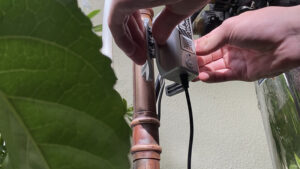
Watch the whole house, not just the laundry room. Bluebot smart water meters track flow in real time and flag unusual patterns, including the long high-flow stretch a laundry day creates. When your usage runs higher than it should, that data tells you where to look first. See how Bluebot monitoring works.
For tactics beyond the laundry room, see Bluebot’s 8 ways to stop wasting water.
How Do You Tell If Your Washer Is Using Too Much Water?
A sudden jump usually points to a fault, not a habit. Three parts fail most often.
Poor draining. Water left in the drum after a cycle can make the unit refill and try again. That repeats part of the fill.
A failing water inlet valve. A worn valve lets water in when nothing is running. Sometimes the drum fills while nobody is home. That shows up on your bill as water you cannot account for.
A faulty water level sensor. If a tub fills to the brim no matter how small the load, the switch that sets the fill may need replacing.
All three are easier to catch with real-time data than with a monthly statement. Bluebot Mini watches continuous flow and alerts your phone when it runs too high or lasts too long. A stuck valve feeding water overnight is exactly that kind of event. Learn more about Bluebot’s leak detection capabilities.
Know Your Numbers First
Washing machines are one of the biggest draws in a home, and the gap between designs is wider than most people guess. A top-loader at 40 gallons per load and a front-loader at 14 gallons per load produce very different yearly totals. The 2016 Residential End Uses of Water Study put laundry water consumption near 16 percent of a person’s total use, close to the 17 percent indoor share reported today.
Knowing how much water a washing machine uses starts with one question: work out which category yours falls into, then look honestly at your cycle habits. Those two facts give you a real basis for using less, without changing how clean your laundry comes out.
If you want the actual number rather than an estimate, Bluebot’s water monitoring technology measures every gallon moving through your home and surfaces patterns that are easy to miss. Some utilities and insurers also offer rebates for homes with smart monitoring. Check available rebates in your area, and confirm with your local water utility as well, since not every program is listed yet.
Sources: ENERGY STAR (Clothes Washers; Version 8.1 and Version 9.0 Draft 1 specifications), EPA WaterSense (Start Saving; Understanding Your Water Bill), U.S. Department of Energy (Energy Conservation Standards for Residential Clothes Washers, October 2024), and the Water Research Foundation’s 2016 Residential End Uses of Water Study.
Frequently Asked Questions
How many gallons of water does a washing machine use per year?
A typical household uses between 3,000 and 18,000 gallons a year on laundry, depending on the machine. ENERGY STAR puts the U.S. average near 300 loads annually. At that volume a standard top-loader running 40 gallons a load reaches roughly 12,000 gallons, while a certified model at 13 gallons lands near 3,900. Your own total depends on load count and drum size.
What is a good Integrated Water Factor to look for when buying a washer?
Lower is better, and anything at or below the federal cap is compliant. The Department of Energy caps Integrated Water Factor at 4.7 for front-loading models and 6.5 for top-loading ones. The ENERGY STAR Version 9.0 draft proposes far tighter limits of 3.00 and 3.70 for larger drums, so a rating near those numbers signals a genuinely efficient design.
How can you find out how much water your washer actually uses?
Check three places. The model’s spec sheet or ENERGY STAR listing gives its rated gallons per load and its Integrated Water Factor. Your water bill shows total household volume but cannot isolate laundry. A real-time flow monitor is the only method that reveals what a single cycle draws, which also makes an overfilling unit obvious within one wash.
Why do high-efficiency washers need special detergent?
They use too little water for regular detergent to rinse away cleanly. Standard soap is formulated for a full tub, so in a shallow HE wash it produces excess suds. The machine then adds rinse cycles to clear them, which can hand back the water the design saved. HE-formulated detergent is low-sudsing and avoids that penalty.
When is it worth replacing a washer just to save water?
Water savings alone rarely justify a replacement, but they shorten the payback when a unit is already failing or well past a decade old. Federal standards tightened in 2018 and again under the amended rules finalized in October 2024, so anything older than ten years usually misses current efficiency levels. Weigh the annual savings against your local rate.
Does washing in cold water lower your water bill?
Not directly. Cold cycles use the same volume as warm ones, so the metered water charge and the sewer charge stay the same. What changes is energy, because heating water is the expensive part of a warm wash. To cut the water side of the bill, run fuller loads and skip rinses you do not need. On the energy side, Smart Money Reverse (2024) breaks down what a cold wash actually saves.