Water damage prevention costs $500-$3,000 for a typical home. Water damage restoration costs $7,000-$15,000 for a moderate loss, and more than $30,000 for a severe one. That gap is the whole story. The first means catching a leak early with sensors, shutoff valves, and a smart water monitoring system. The second means pulling out the water, drying the structure, cleaning it, and rebuilding what got ruined. One is a purchase you schedule. The other is an emergency you cannot.
Monitoring is the cheapest part of the cheaper side of that gap. The 50-W (Bluebot Mini) starts at $258.76, clamps onto the outside of the pipe with no cutting and no plumber, and alerts you when flow looks wrong. Set against a $7,000 restoration, the arithmetic is not close.
As of 2026, the average U.S. repair job runs about $3,867, within a common range of $1,383-$6,384. Big losses sit far above that. The Insurance Information Institute (Triple-I) (2026) puts the average insured claim for water damage and freezing at $15,400, based on 2019 through 2023 data.
This guide prices both paths. Published cost data carries the industry numbers. Our own modeling carries the savings cases. We build smart water meters, so we label our figures as first-party work, not outside research.
Key Facts: Water Damage Costs at a Glance (2026)
- Claim data (Insurance Information Institute, 2019-2023): the average insured claim for water damage and freezing is $15,400. About one in 67 insured homes files one each year. These make up roughly 22.6% of all homeowners claims, second only to wind and hail. Earlier trade estimates put the average nearer $11,000, so the figure has climbed.
- Scale (FEMA and Triple-I data): about 14,000 U.S. homes hit a water damage emergency every day, and insurers pay out roughly $13 billion a year.
- Repair pricing (Water Damage Restoration Pricing, 2026): the average job runs about $3,867, with a common range of $1,383-$6,384. Moderate losses reach $7,000-$15,000. Severe ones pass $30,000.
- Silent waste (EPA WaterSense, 2026): the average home leaks nearly 10,000 gallons a year, 10% of homes leak 90 gallons a day or more, and fixing those leaks trims about 10% off a water and sewer bill.
- Usual up-front budget: $500-$3,000 installed.
| Prevention | Repair after a loss | |
|---|---|---|
| When you pay | Before a loss, on your schedule | After a loss, under pressure |
| Usual cost | $500-$3,000 | $7,000-$15,000 moderate; over $30,000 severe |
| Effect on insurance | May earn a premium credit | Spends a deductible and a claim |
| Disruption | Installed in an afternoon | Weeks or months of work |
| Control | Chosen and budgeted | Forced and open-ended |

What Is Water Damage Restoration, and What Does It Cost?
Water damage restoration is the work of removing water, drying a building, cleaning it, and rebuilding the parts the water wrecked. Contractors also call it water damage remediation. The restoration process runs in stages: extraction, structural drying, cleaning, then repair. That first half, extraction and drying, is known as water mitigation.
Common triggers include burst pipes, roof leaks, appliance failures, basement flooding, and plumbing fixture failures. Professional restoration prices off one core unit: dollars per square foot of wet area. Two things move that number. The first is how dirty the water is. The second is how much material soaked it up.
The IICRC, the standards body behind the S500 standard (Fifth Edition, 2021), keeps those two ideas apart. Category covers how dirty the water is. Class covers how much of it soaked in. They are not one cost ladder, and mixing them up is why online estimates clash so often.
Restoration Cost by Water Category
Category sets the safety scope. Safety scope sets the labor bill.
- Category 1 (clean): $3.75-$7.00 per square foot. The source is a supply line or a clean fixture.
- Category 2 (gray): $4.00-$7.50 per square foot. Think washing machine overflow or dishwasher discharge.
- Category 3 (black): $7.00-$13.00 per square foot. Sewage and standing water force biohazard handling, protective gear, and disposal, which drives the price up.
By incident, the ranges widen:
- Basement flooding: $10,000-$25,000
- Burst pipe repair: $5,000-$15,000
- Roof leak repair: $2,500-$8,000
- Mold remediation: $2,000-$6,000 on top of the base job
Most homeowners land at $7,000-$15,000 for a moderate loss. Severe jobs that need structural rebuilding and mold work cross $30,000.
Restoration Cost by Damage Class
Class measures how much water the building soaked up and how hard it will be to dry.
- Class 1, minimal soak-in: $3-$5 per square foot
- Class 2, heavy soak-in: $4-$7 per square foot
- Class 3, maximum soak-in from above: $7-$10 per square foot
- Class 4, special drying for dense materials: $10-$15 per square foot
Materials matter too. Saving water-damaged hardwood floors runs $8-$15 per square foot. Carpet replacement runs $3-$6 per square foot. Electronics and sensitive gear usually get swapped out, not dried.
None of this has to run if a leak is caught first. A Bluebot monitor watching the line upstream is what gives that warning.
What Is Water Damage Prevention, and What Does It Cost?
Water damage prevention is a set of steps that catch leaks early, watch home water use, and warn you before a small problem turns into a claim. It is the cheaper half of this matchup for one simple reason. Preventive measures buy hardware. The alternative buys emergency labor.
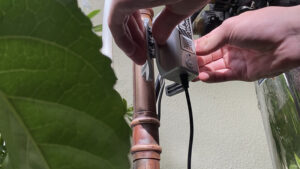
A smart water monitoring system sits on the line you care about and measures flow there. That is where Bluebot goes anywhere other monitors cannot: it clamps onto the outside of the pipe, so it can sit on the main, in an irrigation valve box, or on the branch line feeding the water heater, with no cutting and no plumber. Flow-based leak detection is what sets it apart from a puck sensor, which only reports water it can touch. Bluebot’s connected water monitor tracks use in real time and flags odd flow within minutes, so you can shut the valve before it spreads.
Usual leak prevention costs break down like this:
- Basic leak detectors: $10-$50 per sensor
- Whole-home leak detection: $250-$800 for a smart water monitor
- Waterproofing by a pro: $2,000-$6,000, depending on the area
- Sump pump setup: $1,200-$3,000, with a backup
- Pipe insulation and upgrades: $500-$2,000
Most homes spend $500-$3,000 in total. A whole-house monitor watches the supply line continuously, so it can flag an unusual flow within minutes rather than waiting for water to reach a floor sensor.
The EPA’s 2026 WaterSense figures show why catching leaks early pays even when nothing floods. Household leaks waste nearly 10,000 gallons of water per home each year. Fixing them usually trims about 10% off a water and sewer bill, which on an $80 monthly bill is roughly $96 back over a year.
Is Prevention Really Cheaper Than Restoration?
On avoided cost, yes, in every case we model. Proactive water protection wins because the two options are priced differently. A water monitoring system is a one-time $250-$800 buy you choose. Emergency drying and rebuilding is a per-square-foot service you do not choose.
One caveat first. The three cases below are our own modeling, and we sell the hardware. The prevention costs are rounded to match Bluebot’s real product pricing. Read them as examples, not as measured industry results.
| Modeled scenario | Prevention cost | Repair cost avoided | Net difference |
|---|---|---|---|
| Washing machine leak | $260 | $8,000-$12,000 | $7,740-$11,740 |
| Burst pipe in a basement | $560 | $15,000-$25,000 | $14,440-$24,440 |
| Small leak behind a wall | $260 | $5,000-$9,000 | $4,740-$8,740 |
Across those cases, the modeled return on the monitoring system tops 1,000% when it gives you the warning that heads off one big loss. Here is the honest scope on that number. It is the return in the year a loss is headed off. In every other year the same meter is still earning: a running record of what your house actually uses, an early read on a drip you would otherwise pay for quietly, and a documented flow history when a utility bill or an insurance claim is disputed.
Restore or Replace? What Changes the Math
Some materials survive water. Others do not. Time, dirt, and density decide which.
Usually salvageable:
- Carpet soaked by clean water, if drying starts within 48-72 hours
- Furniture with light exposure
- Drywall caught before it soaks through
- Electronics dried right away by a pro
- Documents and photos saved by special methods
Usually replaced:
- Anything with mold growth or dirty water
- Hardwood warped past its repair threshold
- Carpet pad, which almost never survives
- Electronics soaked by dirty water
- Wet insulation
Replacing an item often costs 200-400% more than saving it, by Bluebot’s own modeling. That is the payoff early warning has. A $500 system that gets you to the leak while the original hardwood floor can still be dried has already earned back many times its price, since replacing that floor runs $8,000-$15,000. Bluebot watches the supply line continuously and flags an unusual flow within minutes, which is the difference between a floor that gets dried and one that gets replaced.
Does Homeowners Insurance Cover Water Damage?
Usually yes for sudden failures, and usually no for slow ones. Coverage varies by policy, carrier, and state. Read your declarations page and check with your own insurer before you rely on any of this.
Commonly covered:
- Sudden pipe bursts and appliance failures
- Accidental discharge from plumbing fixtures
- Water heater failures
- Ice dam damage in winter
Commonly excluded:
- Slow leaks blamed on poor upkeep
- Flooding from outside, which needs a separate policy through the National Flood Insurance Program or a private flood insurer
- Sewer backup, which needs its own endorsement
- Groundwater seeping in through a foundation
Insurers draw the line at “sudden and accidental” because a slow drip reads as upkeep, not an event. The policy covers surprises, not skipped chores. That line is why a hidden leak behind a wall can be both the priciest kind of loss and the least likely to be paid for.
Your deductible usually runs $500-$2,500, so you cover that much before anything kicks in. Claims also have a memory. Repeat claims can raise a premium or cost you the policy, which makes a clean claims history worth real money.
Hardware can push the premium the other way. Carriers such as Amica publish a discount for approved water leak devices. As of 2026, credits commonly run about 3% to 10%, which on a $1,800 annual premium is $54 to $180 a year, and a growing number of insurers now require an automatic water shutoff valve before they will write or renew a large or second home.
Bluebot is a meter, not a valve, and that is deliberate: it is what lets one clamp onto a line a shutoff device cannot reach, from the irrigation valve box to a single tenant’s supply. Bluebot tells you the moment flow goes wrong; you or an automatic valve do the shutting off. Ask your carrier which combination qualifies.
What Do You Gain Long Term?
Money is the obvious return. It is not the only one. The estimates below are Bluebot’s own modeling, not measured industry data.
Financial:
- Fewer claims, which protects your premium and keeps you covered
- Protected home value, since a bad loss can cut it by 10-15%, or $45,000 to $67,500 on a $450,000 house
- Lower water bills through early detection and use tracking
- No hotel bills while a crew dries out your house
Practical:
- Round-the-clock watch on the main line
- Early warning on items no payout can replace
- Less stress during a plumbing failure
Buyers and insurers both notice: they look for lower-risk properties, and a documented flow history is something you can hand them. Business water monitoring applies the same logic at commercial scale, where one loss can run into the hundreds of thousands of dollars and shut the doors on top of the repair bill.
How Many Monitoring Points Does Your Home Need, and Which Bluebot Fits?
Size drives the answer. Larger homes usually need 3-6 monitoring points for full coverage. Smaller homes often need only 1-2 sensors, near the water heater, the washing machine, and the main supply line.
A few other things change the count:
- Whether you want basic alarms or remote water monitoring features
- Pro install versus a DIY setup
- Linking the monitoring system to a smart home setup you already run
Pricing is simple. As of 2026, the Bluebot Mini is $258.76 and fits 3/4-inch to 1-inch pipe. The 100-W (Bluebot Hero) is $558.34 and fits 3/4-inch to 2-inch pipe. Both include a year of premium data.
Protect Your Home Before the Next Leak
The math is not close. A budget of $500-$3,000 sits against a moderate water damage repair bill of $7,000-$15,000 and a severe one above $30,000. Getting ahead of it is the cheaper path in every case modeled here, and it is the only one you get to put on a calendar.
Explore Bluebot’s smart water meters, or start with the Insurance Leak Alarm Bundle. To learn your own baseline first, see our guide to reading your water meter.
This article is general cost information, not financial or insurance advice. Coverage, exclusions, deductibles, and available discounts vary by policy, carrier, and state. Check the details that apply to you with your own insurer.
Frequently Asked Questions
How fast does a Bluebot catch a leak?
A smart water monitor flags odd flow within minutes, because it watches the whole-house supply line instead of waiting for water to reach a floor sensor. That speed is what separates a small cleanup from a structural loss. Actual response time depends on your alert settings and how quickly the water can be shut off.
What is the difference between a water damage category and a class?
Category describes how dirty the water is, and class describes how much of it soaked into the building. The IICRC keeps the two apart in its S500 standard. Category 1 is clean, Category 2 is gray, and Category 3 is black water that needs biohazard handling. Class 1 through Class 4 rate absorption, from minimal to specialty drying. Both raise cost, but they do it independently.
Who pays when a slow leak is found months later?
Usually the homeowner. Most policies cover sudden and accidental discharge but exclude gradual leaks blamed on poor upkeep, so a drip that ran for months is often denied. Coverage varies by policy, carrier and state, so read your declarations page and ask your insurer before assuming anything. That exclusion is the main reason continuous monitoring pays, because it turns a slow hidden leak into a same-day alert.
When should you hire a restoration company instead of drying it yourself?
Call a professional when the water was dirty, when it sat longer than 48-72 hours, or when it reached drywall, insulation or subfloor. Those conditions invite mold and hidden structural moisture that household fans cannot reach. Small clean-water spills caught right away are often fine to dry yourself. If you plan to file a claim, professional documentation of the drying process usually helps.
Where should leak sensors go in a house?
Start with the highest-risk points: the water heater, the washing machine, under sinks, near the dishwasher, and at the main supply line. Larger homes usually need 3-6 monitoring points for full coverage, while smaller homes often need only 1-2 sensors. A whole-home monitor on the main line covers what point sensors miss, because it measures flow rather than surface water.
Why is mold remediation billed on top of water damage restoration?
Mold remediation is a separate scope with its own containment, air filtration and disposal steps, so it is priced separately and typically adds $2,000-$6,000. Restoration dries and rebuilds the structure, while remediation removes biological growth that drying alone will not kill. Mold can start within a couple of days of a leak, which is why drying speed moves the final bill so much.
Does a smart water monitor lower your home insurance premium?
Often, yes. Carriers such as Amica publish a discount for approved water leak devices, and as of 2026 those credits commonly run about 3% to 10%. A growing number of insurers now require an automatic water shutoff valve before they will write or renew a large or second home. Ask your carrier which devices qualify and whether proof of installation is required, because eligibility varies by policy and state.