

Transit-time ultrasonic flow measurement times a pulse of sound as it crosses a pipe, first with the flow and then against it. The gap between those two trips tells you how fast the water is moving. That is the transit-time principle, and it is a close relative of the technology behind the first grainy photo of a baby in utero. It is also what a Bluebot smart water meter uses to read the water in your home.
In both cases a clamp-on ultrasonic transducer sits outside what it measures. Nothing is cut. Nothing is drained. Sound does the work.
That parallel is not a marketing metaphor. It is the real history of the device. Bluebot founder Matt Olin spent a career in ultrasonic flow measurement, most of it at Sierra Instruments, where he served as CEO. The meters were accurate. Putting one in was the problem.
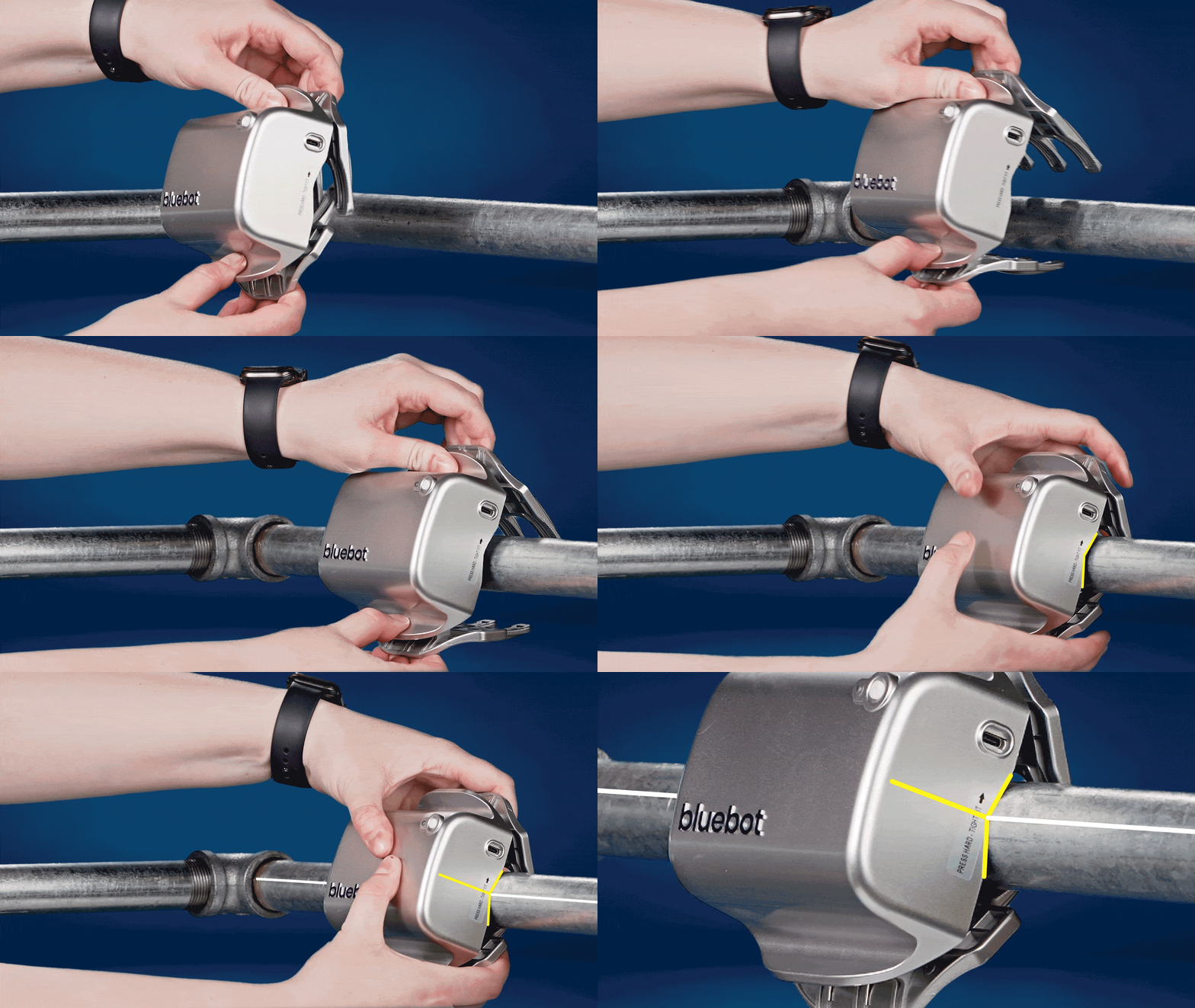
It meant an engineer, a planned shutdown, or a plumber cutting into a live pipe. A mechanical meter was no easier. A positive-displacement meter still means shutting off the water and opening the line. Olin and his co-inventors kept the physics and threw away the install.
The short version. A pulse of sound sent downstream is carried along by the current, so it gets there early. A pulse sent upstream fights the current, so it gets there late. Measure that tiny gap and you know how fast the water is going. Multiply that speed by the area of the pipe and you have flow rate.
That is all sound-based flow measurement really is. The hard part is not the idea. The hard part is building a clock fast enough to catch the gap.
One word does most of the work in that story: clamp-on. Because sound passes straight through the pipe wall, the transducer pair never has to touch the water. The sensor pair straps to the outside of the supply pipe. That single fact is what moves ultrasonic metering out of the plant room and into a normal garage, and it is why the rest of this page keeps coming back to it.
Key facts at a glance
- What it measures: the travel-time gap between an upstream and a downstream sound pulse. That gap tracks how fast the water is moving.
- How small the gap is: vanishingly small. The two trips differ by a fraction of the time it takes sound to cross a household pipe, which is why the timing electronics do the hard work.
- How often it measures: continuously, rather than once a quarter when someone reads a dial.
- Pipe range: as of 2026 the Bluebot line covers pressurized water pipe from three-quarter-inch service lines up to 4-inch commercial mains, across the family. No single model spans the whole range.
- Install: clamp-on. No pipe cutting, no shutoff, no plumber.
- Governing standard: ANSI/AWWA C750, Transit-Time Flowmeters in Full Closed Conduits. The current edition is C750-19, reaffirmed in 2023.
- Why it matters: the U.S. Environmental Protection Agency’s WaterSense (2026) program says the leaks in an average home waste nearly 10,000 gallons of water a year.
How does the technology that images a baby end up measuring water?
Diagnostic ultrasound and ultrasonic flow measurement lean on the same core part: a piezoelectric transducer.
The NIH’s National Institute of Biomedical Imaging and Bioengineering (2026) calls diagnostic ultrasound a way to see inside the body without going inside it. It uses sound pitched above what we can hear, above 20 kHz. Most clinical probes run far higher, well into the megahertz range. Peer-reviewed work on medical transducers puts their working band at roughly 1 to 46 MHz.
The active element in those probes is a slice of piezoelectric ceramic. Squeeze that piezoelectric element and it makes a voltage. Feed it a voltage and it shakes. That two-way trade is what lets one small piezo crystal both speak and listen.
In sonography, a technician uses it to turn echoes into a picture. Ultrasound imaging and a flow meter use the same trick to ask different questions. Not what shape is in there, but how fast is it going.
The method crossed over because it stays outside in both settings. A parent does not want surgery to see a foot. A homeowner does not want a plumber to read a flow rate. Sound goes through the wall of a pipe much as it goes through skin, so a non-invasive sensor works in either place. That is the choice Bluebot made: the same piezoelectric sensing, clamped to the outside of the pipe, so the meter reads your water without ever touching it.
How does a Bluebot meter actually measure flow through the pipe wall?
The Bluebot device carries two external transducers, set apart along the pipe. One sits upstream. One sits downstream.
The upstream one fires a pulse of sound at an angle. The pulse crosses the water, bounces off the far wall in a V-shaped path, and lands on the downstream one. Then the roles swap and a pulse goes back the other way. Because the upstream and downstream transducers take turns sending and listening, each one does both jobs.
Here is the whole idea in one line. With no flow, both trips take the same time. Add flow, and the downstream pulse rides the current and gets there sooner. The upstream pulse fights the current and gets there later.
Technical guides on transit-time flow measurement describe the same thing: sound moves faster with the flow and slower against it, and the time gap tracks how fast the fluid is going. Turning that gap into gallons is all transit-time flow measurement does.
The catch is scale. Sound moves through water at about 1,480 meters per second at room temperature. It speeds up as the water warms, from roughly 1,402 m/s at 32 °F to about 1,482 m/s at 68 °F.
Set against that, the water in your home barely moves, so the gap between the two trips is vanishingly small. Resolving it is the engineering problem.
Angle matters too. AWWA C750 lists Z, V and W configurations, three standard ways to route the sound path. A longer path through the water gives a bigger, easier-to-read time difference.
The trade is a weaker signal coming back. A route that reflects once off the far wall is often called reflect mode, and it is the common arrangement for a clamp-on pair.
Why can one Bluebot sensor cover a whole range of pipe sizes?
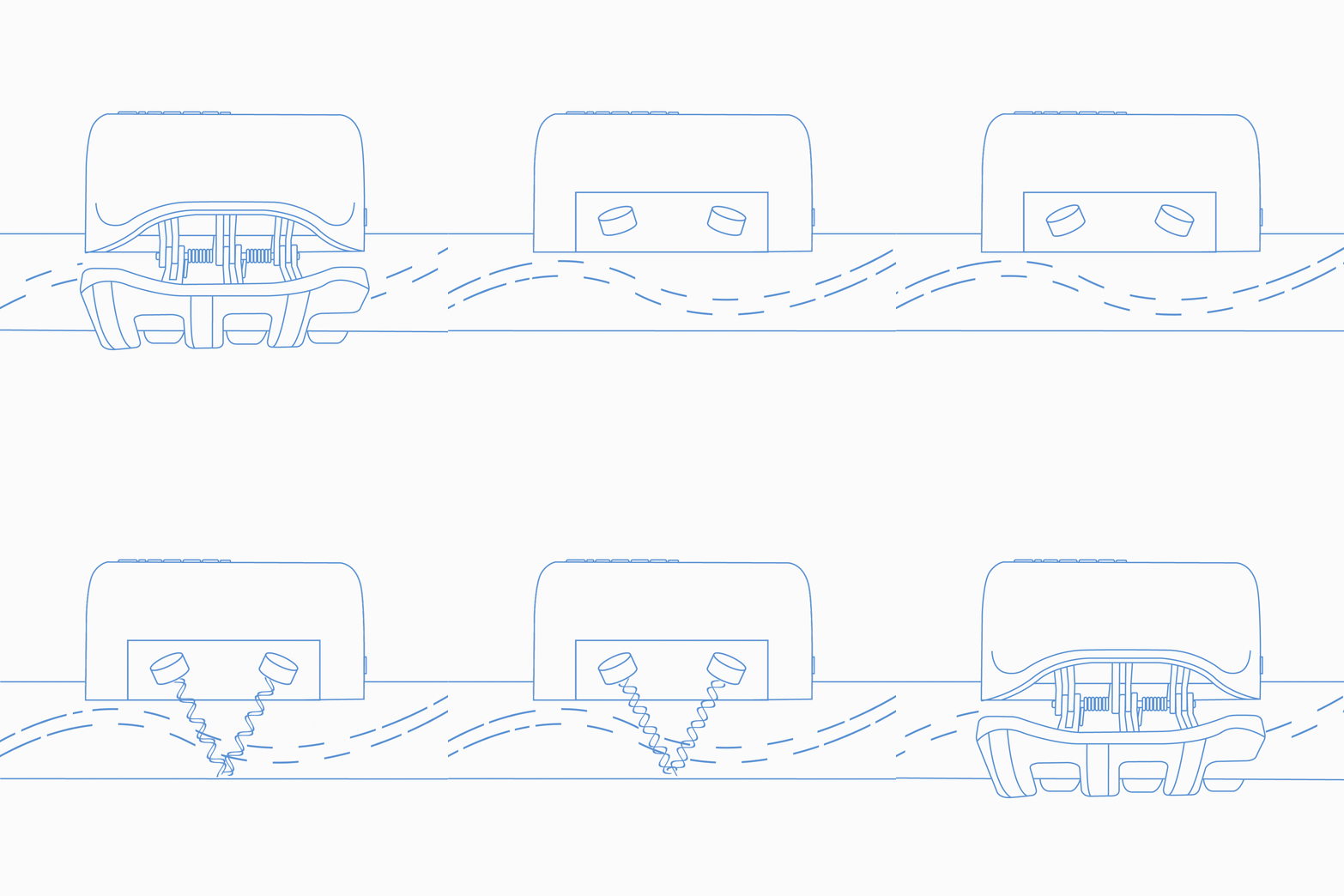
Because the sensors aim themselves. Across the Bluebot line, that covers three-quarter-inch service lines up to 4-inch mains.
Pipe size, wall thickness and pipe material all change the angle a pulse must take to land cleanly on the far side. Installers used to fix that by hand. They nudged, re-clamped and re-tested. It was closer to lining up a bank shot in pool than to setting up a device.
Bluebot does that step for you with Adaptive Angle Technology, driven by Bluebot’s patented robotic servo technology for automatic pipe configuration. Automatic sensor alignment keeps nudging Bluebot’s flow sensor until the sent and received signals line up. Only when the signal is strong enough to trust does the meter start working out water flow. On the 100-W (Bluebot Hero) and 100-WAN (Bluebot ProLink), these self-adjusting sensors support more than 80 pipe size and material combinations.
The real-world result is a change in how you buy. Many meter lines are sold by pipe bore, so a different pipe means a different part number. Strap-on transducers that aim themselves fold much of that range into one device. In Bluebot’s own line, the 50-W (Bluebot Mini) covers three-quarter-inch to one-inch pipe.
The Hero and ProLink cover three-quarter-inch to two-inch. The Bluebot Hero Prime and Bluebot ProLink Prime cover 2.5-inch, 3-inch and 4-inch pipe. That is the practical payoff of the transit-time method: one sensor pair, many pipes.
How do you know a Bluebot meter is accurate?
You do not take the maker’s word for it. You look for a standard and a calibration record.
Two standards bodies set the ground rules. ANSI/AWWA C750 (2019, reaffirmed 2023), from the American Water Works Association, covers transit-time flowmeters in full closed conduits, and it draws an important line. Ultrasonic flowmeters come in two families: Doppler-effect and transit-time.
A Doppler-effect flow meter suits liquids that carry solid bits or gas bubbles, because a Doppler meter needs something in the stream to bounce off. Transit-time ultrasonic technology is the family used across a wide range of water-industry work, clean drinking water included. ANSI/AWWA C715 (2018, reaffirmed 2022) covers electromagnetic and ultrasonic cold-water meters used for billing.
In legal metrology worldwide, ISO 4064 and OIML R 49 set the accuracy classes and the errors a meter may have. These international water-meter standards are the same in substance, with ISO 4064-1:2014 matching OIML R 49-1.
Calibration is the second half. Every Bluebot meter is individually calibrated across its entire operating flow range in Bluebot’s metrology laboratory, against NIST-traceable calibration standards. Each one ships with its own Calibration Certificate recording the serial number, the calibration date, and the measured performance across that flow range, so a Bluebot is proved across the whole range and not at one handy rate.
That detail matters more than it sounds. A meter checked at a single flow rate tells you nothing about how it behaves during a slow overnight drip. A slow drip is exactly what a leak looks like.
What does Bluebot measuring continuously actually give you?
Detail in time, which is what turns a meter into a monitor.
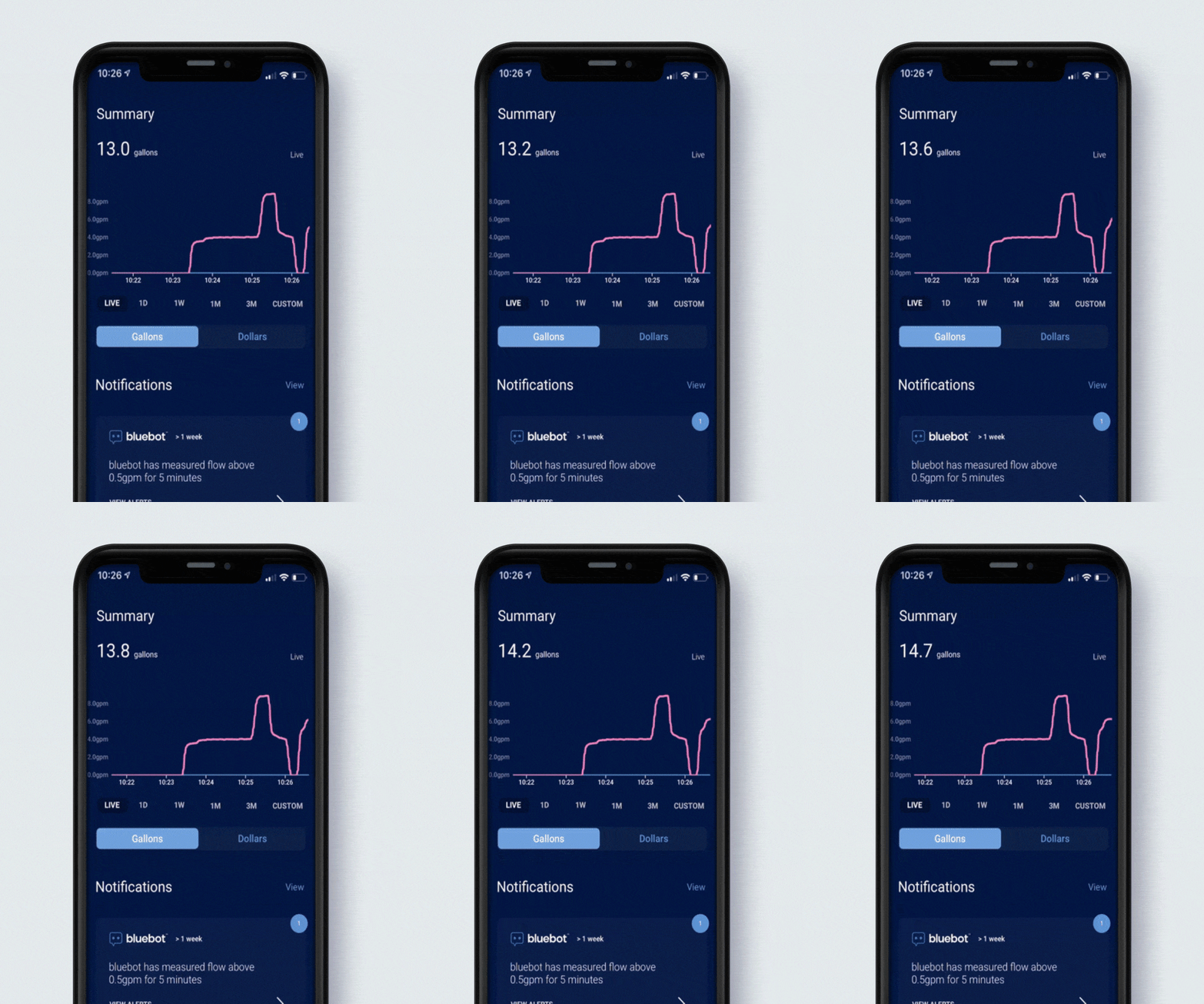
A traditional water meter answers one question: how much water went through since the last reading. A Bluebot unit samples all the time and sends real-time water data to the bluebot Water app, so the smart water meter answers a different one. What is happening right now, and does it look normal? That shift is what makes leak detection possible at home, because consumption data arrives while the leak is still running.
That gap is where the money sits. EPA WaterSense reports that household leaks waste nearly 900 billion gallons of water across the country each year. That is equal to the yearly use of nearly 11 million homes. Ten percent of homes have leaks wasting 90 gallons or more per day.
A hidden leak that size is almost never loud. It is a running toilet flapper, or a slab leak that shows up only as a small, steady draw at three in the morning. It is invisible on a quarterly bill. It is obvious on a live flow chart, and it is the kind of pattern an abnormal usage alert is built to catch.
Why is measuring your water worth doing now?
Because supply swings, and a bill alone will not show you the swing.
In January 2026, California recorded no drought anywhere in the state for the first time in years, and the state’s reservoirs sat at about 126 percent of average. Yet in the same stretch, the statewide snowpack held 9.7 inches of snow-water equivalent, roughly 59 percent of average for the date.
A wet year and a thin snowpack can sit side by side. That is why long-run habits matter more than any one headline.
The numbers at home are steadier. EPA WaterSense puts average American family use at more than 300 gallons of water a day, about 70 percent of it indoors. You cannot manage a number you never see.
That is the through-line from a prenatal ultrasound to the pipe in your garage. The same physics that lets a clinician look inside without a cut lets Bluebot’s clamp-on meter look inside a water line without a wrench. Whether you want a lower bill, an early warning on a leak, or simply less waste, the first step is the same.
Measure it. Get a Bluebot smart water meter and start with real numbers.
Frequently Asked Questions
How do ultrasonic water meters work without touching the water?
Sound passes straight through the pipe wall, so nothing has to enter the line. A clamp-on ultrasonic transducer straps to the outside, sends a pulse through the water and times how long it takes to arrive. The NIH’s National Institute of Biomedical Imaging and Bioengineering describes the same non-invasive principle in diagnostic ultrasound. Nothing is cut, nothing is drained, and no part of the sensor touches your drinking water.
What is Bluebot, and who makes it?
Bluebot is a clamp-on smart water meter made by Lookout Lab, Inc. Founder and CEO Matt Olin came to it from a career selling ultrasonic flow meters into industry, where the physics was never the problem and the installation always was. Bluebot’s answer is patented robotic servo technology that configures the sensor to the pipe automatically. As of 2026 the line runs from the 50-W (Bluebot Mini) to the Prime models, covering pressurized pipe from three-quarter-inch service lines up to 4-inch mains.
What is a clamp-on flow sensor, and will it fit my pipe?
A clamp-on flow sensor is a transducer pair that straps to the outside of a pipe instead of being plumbed into it. Fit depends on pipe size and material, because both change the angle the sound pulse has to take. Bluebot handles that with Adaptive Angle Technology and its patented robotic servo technology for automatic pipe configuration, and on the Hero and ProLink those self-adjusting sensors support more than 80 pipe size and material combinations.
Why do some ultrasonic meters need particles in the water?
Because Doppler meters work by bouncing sound off something moving in the stream. ANSI/AWWA C750 notes that Doppler-effect meters are used for liquids carrying solid particles or gas bubbles for exactly that reason. Transit-time meters need nothing to reflect off, since they time a pulse across a clean, full pipe in both directions. That is why transit-time ultrasonic technology suits household drinking water.
Are ultrasonic water meters accurate enough to bill from?
As a class, yes. ANSI/AWWA C715 covers electromagnetic and ultrasonic cold-water meters specifically for revenue applications, and ISO 4064 with OIML R 49 set the accuracy classes and permitted errors internationally. Approval is granted per model rather than to a technology, so check the certification for the exact meter you are considering instead of assuming the category covers it.
What size leak can a real-time water meter actually catch?
Small, steady ones are the whole point. EPA WaterSense reports that ten percent of homes have leaks wasting 90 gallons or more per day, and leaks that size rarely announce themselves. A meter that samples continuously can surface a low overnight draw that a quarterly bill hides. That is also why every Bluebot is individually calibrated across its full operating flow range and ships with a Calibration Certificate showing the measured result.